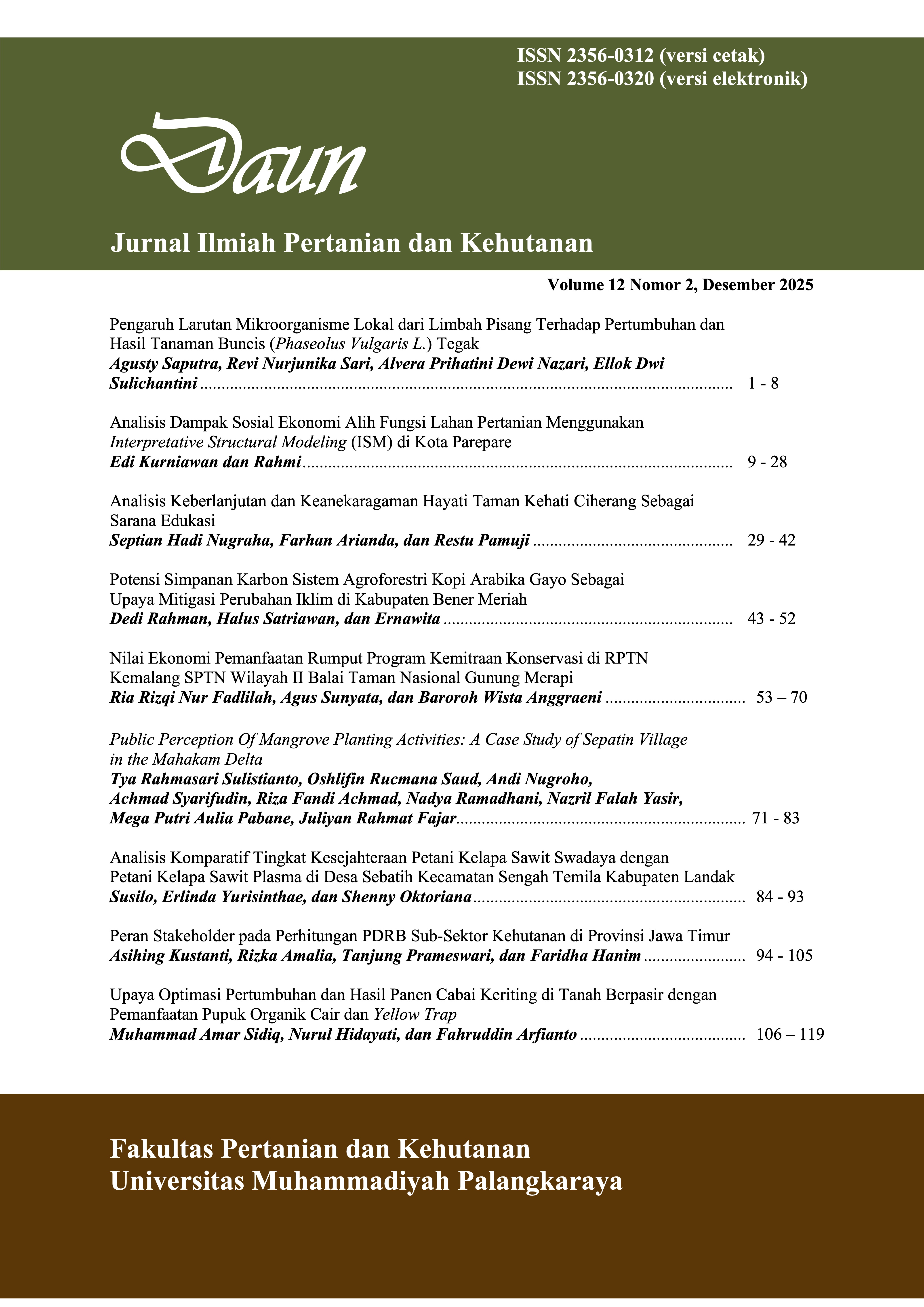
Pengaruh Larutan Mikroorganisme Lokal Dari Limbah Pisang Terhadap Pertumbuhan dan Hasil Tanaman Buncis (Phaseolus vulgaris L.)
Article Sidebar
Main Article Content
Abstract
ABSTRACT
Green beans (Phaseolus vulgaris L.) are high potential leguminous crops whose productivity can be enhanced through the use of local microorganism (MOL) solutions derived from banana waste. This study evaluated the effects of MOL solutions from banana corm, stem, and peel on green bean growth and yield. The experiment was arranged in a Randomized Block Design (RBD) with four treatments and ten replications. Data were analyzed using analysis of variance (ANOVA), and significant differences were further examined using the Least Significant Difference (LSD) test at 5% significance. Results showed that all MOL treatments significantly increased the number of pods per plant, while other growth parameters including plant height, number of branches, flowering and harvest age, pod length, and fresh pod weight were not significantly affected. Among the treatments, the MOL solution from banana peel was the most effective, demonstrating its potential as an organic biofertilizer for improving green bean yield.
Keywords : banana, beans, local microorganism solutions.
Downloads
Article Details

This work is licensed under a Creative Commons Attribution-ShareAlike 4.0 International License.
All rights reserved. This publication may be reproduced, stored in a retrieval system, or transmitted in any form or by any means, electronic, mechanical, photocopying, recording.
References
Badan Perencanaan Pembangunan Daerah Provinsi Kalimantan Timur. 2023. Rancangan Akhir Rencana Pembangunan jangka Menengah Daerah (RPJMD) Provinsi Kalimantan Timur Tahun 2018-2023. Samarinda. Kalimantan Timur.
Badan Pusat Statistik. 2019. Statistik Sayur-Sayuran dan Buah-Buahan Provinsi Kalimantan Timur 2019. Badan Pusat Statistik. Kalimantan Timur.
Firmansyah, I., Syakir, M., dan Lukman, L. 2017. Pengaruh kombinasi dosis pupuk N, P, dan K terhadap pertumbuhan dan hasil tanaman terung (Solanum melongena L.). Hortikultura. 27(1): 69.
Hussein, H. S., Shaarawy, H. H., Hussien, N. H., dan Hawash, S. I. 2019. Preparation of nano-fertilizer blend from banana peels. Bull. Natl. Res. Cent. 43(1):1-9.
Kumar, R., Kumawat, N., dan Sahu, Y. K. 2017. Role of biofertilizers in agriculture. Popular
Kheti 5(4): 63-66.
Manis, I., Supriadi., dan Said, I. 2017. Pemanfaatan limbah kulit pisang sebagai pupuk organik cair dan aplikasinya terhadap pertumbuhan tanaman kangkung (Ipomea reptans Poir). Jurnal Akademika Kim. 6(4): 219-226.
Putri, A., Redaputri, A.P., dan Rinova, D. 2022. Pemanfaatan limbah kulit pisang sebagai pupuk
menuju ekonomi sirkular (UMKM olahan pisang di Indonesia). Pengabdi UMKM. 1(2): 104-109.
Rihana, S., Heddy, Y. B. S., dan Maghfoer, M. D. 2013. Pertumbuhan dan hasil tanaman buncis (Phaseolus vulgaris L.) pada berbagai dosis pupuk kototan kambing dan konsentrasi zat pengatur tumbuh dekamon. Jurnal Produksi Tanaman. 1(4):369-376
Wahyudi, A.A., Maimunah, M., dan Pane, E. 2019. Respon pertumbuhan dan produksi kacang tanah (Arachis hypogaea L.) terhadap pemberian pupuk kandang kambing dan pupuk organik cair bonggol pisang. Ilmiah Pertanian (Jiperta). 1(1): 1-8.
Wiraatmaja, I.W. 2017. Defisiensi dan Toksisitas Hara Mineral Serta Responnya Terhadap Hasil. Skripsi. Fakultas Pertanian Universitas Udayana. Bandung.
Wulandari, D. D N., Fatmawati, E. N., Qolbaini, K. E., dan Praptinasari, S. 2009. Penerapan MOL (Mikroorganisme Lokal) Bonggol Pisang sebagai Biostarter Pembuatan Kompos. Skripsi. Fakultas Pertanian Universitas Sebelas Maret. Surakarta.
Zulputra, T. H. 2018. Respon tanaman kacang panjang (Vigna sinensis L.) terhadap pemberian pupuk organik cair mikroorganisme lokal buah mangga. Sungkai. 6(1): 50-59.