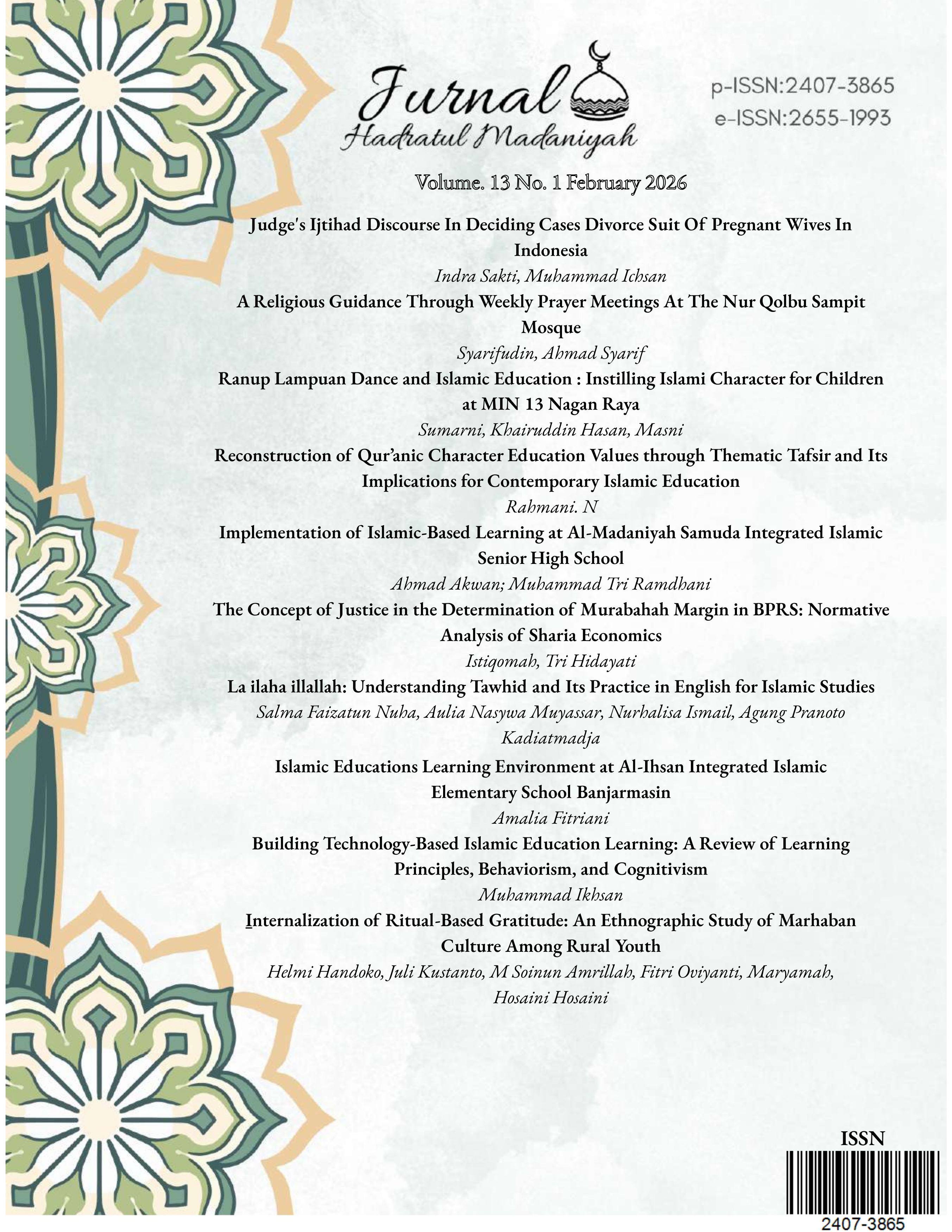
Building Technology-Based Islamic Education Learning: A Review of Learning Principles, Behaviorism, and Cognitivism
Article Sidebar
Main Article Content
Abstract
Abstracts Technological developments in education have not been fully integrated optimally in Islamic Religious Education (PAI) learning, resulting in a gap between the needs of 21st-century learning and learning practices that are still predominantly teacher-centered. This condition encourages the need for an in-depth study of how learning principles and theories of behaviorism and cognitivism can be used as a basis for designing effective technology-based PAI learning. This study aims to analyze the integration of these learning theories as a basis for developing a more comprehensive technology-based PAI learning model. The study uses a library research approach by reviewing journals, books, and relevant research results, which are analyzed through content analysis techniques to identify conceptual patterns, similarities, and theoretical contributions. The results show that learning principles such as subsumption, progressive differentiation, and integrative reconciliation can strengthen the structure of digital PAI materials; behaviorism theory plays a role in designing technological features that are reinforcement and form religious habits; while cognitivism theory supports the development of digital media that facilitate information processing and meaningful learning. The conclusion of the study confirms that the integration of these three theoretical foundations can produce a technology-based PAI learning model that is more interactive, adaptive, and pedagogical. This study contributes to the development of a technology-based PAI conceptual framework and recommends empirical testing of the model's effectiveness through further research.
Downloads
Article Details

This work is licensed under a Creative Commons Attribution-ShareAlike 4.0 International License.
Authors continue to retain the copyright to the article if the article is published in the Jurnal Hadratul Madaniyah. They will also retain the publishing rights to the article without any restrictions.
Authors who publish in this journal agree to the following terms:
- Any article on the copyright is retained by the author(s).
- The author grants the journal the right of first publication with the work simultaneously licensed under a Creative Commons Attribution License that allows others to share work with an acknowledgment of the work authors and initial publications in this journal.
- Authors can enter into separate, additional contractual arrangements for the non-exclusive distribution of published articles (e.g., post-institutional repository) or publish them in a book, with acknowledgment of their initial publication in this journal.
- Authors are permitted and encouraged to post their work online (e.g., in institutional repositories or on their websites) before and during submission. This can lead to productive exchanges and earlier and greater citations of published work.
- The article and any associated published material are distributed under the Creative Commons Attribution-ShareAlike 4.0 International License.
References
Amsari, Dina, Mudjiran, Implikasi Teori Belajar E. Thorndike (behavioristik) Dalam pembelajaran matematika, Dalam jurnal Basicedu, Vol. 2, No. 2, 2018.
Baby, Elvia shahbana, fiqh kautsar farizqqi, rachmat satria, Impelemntasi teori belajar behavioristik dalam pembelajaran, jurnal serunai administrasi pendidikan, vol. 9, No. 1, 2, tahun 2020.
Fadhil, Muhammad, Alghi Fari Majid1, Suyadi, Penerapan Teori belajar Behavioristik, dalam Jurnal Ilmiah Bimbingan dan Konseling Vol.1, No.3, 2020.
Jelita, Mimi, dkk, Teori Belajar Behavioristik, Jurnal Pendidikan dan Konseling, Volume 5 Nomor 3 tahun 2023. Ma’rifah, Siti, Setiawati, “Telaah Teoritis: Apa itu Belajar?”, Helper Vol. 35 No. 1
Marinda, Leny, Teori Perkembangan Kognitif Jean Piaget dan Problematikanya Pada Anak Sekolah Usia Sekolah Dasar, Dalam Jurnal Kajian Perempuan dan Keislaman, Vol. 13, No. 1, 2020.
Nafila, Ariane, Dewi Utami, Dadan Mardani, “Teori Belajar Behaviorisme Ivan Vavlov dan Implikasinya dalam Pembelajaran Bahasa Arab Siswa Madrasah Tsanawiyah Negeri”, Dalam Journal of Education Vol. 05 No. 04, 2023.
Nur, Silvia, Faizah, “Hakikat Belajar dan Pembelajaran”, at-Thullab: Jurnal Pendidikan Guru Madrasah Ibtidaiyah Vol. 1, No. 2, 2017.
Okti, Dwi, Sudarti, Kajian Teori Behavioristik Stimulus dan Respon Dalam Meningkatkan Minat Belajar Siswa, Dalam Jurnal Tarbawi, Vol. 16, No. 2, 2019.
Robithotul, Nova, Khoir, Afiful Ikhwan, Pembelajaran Behavioristik Madrasah dalam Meningkatkan motivasi belajar dan ibadah siswa, Dalam Jurnal pendidikan nusantara, vol. 1, No. 3, 2022.
Sauqy, Ahmad, Inovasi Belajar & Pembelajaran PAI ( Inovatif dan Aplikatif ), (Surabaya: UM Surabaya Publishing, 2019.
Setiawan, Andi, Wulan Fitriani, Zubaedah Nasucha, Dkk, Teori Belajar Kognitif Gestalt dan implikasinya Pada Pembelajaran di sekolah dasar, Dalam Jurnal Pendidikan Guru Madrasah Ibtidaiyah, Vol. 4, No. 2, 2021.
Surya, Nesti, Astuti Zebua, Alianus zalukhu, Herman, Dkk. Kajian Teori Behavioristik stimulus dan respon dalam meningkatkan motivasi belajar siswa pada pembelajaran matematikan, Dalam Journal Of Social Science Research, Vol. 3, No. 4, 2023. Sutarto, Teori Kognotog dan Implikasinya dalam Pembelajaran, Dalam Jurnal
Bimbingan dan Konseling Islam, Vol. 1, No. 2, 2017. Wahab, Gusnarib dan Rosnawati, Teori-Teori Belajar dan Pembelajaran, Jawa Barat: Penerbit Adab, CV. Adanu Abimata, 2021.
Wisman, Yossita, Teori Belajar Kognitif Dan Implementasi Dalam Proses Pembelajaran, Dalam Jurnal Ilmiah Kanderang Tingang, Vol. 11, No. 1, 2020.