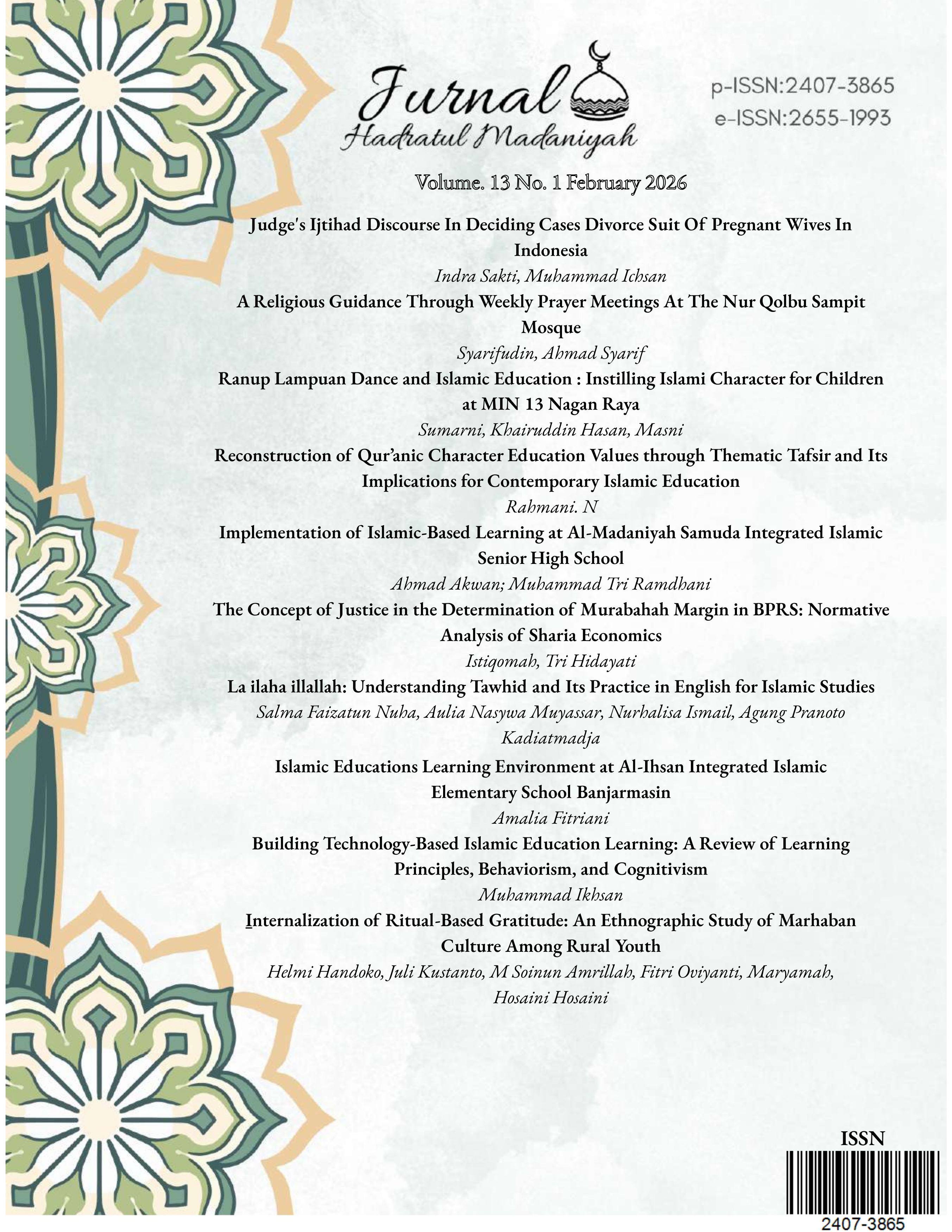
Judge's Ijtihad Discourse In Deciding Cases Divorce Suit Of Pregnant Wives In Indonesia
Article Sidebar
Main Article Content
Abstract
This research focuses on how judges use ijtihad in deciding divorce cases filed by wives in pregnant conditions. By using normative juridical methods and statutory, concept, and case study approaches, this research examines positive legal provisions, expert views, and related court decisions. The research results show that pregnancy cannot be used as a basis for rejecting a divorce suit. The judges use ijtihad to interpret legal rules, assess aspects of benefit, and provide protection for women in accordance with the principles of maqāṣid al-sharī'ah and the provisions in Supreme Court Regulation Number 3 of 2017. From the analysis, two patterns of judge's decisions were found: postponing the divorce until the wife gives birth or immediately granting the divorce if the continuation of the marriage is considered to endanger the wife or fetus. Thus, the judge's ijtihad becomes an important instrument in realizing more substantial justice and ensuring protection for pregnant women in divorce cases.
Downloads
Article Details

This work is licensed under a Creative Commons Attribution-ShareAlike 4.0 International License.
Authors continue to retain the copyright to the article if the article is published in the Jurnal Hadratul Madaniyah. They will also retain the publishing rights to the article without any restrictions.
Authors who publish in this journal agree to the following terms:
- Any article on the copyright is retained by the author(s).
- The author grants the journal the right of first publication with the work simultaneously licensed under a Creative Commons Attribution License that allows others to share work with an acknowledgment of the work authors and initial publications in this journal.
- Authors can enter into separate, additional contractual arrangements for the non-exclusive distribution of published articles (e.g., post-institutional repository) or publish them in a book, with acknowledgment of their initial publication in this journal.
- Authors are permitted and encouraged to post their work online (e.g., in institutional repositories or on their websites) before and during submission. This can lead to productive exchanges and earlier and greater citations of published work.
- The article and any associated published material are distributed under the Creative Commons Attribution-ShareAlike 4.0 International License.
References
Al-Faqi, Sobri Mersi. 2011. Solutions to Modern Household Problems. Surabaya: Pustaka Yassir.
Aziz, M. Malik Abdul, dan Muhammad Habibur Rochman. 2023. “Analysis of Judges' Considerations Regarding Divorce Decisions for Pregnant Wives.” TARUNALAW : Journal of Law and Syariah 1(02):158–65. https://doi:10.54298/tarunalaw.v1i02.155
Fitri, Intan Saziqil. 2022. “Factors Causing High Divorce Rates In The Bandung Religious Court.” Al-Ahwal Al-Syakhsiyyah: Journal of Family Law and Islamic Justice 3(1):101–16. https://doi:10.15575/as.v3i1.17547.
Hidayah, Nur, Nur Asia Hamzah, dan St Risnawati Basri. 2024. “Perspectives of Islamic Fiqh in the Divorce of Pregnant Women.” Jurnal of Family Law and Islamic Court 3(1):53–67.
Hidayat, Rakhmat, Fahmi Al-Amruzi, dan Akh Sukris Sarmadi. 2023. “Juridical Analysis of Divorce Before the Court (Study of Article 39 of Law Number 1 of 1974 Concerning Marriage).” Al Qalam: Journal of Religious and Social Sciences 17(2):1379–91. https://doi:10.35931/aq.v17i2.1939.
Hidayati, Annisa. 2022. “A Legal Review of Divorce Lawsuits Filed by Wives Against Their Husbands (A Study of Islamic Religious Courts).” Journal of Sharia and Law 1(2):232–43.
Hidayatulah, Rizki Pradana. 2020. “Judicial Discovery from the Perspective of Maqashid Syariah.” TERAJU 2(01):83–97. https://doi:10.35961/teraju.v2i01.94.
Indonesia, Republic of. 1974. Chapter VIII Article 38 Law Number 1 of 1974 concerning Marriage.
Indonesia, Republic of. 1974. Article 34 paragraph (3) of Law No. 1 of 1974 concerning Marriage.
Indonesia, Republic of. 2019. Article 39 Paragraph 1 of Law No. 16 of 2019 concerning Marriage.
Manan, Abdul. 2017. Islamic Law Reform in Indonesia. Depok: PT Fajar Interpratama Mandiri.
Marzuki, Peter Mahmud. 2017. Legal Research. Jakarta: Kencana.
Mustofa, Mukhanad Khabib, Ahmad Subekti, and Dwi Ari Kurniawan. 2021. “Judge's Considerations Regarding A Wife's Divorce Suit While Pregnant (Case Study Of The Malang Regency Religious Court).” Hikmatina Journal 4(1):241–48.
Muthmainnah, Kiljamilawati, Samsir Salam, and Roswati Nurdin. 2023. “Judges’ Analysis of Divorce Lawsuits Against Pregnant Wives (Case Study of Decision 0210/PDT.G/2019/PA.PKJ).” Al-Muqaranah Journal 2(1):15–32.
Ribi, Hikmawati. 2025. The Effectiveness of Mediation in Divorce Cases in Religious Courts (A Normative Study of the Implementation of PERMA No. 1 of 2016).” IJI Publication 5(3):302–10.
Shihab, M. Quraish. 2002. Tafsir Al-Misbah: Messages, Impressions, and Harmony in the Qur'an. Jakarta: Lentera Hati.
Subekti. 1985. Fundamentals of Civil Law. Jakarta: Intermasa.
Sururie, Ramdani Wahyu. 2014. “Evidence Validity Of Testimonium De Auditu In A Divorce Case.” Yudisial Journal 7(2):137–55.
Susilo, Budi. 2017. Divorce Proceedings. Yogyakarta: Pustaka Yustisia.
Syarifuddin, Amir. 2014. Islamic Marriage Law in Indonesia: Between Fiqh Munakahat and the Marriage Law. Jakarta: Kencana.