Fear of Missing Out (FOMO) in Generation Z Digital Investment: Risk Analysis and Islamic Finance Perspective
Article Sidebar
Main Article Content
Abstract
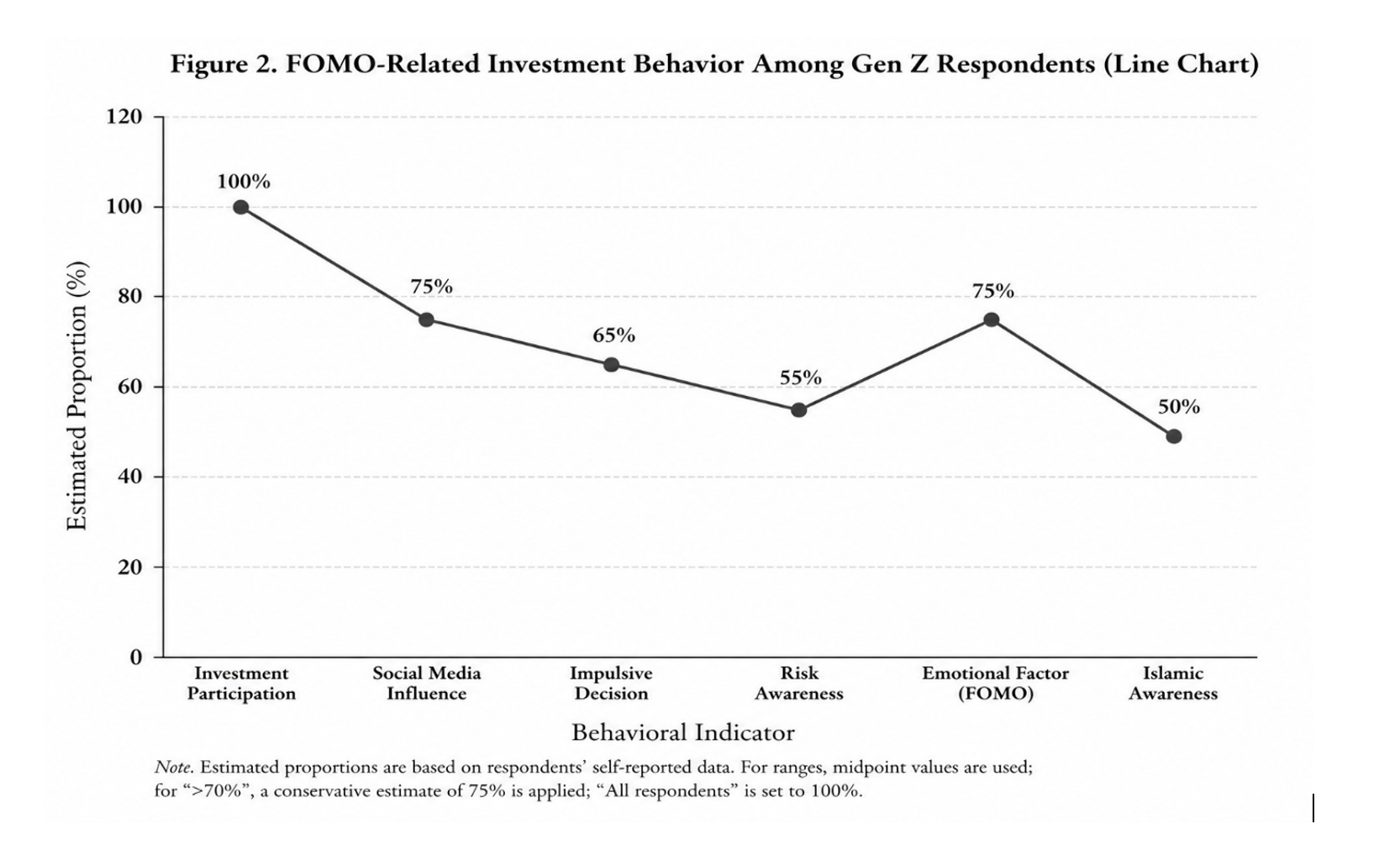
The rapid development of financial technology has significantly increased Generation Z’s participation in digital investment activities. However, limited attention has been given to the psychological factors influencing their investment decisions, particularly Fear of Missing Out (FOMO). This trend is supported by the accessibility of digital platforms and the widespread use of social media, which facilitate the dissemination of investment information. This study aims to analyze the influence of FOMO on digital investment behavior among Generation Z and to examine the phenomenon from the perspective of Islamic finance. This research employs a qualitative descriptive approach, with data collected through open-ended questionnaires distributed to 60 respondents who actively engage in digital investment. The data were analyzed using thematic analysis. The results indicate that FOMO significantly influences investment behavior by encouraging impulsive decisions driven by social media trends, with many respondents prioritizing short-term gains without sufficient risk analysis. From the perspective of Islamic finance, such behavior may lead to elements of gharar and maysir, which are not in accordance with Islamic financial principles. Therefore, improving financial literacy and Islamic financial literacy is essential to support more rational and responsible investment decisions.
Downloads
Article Details

This work is licensed under a Creative Commons Attribution-ShareAlike 4.0 International License.
Authors continue to retain the copyright to the article if the article is published in the Jurnal Hadratul Madaniyah. They will also retain the publishing rights to the article without any restrictions.
Authors who publish in this journal agree to the following terms:
- Any article on the copyright is retained by the author(s).
- The author grants the journal the right of first publication with the work simultaneously licensed under a Creative Commons Attribution License that allows others to share work with an acknowledgment of the work authors and initial publications in this journal.
- Authors can enter into separate, additional contractual arrangements for the non-exclusive distribution of published articles (e.g., post-institutional repository) or publish them in a book, with acknowledgment of their initial publication in this journal.
- Authors are permitted and encouraged to post their work online (e.g., in institutional repositories or on their websites) before and during submission. This can lead to productive exchanges and earlier and greater citations of published work.
- The article and any associated published material are distributed under the Creative Commons Attribution-ShareAlike 4.0 International License.
References
Aisyah, N., Isroni, I., & Suryani, R. (2025). Behavioral Finance in the Digital Age: How Social Media Influences Investment Decisions. Jurnal Akuntansi, Ekonomi Dan Manajemen Bisnis, 5(1), 347–354. https://doi.org/10.55606/jaemb.v5i1.6519
Amelia, R. N., Afiqul Rifqi, M., & Latifah, E. (2024). KONSEP UANG DALAM EKONOMI MAKRO ISLAM. JIAR : Journal Of International Accounting Research, 2(02), 74–83. https://doi.org/10.62668/jiar.v2i02.1148
Azizah, A. N. (2025). The Impact of FOMO (Fear of Missing Out) on Investment Decisions in the Millennial Generation. SSRN Electronic Journal. https://doi.org/10.2139/ssrn.5127021
Cfa Institute. (2023, May 23). Gen Z and Investing: Social Media, Crypto, FOMO, and Family. https://doi.org/10.56227/23.1.15
Clarke, V., & Braun, V. (2017). Thematic analysis. The Journal of Positive Psychology, 12(3), 297–298. https://doi.org/10.1080/17439760.2016.1262613
Eduard, M. B., Widyastuti, T., Maidani, M., & Sari, P. N. (2024). PENGARUH PENGETAHUAN INVESTASI, FINANCIAL LITERACY, DAN PERSEPSI RISIKO TERHADAP KEPUTUSAN INVESTASI PADA GENERASI MILENIAL DAN GENERASI Z DI KECAMATAN BEKASI UTARA. SENTRI: Jurnal Riset Ilmiah, 3(2), 924–941. https://doi.org/10.55681/sentri.v3i2.2338
Evanthi, A., Wikartika, I., & Suwaidi, R. A. (2023). Investment Decision Making With Investment Satisfaction As An Intervening Variable: Availability Bias And Financial Literacy. JBMP (Jurnal Bisnis Manajemen Dan Perbankan), 9(1), 12–24. https://doi.org/10.21070/jbmp.v9i1.1661
Fathin, N. A., & Hersugondo, H. (2022). The Role of Psychological and Social Factors on Retail Investor Investment Decisions in the Indonesia Stock Exchange. Jurnal Dinamika Manajemen, 13(2), 236–252. https://doi.org/10.15294/jdm.v13i2.36588
Goeyana, A., & Marlina, M. A. E. (2024). FINANCIAL LITERACY AND RISK PERCEPTION: THE KEY TO UNDERSTANDING THE RELATIONSHIP BETWEEN FOMO AND INVESTMENT DECISIONS. Jurnal Aplikasi Akuntansi, 9(1), 46–59. https://doi.org/10.29303/jaa.v9i1.433
Hanif, H., Harahap, M. I., & Silalahi, P. R. (2025). Pengaruh Gaya Hidup, Fomo, Literasi Keuangan Syariah, dan Persepsi Risiko Terhadap Keputusan Investasi Cryptocurrency. Journal of Business and Economics Research (JBE), 6(1), 83–93. https://doi.org/10.47065/jbe.v6i1.6916
Hasibuan, T. F. H., Meifari, V., Muda, I., & Kesuma, S. A. (2023). TECHNOLOGY 4.0 ERA INVESTMENT DECISIONS FOR MILENIALS AND GENERATION Z. International Journal of Educational Review, Law And Social Sciences (IJERLAS), 3(4), 1297–1304. https://doi.org/10.54443/ijerlas.v3i4.976
Idris, H. (2024). The Effects of FOMO on Investment Behavior in the Stock Market. Golden Ratio of Data in Summary, 4(2), 879–887. https://doi.org/10.52970/grdis.v4i2.757
Lanciano, E., Previati, D., & Ricci, O. (2026). Crypto ownership among young people: The effect of financial literacy, risk propensity and behavioural biases. The European Journal of Finance, 32(3), 399–419. https://doi.org/10.1080/1351847X.2026.2629350
Laraga, A. G. (2025). Understanding the “Fear of Missing Out” (FOMO) Phenomenon Among Retail Investors in the Indonesian Capital Market: A Literature Review. Journal of Applied Accounting and Taxation, 10(2), 310–319. https://doi.org/10.30871/jaat.v10i2.10625
Li, Y., Delfabbro, P., & King, D. (2025). Investigating the Role of Regret, FOMO and Financial Literacy in Cryptocurrency Speculation. International Journal of Mental Health and Addiction. https://doi.org/10.1007/s11469-025-01555-6
Maheshwari, C. (2026). Chasing Financial Goals: How Social Media Engagement, Fear of Missing Out, and Digital Financial Literacy Shape Investment Behaviour of Gen Z? Vivekananda Journal of Research, 15(2), 86–96. https://doi.org/10.61081/vjr/15v2i102
Manchanda, M., & Bajaj, H. (2025). Fear of Missing Out: A Catalyst for Investment Choices. South India Journal of Social Sciences, 23(3), 15–18. https://doi.org/10.62656/SIJSS.v23i3.1928
Maukar, T. T., & Sudyasjayanti, C. (2025a). The Moderating Impact of Fomo on Adoption Intention Toward Investment Behavior Among Gen Z. Syntax Literate ; Jurnal Ilmiah Indonesia, 10(4), 4180–4192. https://doi.org/10.36418/syntax-literate.v10i4.57923
Maukar, T. T., & Sudyasjayanti, C. (2025b). The Moderating Impact of Fomo on Adoption Intention Toward Investment Behavior Among Gen Z. Syntax Literate ; Jurnal Ilmiah Indonesia, 10(4), 4180–4192. https://doi.org/10.36418/syntax-literate.v10i4.57923
Mubarroq, A. C., & Latifah, L. (2023). ANALISIS KONSEP MUAMALAH BERDASARKAN KAIDAH FIQH MUAMALAH KONTEMPORER. Tadayun: Jurnal Hukum Ekonomi Syariah, 4(1), 95–108. https://doi.org/10.24239/tadayun.v4i1.101
Mwita, K., & Mwilongo, N. (2025). Thematic Analysis of Qualitative Research Data: A Seven-Step Guide. Eminent Journal of Business and Management, 1(1), 51–59. https://doi.org/10.70582/4ajw7k14
Nguyen, K. T. C., Dao, T. H. H., Pham, V. P., & Nguyen, P. H. N. (2026). Fear of missing out and Generation Z’s investment behavior in Vietnam’s stock market: The moderating role of financial literacy. Edelweiss Applied Science and Technology, 10(1), 500–510. https://doi.org/10.55214/2576-8484.v10i1.11624
Nilawati, O., & Ainiah, L. (2025). Financial Literacy and Investment Decision-Making Tendencies: A Comparative Study between Millennials and Gen Z in Indonesia. International Journal of Social Science Research and Review, 8(7), 452–466. https://doi.org/10.47814/ijssrr.v8i7.2838
Nurhayati, N., Mutakin, K., Caroline, C., & Judijanto, L. (2025). Analysis of the influence of financial literacy on investment decisions of millennials and gen Z in the digital ERA. Edelweiss Applied Science and Technology, 9(7), 2129–2138. https://doi.org/10.55214/2576-8484.v9i7.9128
Nurjanah, D. I., Fitriana, Anisa, R., Darmawan, D., Jaweda, P. M. C., & Sulastri. (2024). Konsep Gharar dan Maisir dalam Transaksi Ekonomi Fikih Mu’amalah. Al-Fiqh, 2(3), 159–166. https://doi.org/10.59996/al-fiqh.v2i3.368
Prawitasari, D., Kadarningsih, A., & Ahmad, M. Y. (2025). Financial Behavior of Gen Z Students: Digital Lifestyle, FoMo, and Financial Literacy. Solusi, 23(3). https://doi.org/10.26623/slsi.v23i3.12359
Przybylski, A. K., Murayama, K., DeHaan, C. R., & Gladwell, V. (2013). Motivational, emotional, and behavioral correlates of fear of missing out. Computers in Human Behavior, 29(4), 1841–1848. https://doi.org/10.1016/j.chb.2013.02.014
Rahayu, N. W. I., Hepni, H., Fauzan, F., Poernomo, D., Dafik, D., Mursyidah, I. L., & Jannah, E. S. W. (2024). An Islamic point of view of cryptocurrency investment: Generations z fear of missing out (FOMO) and their personal traits as traders. Edelweiss Applied Science and Technology, 8(5), 1880–1905. https://doi.org/10.55214/25768484.v8i5.1920
Suraweera, B. G. T. N. (2025, November 25). THE IMPACT OF HERDING BEHAVIOR AND OVERCONFIDENCE BIAS ON INVESTMENT DECISIONS OF GEN Z INVESTORS IN SRI LANKA: THE MEDIATING ROLE OF RISK PERCEPTION. Proceedings of the 16th International Conference on Business and Information (ICBI) - 2025. 16th International Conference on Business and Information. https://doi.org/10.64920/ICBI25016
Utami, S. E., Astungkara, A., Mahesti, T., & Ciptaningtias, A. F. (2025). Gen Z Digital Investment Intentions: An Analysis of Financial Literacy, Social Media, and Privacy Issues. Journal of Social Commerce, 5(3), 453–467. https://doi.org/10.56209/jommerce.v5i3.183
Yanida, P., Padmanegara, O. H., Universitas Widyatama, Indonesia, Muklis, T. I., & Universitas Widyatama, Indonesia. (2025). The Intention to use Digital Investment Management Platforms Among Gen Z in Indonesia: Perspective from Individual and Technological Motives. Journal of Economics, Finance And Management Studies, 08(01). https://doi.org/10.47191/jefms/v8-i1-02
Yuliani, I., Setyowati, S. W., & Irianto, M. F. (2023). Determinan keputusan investasi dengan moderasi financial attitude pada IAI Muda Jawa Timur. MBR (Management and Business Review), 7(1), 46–66. https://doi.org/10.21067/mbr.v7i1.8212