Harmonization of Customary Law and Islamic Law in the Zereah Tradition of Marriage in Hiang Tinggi Village: A Maqasid al-Shariah Perspective
Article Sidebar
Main Article Content
Abstract
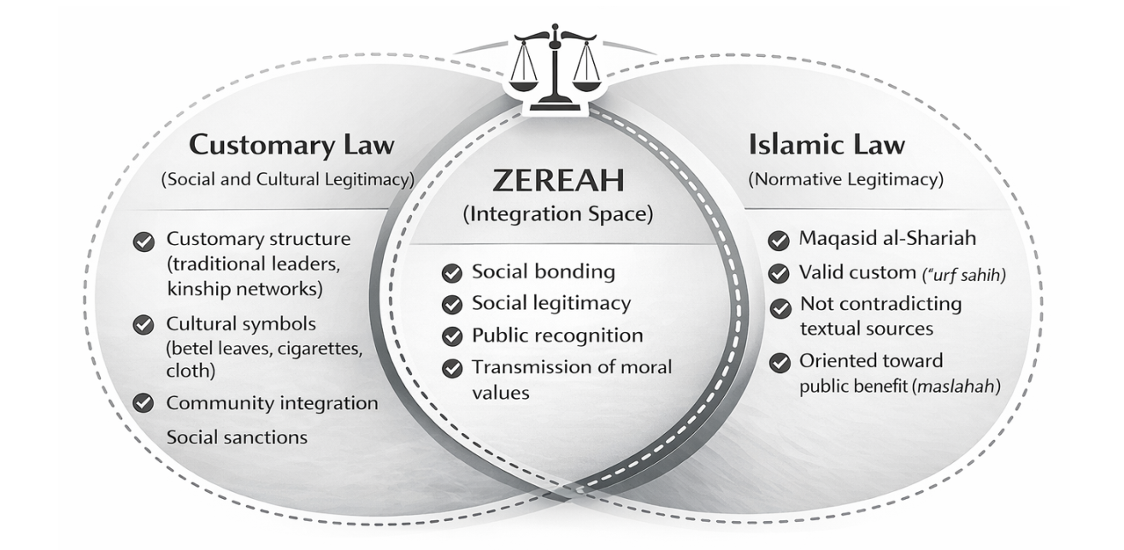
This study examines the Zereah tradition as a post-marriage customary practice and analyzes its role in harmonizing Islamic law and customary law through the maqasid al-shariah framework. The tradition functions to reinforce kinship ties, introduce newlyweds to the wider community, and ensure social legitimacy. It involves symbolic elements such as traditional attire, communal prayers, and marital advice, reflecting the integration of cultural and religious values. While previous studies have primarily emphasized the formal-legal aspects of the marriage contract, this research highlights the customary sphere as a crucial space for the social contextualization of Sharia. Employing a qualitative empirical design with normative-theological and socio-legal approaches, data were collected through observation and in-depth interviews with married couples, customary and religious leaders, and community members. Secondary sources included fiqh literature on maqasid al-shariah and ‘urf, marriage legislation, and related studies. Data were analyzed using the interactive model with source triangulation to ensure validity.The findings reveal that Zereah is practiced in a simple and non-coercive manner, involving symbolic offerings such as cigarettes, sweets, and betel wrapped in a sarong, while the couple often receives rice or monetary support, reflecting communal solidarity. From an Islamic legal perspective, the tradition qualifies as ‘urf sahih and promotes maslahah. Within the maqasid al-shariah framework, it supports the preservation of religion, life, intellect, lineage, and wealth. The study’s novelty lies in conceptualizing Zereah as a model of dialogical legal harmonization that operationalizes Sharia objectives and strengthens the socio-normative legitimacy of marriage.
Downloads
Article Details

This work is licensed under a Creative Commons Attribution-ShareAlike 4.0 International License.
Authors continue to retain the copyright to the article if the article is published in the Jurnal Hadratul Madaniyah. They will also retain the publishing rights to the article without any restrictions.
Authors who publish in this journal agree to the following terms:
- Any article on the copyright is retained by the author(s).
- The author grants the journal the right of first publication with the work simultaneously licensed under a Creative Commons Attribution License that allows others to share work with an acknowledgment of the work authors and initial publications in this journal.
- Authors can enter into separate, additional contractual arrangements for the non-exclusive distribution of published articles (e.g., post-institutional repository) or publish them in a book, with acknowledgment of their initial publication in this journal.
- Authors are permitted and encouraged to post their work online (e.g., in institutional repositories or on their websites) before and during submission. This can lead to productive exchanges and earlier and greater citations of published work.
- The article and any associated published material are distributed under the Creative Commons Attribution-ShareAlike 4.0 International License.
References
Abidin, M. Z., & Zaman, A. Z. (2024). Pengaruh ’Urf dalam Hukum Peminangan dan Akad Nikah, Studi Komparasi KHI di Indonesia Dengan Qanun Al-Ahwal Al-Shakhsiyyah di Yaman. Mabahits: Jurnal Hukum Keluarga, 05(2). https://doi.org/https://doi.org/10.36835/mabahits.v5i02 1995
Abubakar, A., Achyar, G., Khatimah, H., & Samad, S. A. A. (2023). The Postponement of The Implementation of Inheritance Distribusion in The Seunuddon Cmmunity, North Aceh in The Perspective of ’Urf Theory and Legal Pluralism. 6(2), 411–429. https://doi.org/10.22373/ujhk.v6i2.10207.
Andriyaldi. (2021). Al-’Urf Theory and Its Relevance to Contemporary Jurisprudence Issues. Al-Hurriyah: Jurnal Hukum Islam, 6(2). https://doi.org/DOI : 10.30983/alhurriyah.v6i2.4784
Ansori, M. K. R., Dahlan, M., & Ishaq. (2025). The Tradition of Nyadokaken Pengantin in Osing Tribe Marriages in Indonesia : An ’ Urf Perspective. Al-Qadha: Jurnal Hukum Islam Dan Perundang-Undangan, 12(1), 1–19. https://doi.org/https://doi.org/10.32505/qadha.v12i1.10817
Aslati, Agustar, A., Silawati, Arisman, & Arafah, S. (2024). Utilizing Science and Maqasid al-Shariah in Resolving Contemporary Issues of Islamic Family Law. Al-Manahij: Jurnal Kajian Hukum Islam, 18(1), 17–36. https://doi.org/https://doi.org/10.24090/mnh.v18i1.10571
Astuti, E. D., Tahir, M., & Marnita. (2022). Studi Komparatif Larangan Perkawinan Antara Hukum Adat , Hukum Perdata dan Hukum Islam. Al-Manhaj: Jurnal Hukum Dan Pranata Sosial Islam, 4(2), 119–128. https://doi.org/10.37680/almanhaj.v4i1.1574
Baroroh, N., & Sabila, A. A. (2024). Cultural-Religious Harmony in the Mitoni Tradition Perspectives from Nahdlatul Ulama Figures in Bangil, Pasuruan. Media Syari’ah: Wahana Kajian Hukum Islam Dan Pranata Sosial, 26(1). https://doi.org/10.22373/jms.v26i1.19729
Dani, M. I., & Rahmawati, N. P. (2024). A Critical Study of the Nyongkolan Tradition in Lombok Traditional Marriages from the Perspective of ’ Urf. Islamic Review: Jurnal Riset Dan Kajian Keislaman, 13(2), 73–84. https://doi.org/doi.org/10.35878/islamicreview.v13.i2.1309
Defriza, R., Harahap, S. M., & Hidayat, R. (2025). Islam and multiculturalism in building harmony in a diverse society. Scaffolding: Jurnal Pendidikan Islam dan Multikulturalisme, 7(2), 1001–1015. https://doi.org/10.37680/scaffolding.v7i2.7841
Faidah, A. N. (2022). Tinjauan Hukum Islam Terhadap Tradisi Perempuan Meminang Laki-laki di Kecamatan Modo Kabupaten Lamongan. El-USRAH: Jurnal Hukum Keluarga, 5(1), 1–11. https://www.semanticscholar.org/paper/Tinjauan-Hukum-Islam-Terhadap-Tradisi-Perempuan-di-Faidah/1b994d1a726c49286197d54ea4dfd333c725ddf0
Hamzah, M. (2022). Pencapaian Maqasid Syariah dalam Kemajuan Ekonomi Masyarakat Madura Melaui Budaya Rokat Tase’. AL-IQTISHADIYAH: Jurnal Ekonomi Syariah Dan Hukum Ekonomi Syariah, 8(1), 1–20. http://dx.doi.org/10.31602/iqt.v8i1.6808.
Hanafi, & Nirwana, D. (2024). An examination of banjar ethnic marriage customs from a living hadith perspective. Jurnal Living Hadis, IX(1), 85–104. https://doi.org/10.14421/livinghadis.2024.4742
Iskandar, & Tarsid, I. (2025). Customary Ritual and Islamic Law : Legal Reflections on the Pati Ka Du’a Bupu Ata Mata of the Lio Tribe in Pemo Village. Al-Qadha: Jurnal Hukum Islam Dan Perundang-Undangan, 12(1), 82–100. https://doi.org/https://doi.org/10.32505/qadha.v12i1.9738
Ismail, Busyro, Nofiardi, Wadi, F., & Alwana, H. A. (2022). The Contribution of ’Urf to The Reform of Islamic Inheritance Law in Indonesia. Al-Risalah: Forum Kajian Hukum Dan Ssial Kemasyarakatan, 22(2), 165–178. https://doi.org/10.30631/alrisalah.v22i2.1243
Jumain, A. A., & Suleman, Z. (2021). Kedudukan Wali Nikah Dalam Pernikahan Adat Bolangitang. As-Syams: Journal Hukum Islam, 2(2), 90–103. https://ejournal.iaingorontalo.ac.id/index.php/AS-SYAMS/article/view/575
Khashogi, L. R. (2022). Menakar Rekonstruksi Maqasid Syariah Telaah Genealogis Pendekatan System Jasser Auda. Politea: Jurnal Politik Islam, 5(1), 64–82. https://media.neliti.com/media/publications/522351-none-5c78fddb.pdf
Luthfi, M., Fajrin, Y. A., & Bachtiar, H. (2024). The Existence of ’Urf in the Resolution of Marriage Disputes in Islamic Law: A Living Law Perspective. IUS Kajian Hukum Dan Keadilan, 12(1), 68–74. https://doi.org/http://dx.doi.org/10.29303/v12i1.1356
Marwa, M. H. M. (2021). Model Penyelesaian Perselisihan Perkawinan Persfektif Hukum Adat dan Hukum Islam. USM Law Review, 4(2), 777–794. https://doi.org/10.26623/julr.v4i2.4059
Nasution, A. F. (2023). Metode Penelitian Kualitatif (M. Albina (ed.); Cetakan Pe). CV. Harfa Creative.
Nurdin, B. V., Asnani, A., Ratnasari, Y., & Syah, P. (2023). Customary sanctions: Social control of rural development. Jurnal Bina Praja, 15(2), 325–337. https://doi.org/10.21787/jbp.15.2023.325-337
Pranowo, & Firdaus, W. (2020). PENGGUNAAN BAHASA NONVERBAL DALAM UPACARA ADAT PERNIKAHAN GAYA YOGYAKARTA: KAJIAN SIMBOLIK ETNOPRAGMATIK. Ranah: Jurnal Kajian Bahasa, 9(1), 35–55. https://doi.org/https://doi.org/10.26499/rnh/v9i1.2321
Ra’d, H. A., & Yassir, M. (2026). Harmonisasi Hukum Waris Islam dan Hukum Adat: Analisis Tradisi Pembagian Damai dalam Kerangka Maqasid syariah. USRAH: Jurnal Hukum Keluarga Islam, 7(1), 245–264. https://doi.org/10.46773/5hrykg12
Roosinda, F. W., Lestari, N. S., Utama, A. A. G. S., Anisah, H. U., Siahaan, A. L. S., Islamiati, S. H. D., Astiti, K. A., Hikmah, N., & Fasa, M. I. (2021). Metode Penelitian Kualitatif (D. U. Sutiksno (ed.); Cetakan I). Zahir Publishing.
Rosyid, M., & Kushidayati, L. (2022). Anticipating Disaster: The ’Urf Perspective of Rebo Wekasan Ceremony in Kudus, Central Java. Al-Ihkam: Jurnal Hukum Dan Pranata Sosial, 17(1), 91–112. https://doi.org/http://doi.org/10.19105/al-Ihkam.v17i1.5705
Saiin, A., Zaitun, Hajazi, M. Z., & Raadiamoda, A. M. (2023). Examining Malay Customary Marriage Law in the Malay Countries : An Urf Perspective. Al-Qadha: Jurnal Hukum Islam Dan Perundang-Undangan, 10(1), 1–18. https://doi.org/10.32505/qadha.v10i1.4725
Samsidar, Bakry, M., Amin, A. R., Makkarateng, M. Y., & Syam, A. R. (2025). Analisis Maqasid Al-Syariah Terhadap Kontinuitas Tradisi Sipalisunna di Masyarakat Bugis. Familia: Jurnal Hukum Keluarga, 6(1), 108–123. https://doi.org/10.24239/familia.v6i1.249
Saragih, M. A., Harahap, R. D., & Nasution, J. (2025). Analisis Pengembangan Desa Wisata Berbasis Kearifan Lokal Tinjauan Maqasid Syariah (Studi Kasus Pemandian Alam Sejuk Kabupaten Simalungun). Jambura Economic Education Journal, 7(4), 1471–1490. https://ejurnal.ung.ac.id/index.php/jej/article/view/33753.
Sholeh, M. G. I. (2023). Tradisi Sorong Serah dalam Prosesi Perkawinan Masyarakat Adat Sasak : Sebuah Tinjauan ‘ Urf. Al-Qisthu, 21(1), 32–41. https://doi.org/http://dx.doi.org/10.32694/qst.v21i1.2198 Tradisi
Sutisna, M., Dr. Neneng Hasanah, M., Ikhwan Nugraha, M., & Katmas, E. (2021). Panaroma Maqasid Syariah (M. Dr. Abdurrahman Misno BP (ed.)). Media Sains Indonesia.
Syamantha, T., Syahputra, D. H., & Zulfikar. (2025). The subject of customary law and the relevance of customary law in the Indonesian legal system. International Journal of Research and Review, 12(4), 298–301. https://doi.org/10.52403/ijrr.20250436
Syandri, Iskandar, & Kadir, S. (2020). Tradisi Ziarah Kubur Pasca Pernikahan (Studi Kasus Kelurahan Manisa, Kecamatan Baranti, Kabupaten Sidrap, Sulawesi Selatan). Bustanul Fuqaha: Jurnal Bidang Kajian Islam, 1(3), 272–293. https://journal.stiba.ac.id/index.php/bustanul/article/view/159/118.
Syarif, A. (2026). Religious Guidance Through Weekly Prayer Meetings At The Nur Qolbu Sampit Mosque. Jurnal Hadratul Madaniyah, 13(1), 11-27.
Tabroni, R., Izudin, A., Yuwono, D. B., Isnanto, M., Sujibto, B. J., & Suarsana, I. M. (2025). Hybridity, intersection, and challenge: Navigating the history of customary and Islamic family law in Moluccan marriages. Al-Aḥwāl: Jurnal Hukum Keluarga Islam, 18(1), 1–28. https://doi.org/10.14421/ahwal.2015.18101
Tamam, B., Krisnawati, D., Junaidi, A., Rato, D., & Waeno, M. (2025). DETERMINING THE AUSPICIOUS DAY OF A MARRIAGE CEREMONY USING “ TITEN SCIENCE ”: AN ‘ URF PERSPECTIVE IN JEMBER. Hukum Islam, 25(1), 139–156. https://doi.org/http://dx.doi.org/10.24014/hi.v25i1.36034
Tohari, I. (2020). Maqasid Syariah Sebagai Pijakan Konseptual dalam Pembaruan Hukum Keluarga Islam Indonesia. Arena Hukum, 13(2), 314–328. https://doi.org/https://doi .org/10 .21776/ub .arenahukum .2020 .01302 .7
Wijaya, S., Sarkowi, Tenri, B., Zulfahmi, & Najmi, M. (2025). The Problematic of Tradisional Marriage Traditions in The Philippines: A Case Study and Its Implications. Hukum Islam, 25(1), 24–41. https://doi.org/http://dx.doi.org/10.24014/hi.v25i1.31645
Yusuf, J. M., & Yuslem, N. (2023). Acehnese Dayah Ulama’s Response to the Use of ’Urf in Istinbath of Fiqh from Islam Nusantara. Al-Istinbath: Jurnal Hukum Islam, 8(1), 291–306. https://doi.org/https://dx.doi.org/10.29240/jhi.v8i1.5732
Zulkifli, Zikri, A., Artiningsih, D. W., Zainuddin, & Helim, A. (2024). Revitalizing ’Urf in State Legal Development: The Case of Minangkabaunese Marriage Trafitions. Al-Istinbath: Jurnal Hukum Islam, 9(2), 841–862. https://doi.org/https://dx.doi.org/10.29240/jhi.v9i2.11034 Received: