Technology Acceptance Model (TAM), Student Engagement, and Psychological Well-Being in Islamic Education: Evidence from Vocational Schools
Article Sidebar
Main Article Content
Abstract
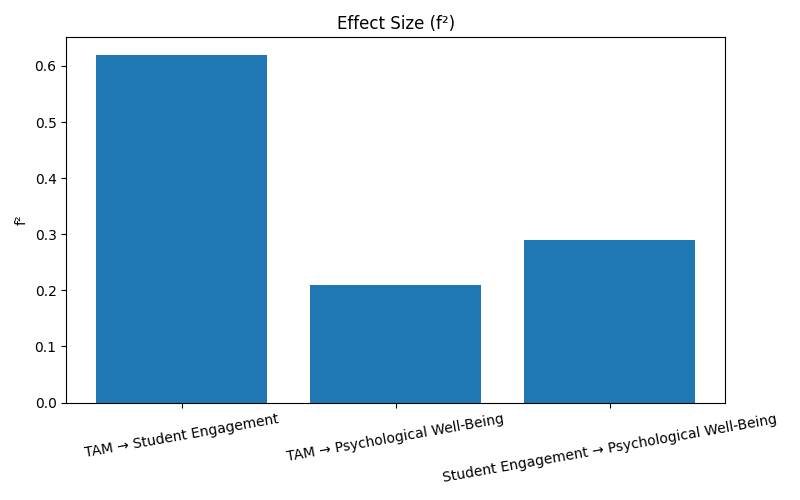
The integration of digital technology in education has become increasingly important; however, its effectiveness in Islamic Education remains underexplored, particularly regarding student engagement and psychological well-being. This gap is evident in vocational school contexts, where technology use does not always translate into active participation or positive mental outcomes. Therefore, this study aims to examine the relationships between the Technology Acceptance Model (TAM), student engagement, and psychological well-being in Islamic Education among students in private vocational schools in Palangka Raya City. This study employed a quantitative approach with a cross-sectional survey design. A sample of 250-300 students was selected using stratified random sampling. Data were collected through a structured questionnaire and analysed using Partial Least Squares Structural Equation Modelling (PLS-SEM). The findings indicate that TAM has a significant positive effect on student engagement and psychological well-being. Student engagement also significantly influences psychological well-being and partially mediates the relationship between technology acceptance and well-being. These results suggest that effective technology integration should promote both usability and active engagement to support students’ psychological well-being. The study contributes to the literature by providing an integrated model in Islamic Education and recommends the development of interactive, student-centred digital learning environments, as well as further longitudinal research.
Downloads
Article Details

This work is licensed under a Creative Commons Attribution-ShareAlike 4.0 International License.
Authors continue to retain the copyright to the article if the article is published in the Jurnal Hadratul Madaniyah. They will also retain the publishing rights to the article without any restrictions.
Authors who publish in this journal agree to the following terms:
- Any article on the copyright is retained by the author(s).
- The author grants the journal the right of first publication with the work simultaneously licensed under a Creative Commons Attribution License that allows others to share work with an acknowledgment of the work authors and initial publications in this journal.
- Authors can enter into separate, additional contractual arrangements for the non-exclusive distribution of published articles (e.g., post-institutional repository) or publish them in a book, with acknowledgment of their initial publication in this journal.
- Authors are permitted and encouraged to post their work online (e.g., in institutional repositories or on their websites) before and during submission. This can lead to productive exchanges and earlier and greater citations of published work.
- The article and any associated published material are distributed under the Creative Commons Attribution-ShareAlike 4.0 International License.
References
Al-Emran, M., Mezhuyev, V., & Kamaludin, A. (2020). Technology acceptance model in education: A systematic review. Education and Information Technologies, 25(4), 2977–3000. https://doi.org/10.1007/s10639-019-10080-6
Biggs, J., & Tang, C. (2019). Teaching for quality learning at university (4th ed.). Open University Press.
Bond, M., Buntins, K., Bedenlier, S., Zawacki-Richter, O., & Kerres, M. (2020). Mapping research in student engagement and educational technology. Springer.
Chiu, T. K. F. (2021). Digital support for student engagement in blended learning. Computers & Education, 168, 104196. https://doi.org/10.1016/j.compedu.2021.104196
Creswell, J. W., & Creswell, J. D. (2018). Research design: Qualitative, quantitative, and mixed methods approaches (5th ed.). SAGE Publications.
Davis, F. D. (1989). Perceived usefulness, perceived ease of use, and user acceptance of information technology. MIS Quarterly, 13(3), 319–340. https://doi.org/10.2307/249008
Deci, E. L., & Ryan, R. M. (2020). Self-determination theory. Psychological Inquiry, 31(2), 119–127. https://doi.org/10.1080/1047840X.2020.1749889
El Aadmi-Laamech, K., Benlahmar, E. H., & Hmida, S. (2024). Learning analytics and student well-being: A systematic review. arXiv. https://doi.org/10.48550/arXiv.2412.02457
Falloon, G. (2020). From digital literacy to digital competence. British Journal of Educational Technology, 51(5), 1473–1486. https://doi.org/10.1111/bjet.12954
Fitriyanto, M. N. ., Syarif, A. ., Suryadini, H. ., & Mulia, D. S. . (2025). Transformasi Digital dalam Dunia Akademik: Pelatihan Edukasi Pemanfaatan AI untuk Penulisan karya tulis Ilmiah Mahasiswa. Jurnal Pengabdian Masyarakat Wadah Publikasi Cendekia, 2(2), 181–184. https://doi.org/10.63004/jpmwpc.v2i2.774
Fredricks, J. A., Reschly, A. L., & Christenson, S. L. (2019). Student engagement interventions: Theory and practice. Educational Psychologist, 54(3), 147–163. https://doi.org/10.1080/00461520.2019.1614446
Hair, J. F., Hult, G. T. M., Ringle, C. M., & Sarstedt, M. (2021). A primer on partial least squares structural equation modeling (PLS-SEM) (3rd ed.). SAGE Publications.
He, J., Wang, Q., & Lee, H. (2025). Enhancing online learning engagement: The role of teacher support and psychological needs satisfaction. BMC Psychology, 13, Article 45. https://doi.org/10.1186/s40359-025-03016-0
Henrie, C. R., Halverson, L. R., & Graham, C. R. (2018). Measuring student engagement in technology-mediated learning: A review. Computers & Education, 122, 1–13. https://doi.org/10.1016/j.compedu.2018.03.019
Henseler, J., Ringle, C. M., & Sarstedt, M. (2015). A new criterion for assessing discriminant validity. Journal of the Academy of Marketing Science, 43(1), 115–135. https://doi.org/10.1007/s11747-014-0403-8
Hidayat, R., et al. (2023). Technology integration in Islamic education. Education Sciences, 13(2), 145. https://doi.org/10.3390/educsci13020145
Huang, C., et al. (2023). Student engagement in digital learning environments. Computers & Education, 191, 104648. https://doi.org/10.1016/j.compedu.2022.104648
Illeris, K. (2018). Contemporary theories of learning: Learning theorists… in their own words (2nd ed.). Routledge. https://doi.org/10.4324/9781315147277
Jennah, R., Purnama, S., Surawan, S., & Mazrur, M. (2025). Utilisation of digital video media to increase learning engagement of Al-Qur'an Hadith learning in madrasahs of Central Kalimantan. Jurnal Pendidikan Agama Islam, 22(2), 339-362. https://doi.org/10.14421/jpai.v22i2.11905
Joshi, A., Kale, S., Chandel, S., & Pal, D. (2015). Likert scale: Explored and explained. British Journal of Applied Science & Technology, 7(4), 396–403. https://doi.org/10.9734/BJAST/2015/14975
Kline, R. B. (2016). Principles and practice of structural equation modeling (4th ed.). Guilford Press.
Li, J., Jin, M., & Chen, X. (2025). TAM and psychological well-being. Frontiers in Psychology, 16. https://doi.org/10.3389/fpsyg.2025.1521174
Mayer, R. E. (2021). Multimedia learning (3rd ed.). Cambridge University Press. https://doi.org/10.1017/9781316941355
Mazrur, M., Jennah, R., Norhidayah, S., & Surawan, S. (2025). Integrating technology acceptance and pedagogical deep learning in Islamic education: A TAM-based study. Ta’dib, 28(2), 501–514. https://doi.org/10.31958/jt.v28i2.15981
Nurrahmi, D., Muslimah, M., & Surawan, S. (2026). Digital da’wah YouTube and psychological well-being student: A transformation in Islamic education in the contemporary era. SOSIOEDUKASI: Jurnal Ilmiah Ilmu Pendidikan dan Sosial, 15(1), 2004–2018. https://doi.org/10.36526/sosioedukasi.v15i1.7715
Orth, U., & Robins, R. W. (2022). Longitudinal research in psychology. Annual Review of Psychology, 73, 21–45. https://doi.org/10.1146/annurev-psych-020821-114927
Prananto, K., Suyadi, B., & Nugroho, A. (2025). Perceived teacher support and student engagement: A systematic review. BMC Psychology, 13, Article 112. https://doi.org/10.1186/s40359-025-02412-w
Putra, A., et al. (2022). Digital learning in Indonesia. Education and Information Technologies, 27, 12345–12360. https://doi.org/10.1007/s10639-022-11000-1
Rahmayani, A., & Surawan, S. (2025). Menanamkan digital well-being dalam kurikulum: Upaya membangun kesehatan mental siswa di era digital. Jurnal Pendidikan dan Pembelajaran, 4(02), 441–449. https://ojs.smkmerahputih.com/index.php/juperan/article/view/902
Rahman, A., et al. (2021). Islamic education and technology. Journal of Religious Education, 69(3), 321–335. https://doi.org/10.1007/s40839-021-00145-2
Reeve, J. (2018). Understanding motivation and engagement. Educational Psychology Review, 30, 1–15. https://doi.org/10.1007/s10648-017-9439-0
Ringle, C. M., Wende, S., & Becker, J. M. (2022). SmartPLS 4. SmartPLS GmbH.
Ryan, R. M., & Deci, E. L. (2020). Intrinsic and extrinsic motivation from a self-determination theory perspective: Definitions, theory, practices, and future directions. Guilford Press.
Ryff, C. D. (2018). Psychological well-being revisited: Advances in the science and practice. Psychotherapy and Psychosomatics, 87(4), 215–221. https://doi.org/10.1159/000490936
Sahduari, S., & Surawan, S. (2025). The role of Islamic spirituality in improving psychological well-being among the elderly Palangka Raya City. Insight Journal, 1(2), 62-69.
Sari, D., et al. (2023). Student engagement in Indonesia. Heliyon, 9(5), e15000. https://doi.org/10.1016/j.heliyon.2023.e15000
Sarstedt, M., Ringle, C. M., & Hair, J. F. (2020). Partial least squares structural equation modeling. Handbook of Market Research. https://doi.org/10.1007/978-3-319-05542-8_15-2
Scherer, R., Siddiq, F., & Tondeur, J. (2019). The technology acceptance model (TAM): A meta-analytic structural equation modeling approach. Educational Technology Research and Development, 67(3), 625–650. https://doi.org/10.1007/s11423-019-09632-4
Schunk, D. H., & DiBenedetto, M. K. (2020). Motivation and social-emotional learning: Theory, research, and practice. Routledge. https://doi.org/10.4324/9780429434914
Slavin, R. E. (2018). Educational psychology: Theory and practice (12th ed.). Pearson.
Sun, Y., & Zhang, Y. (2022). Technology acceptance and engagement. Computers in Human Behavior, 131, 107234. https://doi.org/10.1016/j.chb.2022.107234
Thoyibah, F. A., Wahdah, N., & Surawan, S. (2025). Exploring students’ school well-being in private Islamic boarding school: A case study. International Journal of Education and Teaching Zone, 4(3), 358–375. https://doi.org/10.57092/ijetz.v4i3.467
Venkatesh, V., Thong, J., & Xu, X. (2016). Unified theory of acceptance. MIS Quarterly, 40(1), 157–178. https://doi.org/10.25300/MISQ/2016/40.1.07
Wang, Y., et al. (2022). Technology use and well-being. Computers & Education, 182, 104463. https://doi.org/10.1016/j.compedu.2022.104463
Yu, J., Kreijkes, P., & Salmela-Aro, K. (2023). Students’ academic achievement and well-being: A longitudinal study. Learning and Individual Differences, 103, 102291. https://doi.org/10.1016/j.lindif.2023.102291
Zaimoğlu, S., & Dağtaş, A. (2025). Psychological well-being and academic outcomes among university students. Frontiers in Psychology, 16, 1629498. https://doi.org/10.3389/fpsyg.2025.1629498
Zhao, Y., et al. (2021). Integrating TAM and engagement. Educational Psychology, 41(6), 750–768. https://doi.org/10.1080/01443410.2020.1869212
Zheng, Z., Liu, Y., & Chen, L. (2025). Academic engagement and basic psychological needs: A systematic review based on self-determination theory. International Journal of Learning, Teaching and Educational Research, 24(1), 45–62. https://doi.org/10.26803/ijlter.24.1.3