The Legality of Stablecoins as Digital Financial Instruments in Sharia Economic Law
Article Sidebar
Main Article Content
Abstract
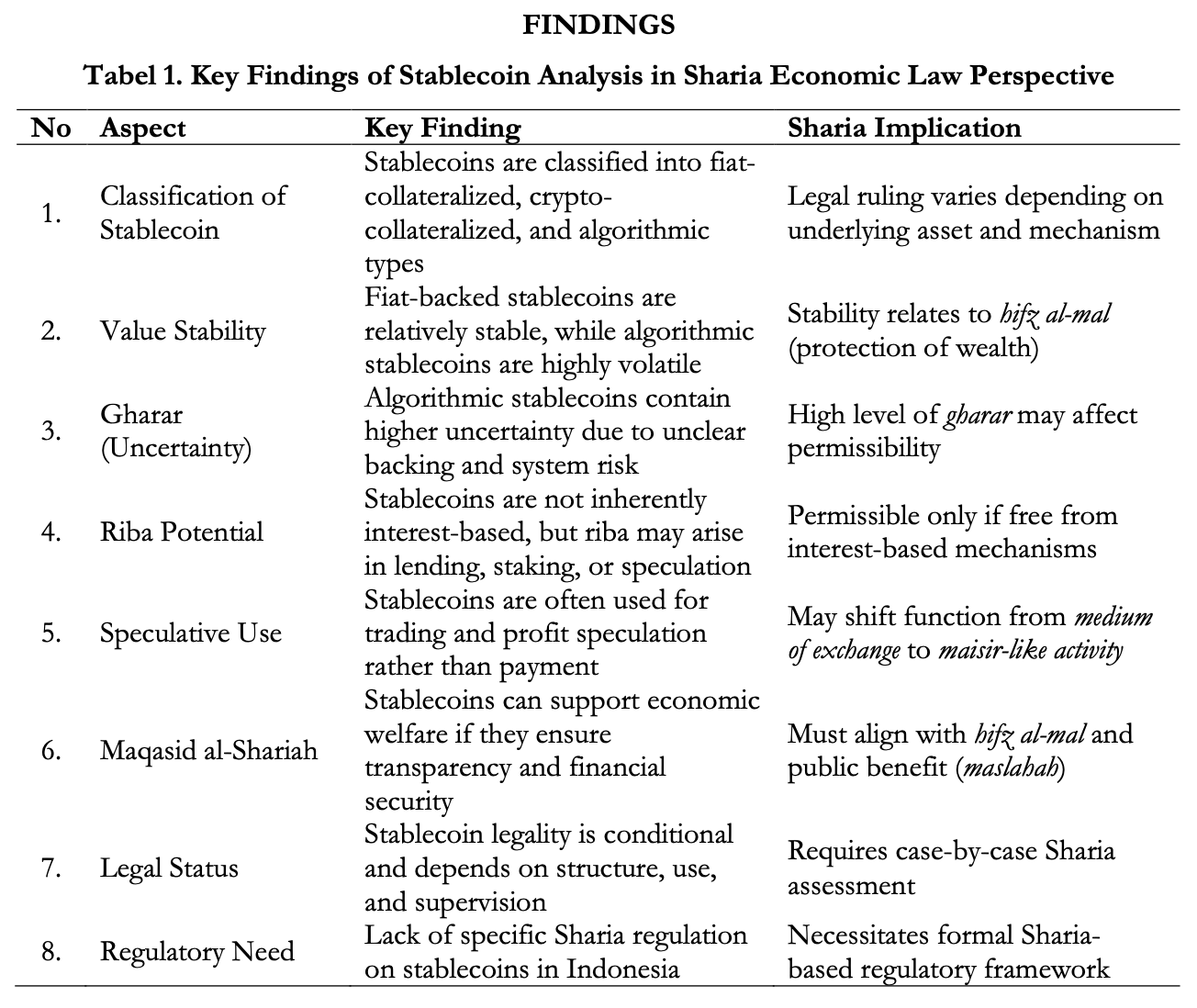
The development of financial technology has given rise to various digital payment instruments, one of which is stablecoin. Stablecoins exist as digital assets designed to maintain stable value through support from certain assets such as fiat currency, gold, or algorithms. The presence of stablecoins has sparked legal debate, particularly from the perspective of Islamic Economic Law, as on one hand they offer digital transaction efficiency, yet on the other hand they may contain elements of gharar, riba, and speculation. This study aims to analyse the legality of stablecoins as digital payment instruments from the perspective of Islamic Economic Law, focusing on the elements of gharar, riba, and value stability. The study uses a normative juridical method with a conceptual approach, a legislative approach, and a maqashid sharia approach. The data sources were obtained from the Qur’an, Hadith, DSN-MUI fatwas, Bank Indonesia and OJK regulations, as well as scientific literature related to digital assets and Islamic finance. The research findings indicate that stablecoins have the potential to be accepted within the Islamic economic system if they meet the principles of transparency, possess clear underlying assets, avoid excessive speculation, and maintain transaction value stability. However, algorithmic stablecoins may carry high gharar due to unclear asset backing and system volatility. From the perspective of maqashid syariah, stablecoins can support the benefits of the digital economy if strictly regulated through Sharia regulations and state supervision. This research emphasises the importance of formulating specific Sharia regulations regarding stablecoins within Indonesia's digital financial system.
Downloads
Article Details

This work is licensed under a Creative Commons Attribution-ShareAlike 4.0 International License.
Authors continue to retain the copyright to the article if the article is published in the Jurnal Hadratul Madaniyah. They will also retain the publishing rights to the article without any restrictions.
Authors who publish in this journal agree to the following terms:
- Any article on the copyright is retained by the author(s).
- The author grants the journal the right of first publication with the work simultaneously licensed under a Creative Commons Attribution License that allows others to share work with an acknowledgment of the work authors and initial publications in this journal.
- Authors can enter into separate, additional contractual arrangements for the non-exclusive distribution of published articles (e.g., post-institutional repository) or publish them in a book, with acknowledgment of their initial publication in this journal.
- Authors are permitted and encouraged to post their work online (e.g., in institutional repositories or on their websites) before and during submission. This can lead to productive exchanges and earlier and greater citations of published work.
- The article and any associated published material are distributed under the Creative Commons Attribution-ShareAlike 4.0 International License.
References
Buku
Antonio, M. S. (2019). Bank syariah: Dari teori ke praktik. Gema Insani.
Ascarya. (2015). Akad dan produk bank syariah. Rajawali Pers.
Karim, A. A. (2017). Ekonomi mikro Islam (5th ed.). Rajawali Pers.
Mardani. (2019). Hukum ekonomi syariah di Indonesia. Kencana.
Muhammad. (2018). Manajemen keuangan syariah. UPP STIM YKPN.
Sjahdeini, S. R. (2020). Perbankan syariah: Produk-produk dan aspek hukumnya. Kencana.
Sudarsono, H. (2018). Bank dan lembaga keuangan syariah. Ekonisia.
Zuhaili, W. (2011). Al-fiqh al-Islami wa adillatuhu (Vol. 5). Dar al-Fikr.
Jurnal dan Artikel Ilmiah
Ahmed, H. (2019). Blockchain, fintech, and Islamic finance: Building the future in the new Islamic digital economy. Islamic Economic Studies, 27(1), 1–15.
Aji, A. M., & Mukri, S. G. (2021). Cryptocurrency in Islamic economic law perspective. Al-Iqtishad: Jurnal Ilmu Ekonomi Syariah, 13(1), 95–112.
Aloui, C., Hammoudeh, S., & Ben Hamida, H. (2021). Cryptocurrency and blockchain technology in Islamic finance. Journal of Risk and Financial Management, 14(9), 1–18.
Bakar, M. D. A. (2018). Shariah analysis of bitcoin, cryptocurrency, and blockchain. International Journal of Islamic Economics and Finance Studies, 4(1), 1–11.
Firmansyah, H., & Anwar, M. (2022). Analisis hukum Islam terhadap penggunaan cryptocurrency sebagai alat transaksi digital. Jurnal Hukum Ekonomi Syariah, 6(2), 145–160.
Hakim, L., & Rahmawati, I. (2023). Stablecoin and Islamic financial stability: A maqashid sharia perspective. Journal of Islamic Monetary Economics and Finance, 9(3), 455–472.
Hasan, Z. (2020). Cryptocurrency and the evolution of money in Islamic finance. Arab Law Quarterly, 34(4), 325–344.
Ismail, A. G., & Tohirin, A. (2021). Islamic law perspectives on cryptocurrency and digital assets. International Journal of Islamic and Middle Eastern Finance and Management, 14(2), 361–378.
Nugroho, L., & Tamala, D. (2022). Fintech syariah dan tantangan regulasi aset digital di Indonesia. Jurnal Ekonomi Syariah Indonesia, 12(1), 77–92.
Rahman, F., & Hosen, M. N. (2023). Legal uncertainty of stablecoin in Indonesian financial regulation. Jurnal RechtsVinding, 12(2), 201–218.
Sakti, A., & Mohamad, S. (2021). Maqashid sharia and digital financial innovation in Islamic economics. International Journal of Ethics and Systems, 37(4), 567–583.
Setiawan, B. (2022). Analisis gharar dalam transaksi cryptocurrency perspektif hukum Islam. Al-Mashrafiyah: Jurnal Ekonomi, Keuangan, dan Perbankan Syariah, 6(1), 33–49.
Susilo, A., & Maulida, R. (2024). Stablecoin as digital payment instrument: Islamic law analysis on transparency and stability value. Journal of Islamic Law Studies, 8(1), 55–73.
Yusoff, M. B., & Amin, H. (2022). Digital currency and Islamic finance: Opportunities and challenges. Humanomics, 38(3), 412–430.
Regulasi dan Fatwa
Bank Indonesia
Bank Indonesia. (2021). Blueprint sistem pembayaran Indonesia 2025. Bank Indonesia.
Otoritas Jasa Keuangan
Dewan Syariah Nasional Majelis Ulama Indonesia. (2017). Fatwa DSN-MUI No. 116/DSN-MUI/IX/2017 tentang uang elektronik syariah. DSN-MUI.
Majelis Ulama Indonesia. (2021). Fatwa hukum cryptocurrency. MUI Pusat.
Otoritas Jasa Keuangan. (2024). Regulasi aset digital dan perlindungan konsumen sektor keuangan digital. OJK.
Sumber Pendukung Teori Maqashid Syariah
Auda, J. (2008). Maqasid al-shariah as philosophy of Islamic law: A systems approach. The International Institute of Islamic Thought.
Chapra, M. U. (2000). The future of economics: An Islamic perspective. Islamic Foundation.
Kamali, M. H. (2008). Shari’ah law: An introduction. Oneworld Publications.