Sustainable Islamic Education Based on Tawhid Values at MAN 2 Kota Probolinggo
Article Sidebar
Main Article Content
Abstract
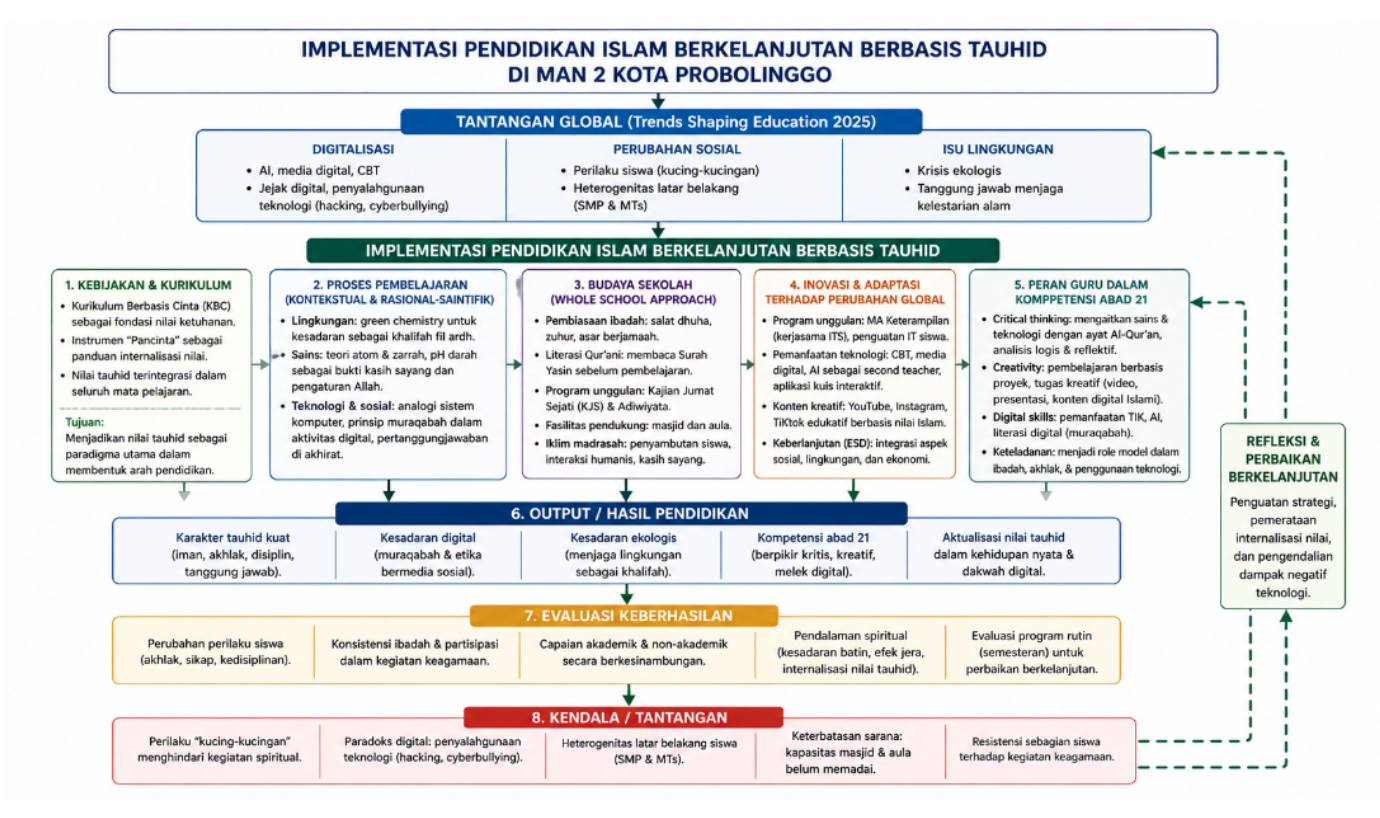
This study aims to analyse the integration of Tawhid values in the implementation of sustainable Islamic education and its application in addressing the global challenges of Trends Shaping Education 2025 at MAN 2 Kota Probolinggo. The background of this study is based on the gap between the ideal concept of Islamic education grounded in Tawhid values and the learning practices in madrasahs, which still tend to be cognitively oriented and have not fully integrated the principles of sustainability and global challenges. This study employed a qualitative approach using a case study design. Data were collected through participant observation, in-depth interviews, and documentation, and were subsequently analysed using the Miles, Huberman, and Saldaña model, which includes data reduction, data display, and conclusion drawing.
The findings reveal that the integration of Tawhid values at MAN 2 Kota Probolinggo is carried out systematically and multidimensionally through policies, curriculum, learning processes, and school culture. This implementation is reflected in religious habituation, the application of the Love-Based Curriculum (KBC), and contextual learning that connects Tawhid values with contemporary issues such as technology and the environment. Furthermore, sustainable Islamic education in this madrasah demonstrates an adaptive character in responding to global challenges, particularly in the areas of digitalisation, social change, and environmental sustainability, without neglecting Islamic values as its foundation. Nevertheless, several obstacles remain in its implementation, including the heterogeneity of students’ backgrounds, the negative impact of digital technology, and the uneven internalisation of Tawhid values across institutional aspects.
In conclusion, sustainable Islamic education based on Tawhid values at MAN 2 Kota Probolinggo represents a transformative educational model capable of integrating spiritual dimensions with global demands. This model has the potential to become an alternative framework for developing Islamic education that is adaptive, integrative, and oriented towards nurturing a generation that is faithful, morally grounded, and globally competitive.
Downloads
Article Details

This work is licensed under a Creative Commons Attribution-ShareAlike 4.0 International License.
Authors continue to retain the copyright to the article if the article is published in the Jurnal Hadratul Madaniyah. They will also retain the publishing rights to the article without any restrictions.
Authors who publish in this journal agree to the following terms:
- Any article on the copyright is retained by the author(s).
- The author grants the journal the right of first publication with the work simultaneously licensed under a Creative Commons Attribution License that allows others to share work with an acknowledgment of the work authors and initial publications in this journal.
- Authors can enter into separate, additional contractual arrangements for the non-exclusive distribution of published articles (e.g., post-institutional repository) or publish them in a book, with acknowledgment of their initial publication in this journal.
- Authors are permitted and encouraged to post their work online (e.g., in institutional repositories or on their websites) before and during submission. This can lead to productive exchanges and earlier and greater citations of published work.
- The article and any associated published material are distributed under the Creative Commons Attribution-ShareAlike 4.0 International License.
References
Aminuddin, M. F., Falah, M. R., Salamat, N. S., Suryadi, N. P. P., Sriwahyuni, R. A., Parhan, M., & Syahidin, S. (2024). Paradigma Konsep Pendidikan Hadhari Dalam Pendidikan Islam. Edukatif Jurnal Ilmu Pendidikan, 6(2), 1066–1080. https://doi.org/10.31004/edukatif.v6i2.6194
Ansori, M. (2021). Pengembangan Kurikulum Madrasah Di Pesantren. Munaddhomah Jurnal Manajemen Pendidikan Islam, 1(1), 41–50. https://doi.org/10.31538/munaddhomah.v1i1.32
Dalimunthe, D. S. (2023). Transformasi Pendidikan Agama Islam: Memperkuat Nilai-Nilai Spiritual, Etika, Dan Pemahaman Keislaman Dalam Konteks Modern. Al-Murabbi, 1(1), 75–96. https://doi.org/10.62086/al-murabbi.v1i1.426
Dewi, C. S., Putri, M. A., & Amrillah, R. (2024). Integrasi Ilmu Keislaman Dengan Ilmu Pendidikan Anak Usia Dini Dalam Perspektif Muhammad Amin Abdullah. Paud, 1(3), 8. https://doi.org/10.47134/paud.v1i3.575
Fullan, M. (2016). The New Meaning of Educational Change. Teachers College Press. https://books.google.co.id/books?id=OlhdCwAAQBAJ
Hudia, T., Supriadi, S., Yolanda, D. D., Rahmaditha, K., & Alkaf, R. (2023). Islamic Education in the Era of Disruption. Gic, 1, 237–241. https://doi.org/10.30983/gic.v1i1.172
Kioupi, V., & Voulvoulis, N. (2019). Education for Sustainable Development: A Systemic Framework for Connecting the SDGs to Educational Outcomes. Sustainability, 11(21), 6104. https://doi.org/10.3390/su11216104
Kotter, J. P. (1996). Leading Change. Harvard Business School Press. https://books.google.co.id/books?id=ib9Xzb5eFGQC
Maryati, S., Lestarika, L., Idi, A., & Samiha, Y. T. (2023). Madrasah as an Institution of Islamic Education and Social Change. Jurnal Konseling Pendidikan Islam, 4(2), 317–326. https://doi.org/10.32806/jkpi.v4i2.11
Moleong, L. J. (2017). Metodologi Penelitian Kualitatif. Remaja Rosdakarya.
Muin, A., Rosyid, M. Z., Rahman, H., & Rofiqi, R. (2025). Ecological Tauhid-Based Green School Management: A Case Study of Eco-Pesantren Implementation at Mambaul Ulum Islamic Junior High School, Pamekasan. EDUKASIA Jurnal Pendidikan Dan Pembelajaran, 6(1), 551–562.
Nurfalah, Y. (2014). Urgensi Pendidikan Tauhid Dalam Keluarga. Tribakti Jurnal Pemikiran Keislaman, 25(2), 338–347. https://doi.org/10.33367/tribakti.v25i2.190
OECD. (2025). Trends Shaping Education 2025. OECD Publishing. https://doi.org/10.1787/ee6587fd-en
Qolbiyah, A., M, A. M. A., & Zulhendri, Z. (2023). Konsep Integrasi Agama Dan Sains Makna Dan Sasarannya. Jurnal Basicedu, 7(3), 1924–1934. https://doi.org/10.31004/basicedu.v7i3.5711
Rahman, N. A., Zabidi, F. N. M., Othman, M. Y., Halim, L., Iksan, Z., & Abdullah, W. N. W. (2019). Conceptual Framework for Integration of Tauhidic Elements for Environmental Conservation (TEFEC): A Review. International Journal of Academic Research in Progressive Education and Development, 8(3). https://doi.org/10.6007/IJARPED/v8-i3/6265
Salsabila, U. H., Spando, I. I. T., Astuti, W. D., Rahmadia, N. A., & Nugroho, D. W. (2023). Integrasi Teknologi Informasi Dan Komunikasi Dalam Bidang Pendidikan Islam. Jurnal Pendidikan, 11(1), 172–177. https://doi.org/10.36232/pendidikan.v11i1.3207
Suryana, E., Aprina, M. P., & Harto, K. (2022). Teori Konstruktivistik Dan Implikasinya Dalam Pembelajaran. Jiip - Jurnal Ilmiah Ilmu Pendidikan, 5(7), 2070–2080. https://doi.org/10.54371/jiip.v5i7.666
Tilbury, D., & Henderson, K. (2004). Whole-school approaches to sustainability: an international review of whole-school sustainability programs. https://api.semanticscholar.org/CorpusID:268429224
UNESCO. (2017). Education for Sustainable Development Goals: learning objectives. UNESCO. https://unesdoc.unesco.org/notice?id=p::usmarcdef_0000247444
Wahid, L. A., & Hamami, T. (2021). Tantangan Pengembangan Kurikulum Pendidikan Islam Dan Strategi Pengembangannya Dalam Menghadapi Tuntutan Kompetensi Masa Depan. J-Pai Jurnal Pendidikan Agama Islam, 8(1). https://doi.org/10.18860/jpai.v8i1.15222