Inclusive Education Management and the Development of Multicultural School Culture: A Case Study of MAN 2 Sleman
Article Sidebar
Main Article Content
Abstract
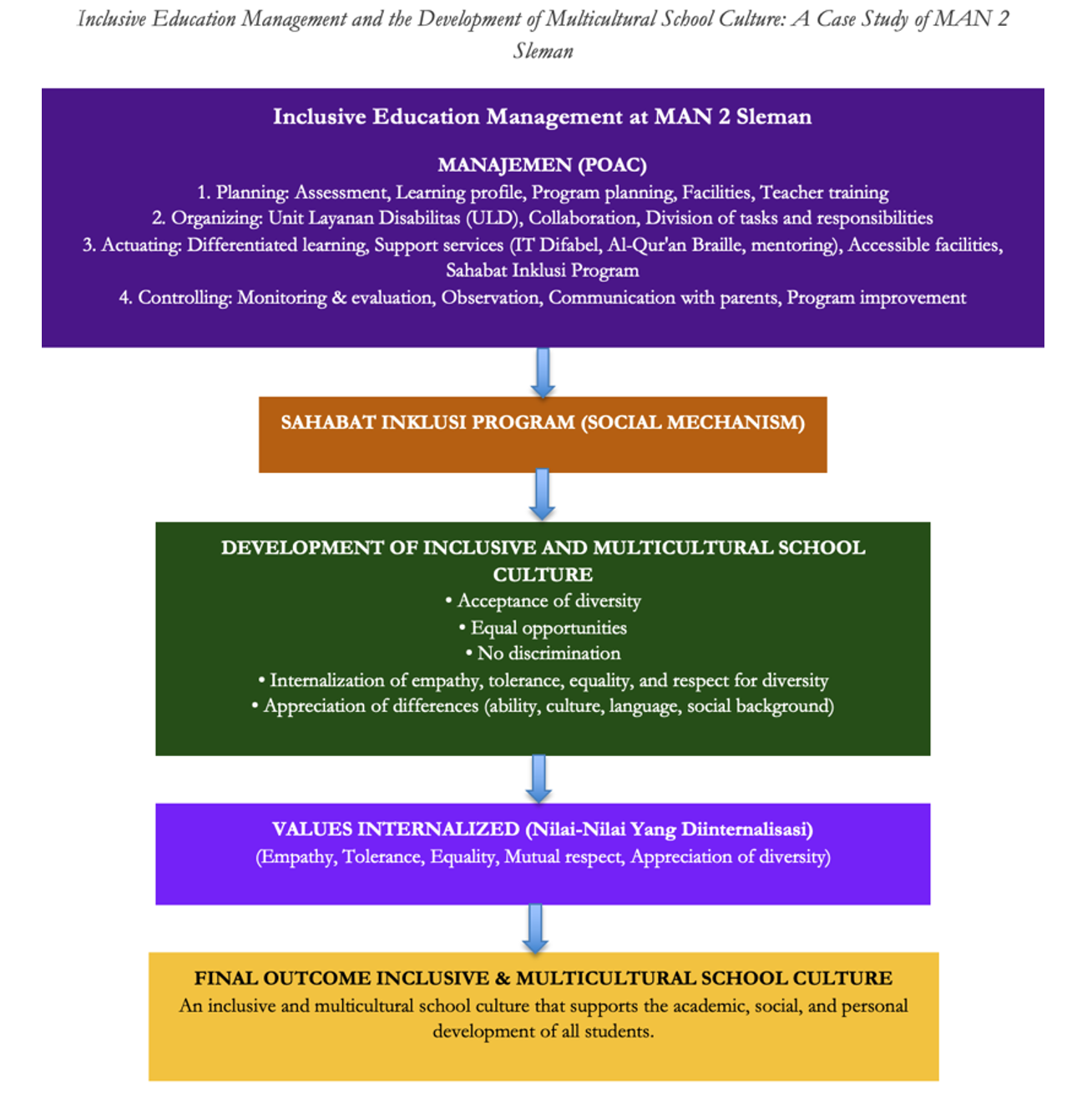
Inclusive education not only aims to provide equal access to education for students with special needs, but also plays a role in building an inclusive and multicultural learning environment. However, studies on the role of inclusive education management in shaping social and cultural interactions at school are still limited, especially in the madrasah context. This study aims to analyze the implementation of inclusive education management and its role in building inclusive and multicultural social and cultural interactions at MAN 2 Sleman. This study uses a qualitative approach with a case study design. The research subjects consisted of the madrasah principal, teachers, managers of the Disability Services Unit (ULD), students with special needs, and regular students. Data were collected through interviews, observations, and documentation, then analyzed using an interactive model that includes data reduction, data presentation, and drawing conclusions. The results show that inclusive education management has been implemented systematically through the functions of planning, organizing, actuating, and controlling. This implementation is realized through student needs assessments, the establishment of Disability Service Units, differentiated learning, inclusive classes, the Inclusive Friend program, IT services for the Disabled, Braille Quran learning, and ongoing evaluation and monitoring. Inclusive education management also plays a role in building social interactions characterized by the development of empathy, tolerance, cooperation, and respect for diversity. These interactions then develop into an inclusive and multicultural school culture reflected in equal access, active student participation, and minimal discriminatory practices. These findings indicate that inclusive education management functions not only as a service system for students with special needs, but also as a strategic instrument in building an inclusive and multicultural school culture. Therefore, strengthening teacher competencies, accessibility facilities, and collaboration with various stakeholders need to be continuously improved.
Downloads
Article Details

This work is licensed under a Creative Commons Attribution-ShareAlike 4.0 International License.
Authors continue to retain the copyright to the article if the article is published in the Jurnal Hadratul Madaniyah. They will also retain the publishing rights to the article without any restrictions.
Authors who publish in this journal agree to the following terms:
- Any article on the copyright is retained by the author(s).
- The author grants the journal the right of first publication with the work simultaneously licensed under a Creative Commons Attribution License that allows others to share work with an acknowledgment of the work authors and initial publications in this journal.
- Authors can enter into separate, additional contractual arrangements for the non-exclusive distribution of published articles (e.g., post-institutional repository) or publish them in a book, with acknowledgment of their initial publication in this journal.
- Authors are permitted and encouraged to post their work online (e.g., in institutional repositories or on their websites) before and during submission. This can lead to productive exchanges and earlier and greater citations of published work.
- The article and any associated published material are distributed under the Creative Commons Attribution-ShareAlike 4.0 International License.
References
‘Aini, A. N., Aziz, K. Z., & Nazihah, K. (2024). Evaluasi dan Tindak Lanjut Pengawasan Pendidikan. Al- Mumtaz: Jurnal Manajemen Pendidikan Islam, 1(2), 10–13. https://doi.org/10.47945/Al-Mumtaz.v1i2.xx
Agustin, R. D., Zakiah, L., Hasanah, A., Faruqi, M. I., & Ashri, C. (2024). Implementasi Pendidikan Multikultural Pada Anak Berkebutuhan Khusus di Sekolah Dasar Inklusi. Jurnal Ilmiah Profesi Pendidikan, 9, 875–882. https://doi.org/10.29303/jipp.v9i2.2217
Arifah, I. N., Untari, S., Nugroho, A. C., & Widyasari, C. (2024). Manajemen Pendidikan Inklusi di Sekolah Dasar. Jurnal Basicedu, 8(4), 2561–2567. https://doi.org/10.31004/basicedu.v8i4.7870
Arikarani, Y., Suradi, Ngimadudin, & Wulandari, Y. (2024). Pendidikan Agama Islam Multikultural: Konsep, Nilai dan Praktiknya di Lingkungan Madrasah. Edification Journal: Pendidikan Agama Islam, 7(2), 233–254. https://doi.org/10.37092/ej.v7i2.993
Azzahra, A. H., Safitri, D., & Sujarwo. (2024). Peran Teknologi Non-Visual Desktop Access ( NVDA ) Untuk Siswa Tunanetra dalam Proses Pembelajaran. Jurnal Teknologi Pendidikan, 1(4), 1–7. https://doi.org/10.47134/jtp.v1i4.606
Banks, J. A., & Banks, C. A. M. (2015). Multicultural Education: Issues and Perspectives (9th ed.). Wiley.
Cabatay, M. M., & Aningrum, R. (2024). Contributing Factors to the Progress of Inclusive Education Implementation in Indonesia : A Scoping Review. INKLUSI: Journal of Disability Studies, 11(01). https://doi.org/10.14421/ijds.110103
Fatah, M. H. N. Al, Husna, D., Minulyo, M. H., & Daizona, R. (2023). Pelaksanaan Manajemen Pendidikan Inklusi di MAN 2 Sleman. (JOUMI):Jurnal Multidisiplin Indonesia, 1(3). https://doi.org/10.62007/joumi.v1i3.215
Hernawati, Hadiyanto, A., & Amaliyah. (2025). Integrasi Nilai-Nilai Multikultural Dalam Pembelajaran Pendidikan Agama Islam (Studi SMAN 14 Jakarta). Jurnal Penelitian Ilmu Pendidikan Indonesia, 4, 1645–1653. https://doi.org/10.31004/jpion.v4i3.650
Ichsan, R. S., & Rofiq, M. (2026). Konstruksi Sosial Pengetahuan dalam Pembelajaran : Tinjauan Teoretis dan Implikasinya Bagi Pendidikan. Socius: Jurnal Penelitian Ilmu-Ilmu Sosial, 3(7), 212–216. https://doi.org/10.5281/zenodo.18522523
Imanudin, I., & Septiana, F. I. (2025). Upaya Guru dalam Meningkatkan Kemampuan Membaca Al- Qur ’ an Braille pada Peserta Didik Tunanetra di SLBN Kabupaten Kuningan. IQRO: Journal of Islamic Education, 8(3), 952–965. https://doi.org/10.24256/iqro.v8i3.7898
Iryani, E., Hufad, A., & Rusdiyani, I. (2023). Efektivitas Model Pembelajaran Inklusif Terintegrasi Model Pembelajaran Differensiasi pada Sekolah Dasar Inklusi. Research and Development Journal Of Education, 9(2), 968–976. https://doi.org/10.30998/rdje.v9i2.19505
Karina, A., Riadurrahman, T., Khairunnisa, S. N., Maftuhah, & Taufiqurrahman. (2025). Strategi perencanaan dalam manajemen pendidikan: sebuah kajian teoretis. Pedagogy: Jurnal Ilmiah Ilmu Pendidikan, 12(2), 7–15. https://e-journal.upm.ac.id/index.php/pedagogy/article/view/63/128
Miles, M. B., Huberman, A. M., & Saldaña, J. (2014). Qualitative Data Analysis: A Methods Sourcebook (3rd ed.). SAGE Publications.
Morgan, H. (2024). Using Triangulation and Crystallization to Make Qualitative Studies Trustworthy and Rigorous. Qualitative Report, 29(7), 1844–1856. https://doi.org/10.46743/2160-3715/2024.6071
Nadhiroh, U., & Ahmadi, A. (2024). Pendidikan Inklusif: Membangun Lingkungan Pembelajaran Yang Mendukung Kesetaraan Dan Kearifan Budaya. Ilmu Budaya: Jurnal Bahasa, Sastra, Seni, Dan Budaya, 8(2008), 11–22. https://doi.org/10.30872/jbssb.v8i1.14072
Nawawi, M., Fatkhiyah, M., & Sopiah. (2024). Manajemen Pengorganisasian dalam Pendidikan Islam. Jurnal Manajemen Pendidikan, 9(1), 22–33. https://doi.org/10.34125/jmp.v9i1.252 This
Ningsih, A., Suriansyah, A., Harsono, A. M. B., Annisa, M., & Novitawati. (2024). Kolaborasi Guru Kelas dan Guru Pendamping dalam Meningkatkan Kualitas Pembelajaran Inklusif. Joyful Learning Journal, 13(4), 101–109. https://journal.unnes.ac.id/journals/jlj/article/view/18071/2625
Nurfand, L. N., Simamora, N. H. P., & Meilana, S. F. (2025). Kolaborasi Guru dan Orang Tua dalam Penerapan Metode Pembelajaran Berdiferensiasi untuk Anak Berkebutuhan Khusus di Kelas Inklusif. Pendas : Jurnal Ilmiah Pendidikan Dasar, 10. https://doi.org/10.23969/jp.v10i01.22040
Nurhikmah. (2021). Educational Management Functions: Planning, Organizing, Actuating, Controlling. INTIHA: Islamic Education Journal, 1. https://doi.org/10.58988/intiha.v1i2.293
Pramono, M. S., Tampake, T., Lattu, I. Y. M., & Molewe, A. C. (2024). Peter L . Berger and Thomas Luckmann ’ s social construction of the institutionalization of tolerance values in the Nyadran Perdamaian tradition. AL MA’ARIEF: Jurnal Pendidikan Sosial Dan Budaya, 6. https://doi.org/10.35905/almaarief.v6i1.9759
Putri, V. A., & Suharjanto, L. (2025). Minority Ethnic Students’ Experiences in Multicultural Education: A Study Based on Banks’ Five Dimensions at an Elite Catholic High School in Surabaya. IJLECR (International Journal of Language Education and Cultural Review), 11(2), 190–203. https://doi.org/10.21009/ijlecr.v11i2.60566
Ramadhan, A. F., & Maryani, I. (2024). Management of inclusive education in public schools. Jurnal Pendidikan Inklusi, 8, 67–77. https://doi.org/10.26740/inklusi.v8n1.p67-77
Republik Indonesia. (2016). Undang-Undang Nomor 8 Tahun 2016 tentang Penyandang Disabilitas. https://jdihn.go.id/pencarian/detail/1325881/index
Siagian, Y. M. P., Gultom, B. T., Gultom, M. B., Simanjuntak, B., & Marpaung, R. E. S. M. (2026). Implementasi Pembelajaran Diferensiasi Bagi Siswa Berkebutuhan Khusus di Sekolah Inklusi di Sekolah Dasar. Pendas : Jurnal Ilmiah Pendidikan Dasar, 11, 194–207. https://doi.org/10.23969/jp.v11i01.42605
Sugiyono. (2017). Metode Penelitian Kuantitatif, Kualitatif, dan RND. Alfabeta.
UNESCO. (2020). Global Education Monitoring Report 2020: Inclusion and Education: All Means All. https://unesdoc.unesco.org/ark:/48223/pf0000373718
Wijayanti, N., & Wicaksana, F. A. (2023). Implementasi Fungsi Manajemen George R Terry dalam Meningkatakan Mutu Lembaga Pendidikan. Jurnal Cerdik: Jurnal Pendidkan Dan Pengajaran, 3, 30–43. https://doi.org/10.21776/ub.jcerdik.202
Windayani, N. L. I., Dewi, N. W. R., Laia, B., Sriartha, I. P., & Mudana, W. (2024). Membangun Kesadaran Multikultural Melalui Implementasi Model Pendidikan Inklusif di Sekolah. Jurnal Ilmiah Pendidikan Citra Bakti, 11, 383–396. https://doi.org/10.38048/jipcb.v11i2.2889
Yawati, Y. S., Bakri, N., Elya, Z., Asmendri, & Sari, M. (2023). Konsep perencanaan pendidikan inklusif di sekolah dasar. Jurnal Diklat Review, 7(137). https://doi.org/10.35446/diklatreview.v7i3.1593