Multimodal Practices in Tahfizh Al-Qur’an Learning at SMP Islam Ar-Rahmah: An Analysis within the VARK Framework
Article Sidebar
Main Article Content
Abstract
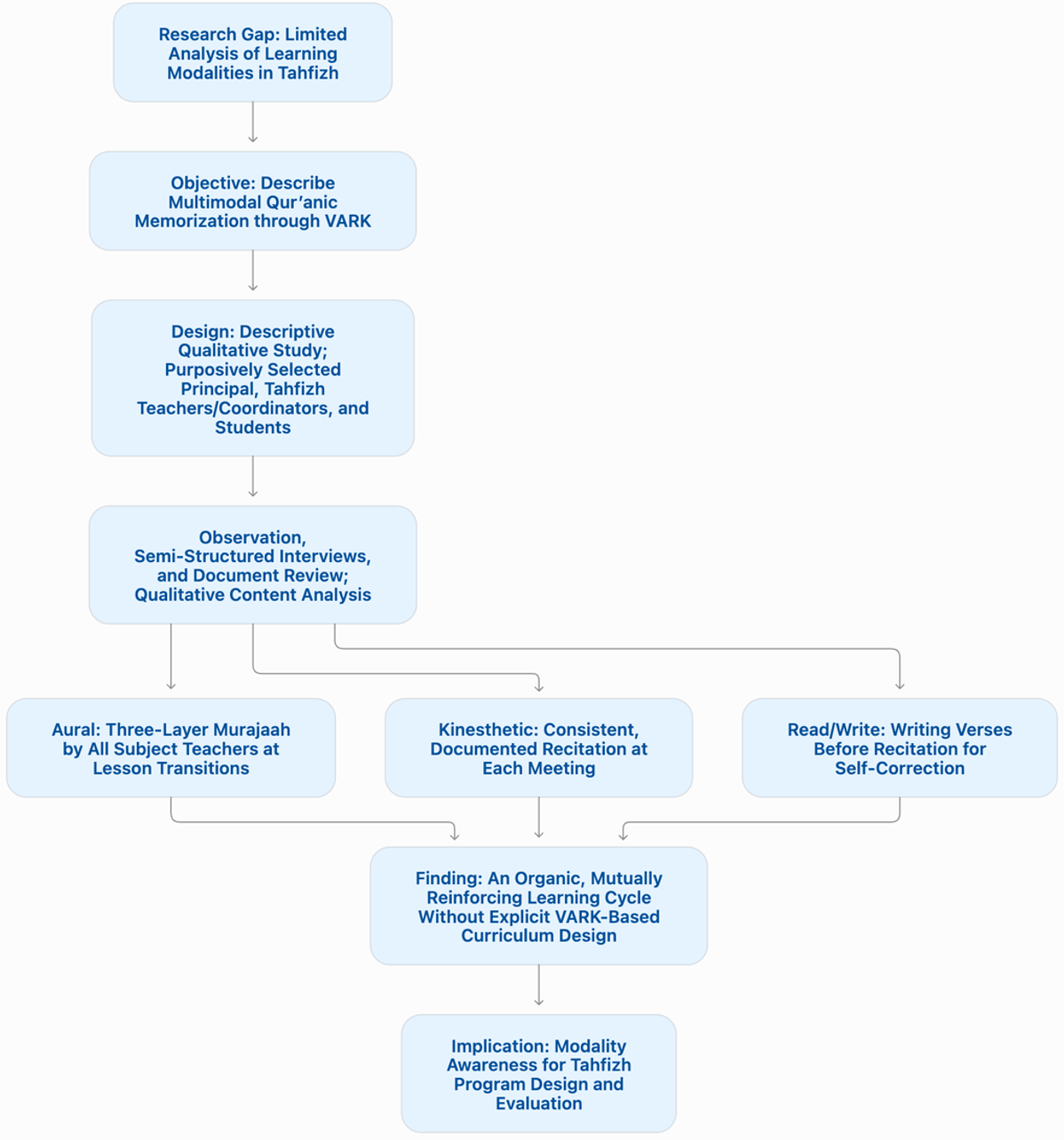
The tahfizh program in formal schools has evolved into a learning process involving multiple methods. However, analysis of how these methods work from the perspective of students’ learning modalities is still very limited. This study aims to describe the implementation of multimodal-based Qur’anic memorization learning at SMP Islam Ar-Rahmah, Semarang Regency, within the VARK framework. This study uses a descriptive qualitative approach with purposively selected research subjects, including the principal, teachers who are also tahfizh coordinators, and students. Data were collected through observation, semi-structured interviews, and document reviews, then analyzed using qualitative content analysis. The results show that the tahfizh program at SMP Islam Ar-Rahmah naturally reflects three VARK modalities simultaneously: the aural modality through three layers of murajaah involving all subject teachers at each lesson change; the kinesthetic modality through a consistent recitation system at each formally documented meeting; and the read/write modality through the activity of writing verses before recitation which functions as a self-correction mechanism. These three modalities operate in a mutually reinforcing cyclical flow. These findings demonstrate that multimodal learning can develop organically within formal school memorization programs without a curriculum design that explicitly refers to VARK theory. They suggest thatawareness of learning modalities can serve as a foundation for designing and evaluating tahfizh program more effectively.
Downloads
Article Details

This work is licensed under a Creative Commons Attribution-ShareAlike 4.0 International License.
Authors continue to retain the copyright to the article if the article is published in the Jurnal Hadratul Madaniyah. They will also retain the publishing rights to the article without any restrictions.
Authors who publish in this journal agree to the following terms:
- Any article on the copyright is retained by the author(s).
- The author grants the journal the right of first publication with the work simultaneously licensed under a Creative Commons Attribution License that allows others to share work with an acknowledgment of the work authors and initial publications in this journal.
- Authors can enter into separate, additional contractual arrangements for the non-exclusive distribution of published articles (e.g., post-institutional repository) or publish them in a book, with acknowledgment of their initial publication in this journal.
- Authors are permitted and encouraged to post their work online (e.g., in institutional repositories or on their websites) before and during submission. This can lead to productive exchanges and earlier and greater citations of published work.
- The article and any associated published material are distributed under the Creative Commons Attribution-ShareAlike 4.0 International License.
References
Anggoro, I. D., Suhendro, P. P. M., Fahrurrozi, & Hasanah, U. (2024). Analisis Gaya Belajar Siswa dalam Mengoptimalkan Pemahaman Siswa: Studi Deskriptif di SD Negeri Klender 10. Ideguru: Jurnal Karya Ilmiah Guru, 9(3), 1686–1692. https://doi.org/10.51169/ideguru.v9i3.1067
Ardiansyah, Waston, Mahmuddulhassan, Daud, Z., Salleh, N. M., Nirwana AN, A., & Muthoifin. (2024). Tracing Trends in Quran Memorization and Cognitive Learning: A Bibliometric Analysis from the Scopus Database. Pakistan Journal of LIfe and Social Sciences, 22(2), 1493–1509. https://doi.org/https://doi.org/10.57239/PJLSS-2024-22.2.00105
Chew, M., Murat, R., & Justine, K. (2023). Tahfidz Al-Quran Learning Methods With Superior Class Programs. Journal Neosantara Hybrid Learning, 1(1), 37–53. https://doi.org/10.55849/jnhl.v1i1.83
Demberel, T., & Baasanjav, U. (2025). Identifying Learners Learning Styles Using the VARK Model. International Journal of Innovative Technologies in Social Science, 2(46), 1–10. https://doi.org/10.31435/ijitss.2(46).2025.3423
Fleming, N., & Baume, D. (2006). Learning Styles Again: VARKing up the Right Tree! Educational Developments, 7, 4–7.
Fleming, N. D., & Mills, C. (1992). Not Another Inventory, Rather a Catalyst for Reflection. To Improve the Academy: A Journal of Educational Development, 11(1), 137–155.
Haris, A., Aljauhari, S., & Faisal. (2024). Model Pembelajaran Tahfidz dalam Pembentukan Karakter Siswa Madrasah Tsanawiyah. Jurnal Hadratul Madaniyah, 11(1), 10–18.
Husna, A., Hasanah, R., & Nugroho, P. (2021). Efektivitas Program Tahfidz Al-Qur’an dalam Membentuk Karakter Siswa. Jurnal Isema: Islamic Educational Menagement, 6(1), 47–54. https://doi.org/10.15575/isema.v6i1.10689
Ikhsan, A. N., Jumrodah, J., & Zulkarnain, A. I. (2025). Implementasi Kinestetik dalam Pendidikan Agama Islam: Solusi Efektif untuk Pembelajaran Praktik. Jurnal Intelektualita: Keislaman, Sosial, dan Sains, 14(1), 1–12. https://doi.org/10.19109/intelektualita.v14i1.27657
Markhabi, F., Nurmawati, & Salminawati. (2024). Efektivitas Program Tahfizh Al- Qur’an di SMP Tahfizh Azhar Centre. Didaktika: Jurnal Kependidikan, 13(1), 441–454. https://doi.org/10.58230/27454312.512
Mu’minatun, D. I., & Misbah, M. (2022). Metode Tikrar dalam Pembelajaran Tahfidz Al- Qur’an di Pondok Pesantren Modern Darul Qur’an Al-Karim Baturraden. Jurnal Ilmiah Mandala Education (JIME), 8(2), 1332–1338. https://doi.org/10.36312/jime.v8i2.3070
Mustafa, N. M., Zaki, Z. M., Mohamad, K. A., Basri, M., & Ariffin, S. (2021). Development and Alpha Testing of EzHifz Application: Al-Quran Memorization Tool. Advances in Human-Computer Interaction, 5567001, 10 pages. https://doi.org/10.1155/2021/5567001
Othman, N., & Amiruddin, M. H. (2010). Different Perspectives of Learning Styles from VARK Model. Procedia: Social and Behavioral Sciences, 7(C), 652–660. https://doi.org/10.1016/j.sbspro.2010.10.088
Pitambara, S., Rasyid, M. R., Hermanto, & Khairi, A. (2025). Implementasi Multimodal Learning sebagai Strategi Unggul dalam Penguatan Hafalan Al- Qur’an: Studi di PPTQ Fahd Al-Muslim Sorong. Cognitive Insight in Education, 1(1), 9–24.
Rakhmayanti, F. Z., Sudadi, Salim, A., Adib, S., & Fatimah, S. (2025). Management of Excellence Tahfidz Program in Increasing Al-Quran Memorization in Islamic Elementary School. International Journal of Scietific Multidisiplinary Research (IJSMR), 4(9), 1261–1274.
Ratnawati, R., Purwoko, L. F., Majid, A., Pekei, M., & Purwoko, B. (2024). Manajemen Program Tahfidz dalam Pembentukan Karakter Santri: Studi di Sekolah Menengah Pertama Plus Nurul Hikmah Pamekasan. re-JIEM: Research Journal of Islamic Education Management, 7(2), 362–379. https://doi.org/10.19105/re-jiem.v7i2.16125
Rohmah, N. F., & Nursikhin, M. (2023). Pelaksanaan Program Unggulan Tahfidz Al-Qur’an dalam Penanaman Karakter Disiplin dan Adversity Quotient Siswa Kelas VII Madrasah Tsanawiyah Negeri 1 Kudus. Jurnal Penelitian dan Pemikiran Islam, 10(2), 176–186.
Rohmah, S., Iman, F., & Muslihah, E. (2022). Implementasi Metode Pengembangan Muroja’ah dan Tahsin pada Program Tahfidz Al-Qur’an dalam Upaya Mempertahankan Hafalan Al-Qur’an: Studi di Pondok Pesantren Daar El-Qolam 4. Teaching: Jurnal Inovasi Keguruan dan Ilmu Pendidikan, 2(3), 316–326.
Rustiana, D., & Ma’arif, M. A. (2022). Manajemen Program Unggulan Tahfidz Qur’an dalam Meningkatkan Kualitas Hafalan Al-Qur’an Siswa. Kharisma: Jurnal Administrasi dan Manajemen Pendidikan, 1(1), 12–24.
Salsabillah, Z., & Jinan, M. (2026). Optimalisasi Program Tahfidz Al-Qur’an: Analisis Implementasi dan Hambatan di SMP Muhammadiyah Al-Kautsar Kartasura. Instructional Development Journal (IDJ), 9(1), 32–40.
Sandelowski, M. (2000). Focus on Research Methods Whatever Happened to Qualitative Description? Research in Nursing & health, 23, 334–340.
Santoso, B., & Khaudli, I. (2025). Tahfidz Curriculum Management: An Analysis of the Integration of Qur’anic Values Into the Educational System. Kalijaga: Jurnal Penelitian dan Multidisiplin Mahasiswa, 2(3), 89–97. https://doi.org/10.62523/kalijaga.v2i3.47
Sucia, I., Aliyah, A., & Rosadi, A. (2025). Penerapan Metode Muroja’ah pada Mata Pelajaran Tahfidz dalam Meningkatkan Kemampuan Menghafal Al-Qur’an. Jurnal Manajemen Pendidikan, 13(2), 127–135. https://doi.org/10.33751/jmp.v13i1.11869
Susiatun. (2025). Strategi Guru Tahfidz dalam Meningkatkan Kualitas Hafalan Al-Qur’an Siswa-Siswi di SDTQ Al-Fajri Sawangan, Depok. At-Taklim: Jurnal Pendidikan Multidisipli, 2(11), 425–437. https://doi.org/10.71282/at-taklim.v2i11.1209