Reconstructing Contemporary Islamic Thought to Address the Moral Crisis of the Digital Generation
Article Sidebar
Main Article Content
Abstract
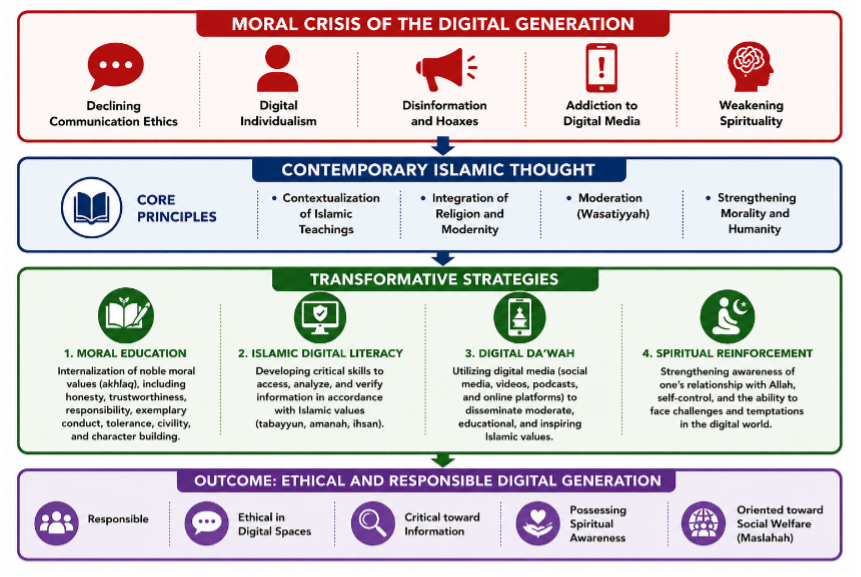
The development of digital technology has changed the patterns of social interaction, access to information, and the construction of values among the younger generation. While digitalization opens up opportunities for the development of knowledge and creativity, it also raises various moral problems, such as a decline in communication ethics, increased individualism, the spread of disinformation, and the weakening of the internalization of religious values. This article aims to analyze the relevance of contemporary Islamic thought in responding to the moral crisis of the digital generation through an adaptive approach to technological developments without neglecting Islamic ethical principles. This research uses a descriptive-analytical literature study method, analyzing various literature discussing contemporary Islamic thought, morality, and digital transformation. The results of the study indicate that contemporary Islamic thought offers an integrative paradigm that connects the strengthening of morals, critical digital literacy, religious moderation, and the development of spirituality as the foundation for character formation. Technology is viewed not as a threat to Islamic values, but as a strategic instrument that needs to be guided through ethical awareness and social responsibility. Thus, the moral reconstruction of the digital generation requires a synergy between Islamic character education, strengthening digital literacy, and the internalization of universal human values
Downloads
Article Details

This work is licensed under a Creative Commons Attribution-ShareAlike 4.0 International License.
Authors continue to retain the copyright to the article if the article is published in the Jurnal Hadratul Madaniyah. They will also retain the publishing rights to the article without any restrictions.
Authors who publish in this journal agree to the following terms:
- Any article on the copyright is retained by the author(s).
- The author grants the journal the right of first publication with the work simultaneously licensed under a Creative Commons Attribution License that allows others to share work with an acknowledgment of the work authors and initial publications in this journal.
- Authors can enter into separate, additional contractual arrangements for the non-exclusive distribution of published articles (e.g., post-institutional repository) or publish them in a book, with acknowledgment of their initial publication in this journal.
- Authors are permitted and encouraged to post their work online (e.g., in institutional repositories or on their websites) before and during submission. This can lead to productive exchanges and earlier and greater citations of published work.
- The article and any associated published material are distributed under the Creative Commons Attribution-ShareAlike 4.0 International License.
References
A, Y. M., Ariesmansyah, A., Indrianie, M., Arifin, R. K., & Lastari, R. (2024). Dinamika Digital Governance : Antara Teori dan Praktek di Era 4.0 (Cetakan Pe; Y. Agusdi, ed.). Jambi: PT. Sonpedia Publishing Indonesia. https://doi.org/https://books.google.co.id/
Agustina, A. P. (2024). Perubahan Pola Komunikasi Keluarga Di Era Digital. Global Komunika : Jurnal Ilmu Sosial Dan Ilmu Politik, 6(2), 73–80. https://doi.org/10.33822/gk.v6i2.6498
Akalily Narmi, Mohd. Zariat Abdul Rani, K. K. (2022). Sumbangan Shah Waliyullah Al-Dihlawi dalam Perkembangan Intelektual Islam di Malaysia: Beberapa Perkembangan Mutakhir. Journal of Al-Tamaddun, 9(1), 356–363.
Al-Haq, H., & Amalih, I. (2021). Keadilan Sosial Dalam Al-Qur’an (Tela’Ah Atas Penafsiran Buya Hamka Dalam Tafsir Al-Azhãr). El-Waroqoh : Jurnal Ushuluddin Dan Filsafat, 5(2). https://doi.org/10.28944/el-waroqoh.v5i2.315
Anggara, R. C., & Muttaqin, M. I. (2025). Kehidupan Sosial dan Dinamika Domestik Keluarga di Timur Tengah : Sebuah Analisis Historis , Sosiokultural , dan Teoretis. Al-Ikhtiar: Jurnal Studi Islam, 2(1), 280–291. https://doi.org/https://doi.org/10.71242/0yqjn912
Dakhoir, A., & Tarantang, J. (2023). FIKIH WASATHIYAH IQTISHADIYAH : (Pengembangan Teori Hukum Islam di Bidang Perbankan). Yogyakarta: K-Media.
Dimas Taufiqurahman, Rangga Saputra, I. D. (2025). RUANG LINGKUP KAJIAN AYAT – AYAT AKHLAK DALAM ILMU TAFSIR: ANALISIS METODOLOGIS. MUSHAF JOURNAL : Jurnal Ilmu Al Quran Dan Hadis, 5(2), 324–330.
Dini Ramdhani, & Pramono pramono. (2024). Memanfaatkan Kekuatan Ekonomi 5.0: Peluang dan Tantangan untuk Transformasi Bisnis. Jurnal Kajian Dan Penalaran Ilmu Manajemen, 2(2), 110–123. https://doi.org/10.59031/jkpim.v2i2.410
Fauzan, F. (2020). Progressive Law Paradigm in Islamic Family Law Renewal in Indonesia. Jurnal Ilmiah Mizani: Wacana Hukum, Ekonomi Dan Keagamaan, 7(2), 187. https://doi.org/10.29300/mzn.v7i2.3617
Fauzi, A., Elmi, I., Pelu, A. S., & Suhairom, N. (2023). Local Wisdom of Pesantren as Core Value in Building an Islamic Education Organizational Culture in Indonesia. Cendekia: Jurnal Kependidikan Dan Kemasyarakatan, 21(1), 16–28. https://doi.org/https://doi.org/10.21154/cendekia.v21i1.6065
Haq, I. A. (2026). Integrasi Nilai-Nilai Ulul Albab dalam Pendidikan Karakter sebagai Strategi Pembentukan Generasi Emas Indonesia 2045. 2(1), 11–31.
Muhammad Suherman, M. H. (2025). TRANSFORMATION OF MADRASAH GOVERNANCE THROUGH THE IMPLEMENTATION OF CHANGE AGENTS IN INTEGRITY ZONE DEVELOPMENT. An--Nuha., 12(02), 401–425.
Mujianto, H., & Nurhadi, Z. F. (2022). Dampak Literasi Media Berbasis Digital Terhadap Perilaku Anti Penyebaran Hoaks. Alhadharah: Jurnal Ilmu Dakwah, 21(1), 31. https://doi.org/10.18592/alhadharah.v21i1.6419
Mukhlis, M. H., & Syaifuddin, M. (2024). Konsep Pendidikan Islam Prespektif KH Abdurrahman Wahid. Jurnal Praktek Pembelajaran Dan Pengembangan Pendidikan, 3(3), 265–272. https://doi.org/10.58737/jpled.v4i3.379
Musa Sahat, T., Wulandari, U., Marito Sari, S., & Raihana, R. (2023). Tinjauan Terhadap Modus-Modus Kejahatan Dalam Hukum Cyber Crime. Jurnal Hukum Dan Sosial Politik, 1(2), 60–67. https://doi.org/10.59581/jhsp-widyakarya.v1i2.239
Muzni, N., & Budiman, D. A. (2021). Studi Social Judgment Perilaku Gen-Z Di Bengkulu Selama Masa Pandemi. Jurnal Komunikasi Dan Budaya, 2(2), 314–322. https://doi.org/10.54895/jkb.v2i2.1020
Nadliroh, F. (2024). Konsep Dasar Pendidikan Islam. Akhlak: Jurnal Pendidikan Agama Islam Dan Filsafat, 1(3), 23–30.
Permatasari, S. R. D., Ramadani, R. A., & ... (2025). Sejarah Perkembangan Ushul Fiqih, Tokoh-Tokoh Ushuliyah, dan Kitab-Kitab Ushul Fiqih. … Agama Islam Dan …. Retrieved from https://ejournal.aripafi.or.id/index.php/Akhlak/article/view/649
Raihanah, R. (2019). Konsep Kejujuran Dalam Al-Qur’an (Studi Pada Pedagang Pasar Sentral Antasari Banjarmasin). Al Iqtishadiyah Jurnal Ekonomi Syariah Dan Hukum Ekonomi Syariah, 4(2), 160. https://doi.org/10.31602/iqt.v4i2.2047
Rosyid, M., & Dhani Dwi Afrizal. (2025). Integrasi Hukum Adat Dalam Pembaharuan Hukum Keluarga Islam Di Indonesia. Indonesian Journal of Islamic Jurisprudence, Economic and Legal Theory, 3(2), 1792–1812. https://doi.org/10.62976/ijijel.v3i2.1170
Shodikin, E. N., Nugroho, A., & Intania, N. (2025). CRISIS OF SPIRITUALITY AND RATIONALITY BALANCE IN ISLAMIC EDUCATION : PHILOSOPHICAL ANALYSIS OF K . H . AHMAD DAHLAN ’ S EDUCATIONAL THOUGHT. An--Nuha, 12(2), 365–380.
Timothy, T., & Choandi, M. (2020). Kantor Digital Kreatif Startup. Jurnal Sains, Teknologi, Urban, Perancangan, Arsitektur (Stupa), 1(2), 1519. https://doi.org/10.24912/stupa.v1i2.4517