The Concept of Islamic Philanthropy and Its Potential for Disputes in Religious Courts
Article Sidebar
Main Article Content
Abstract
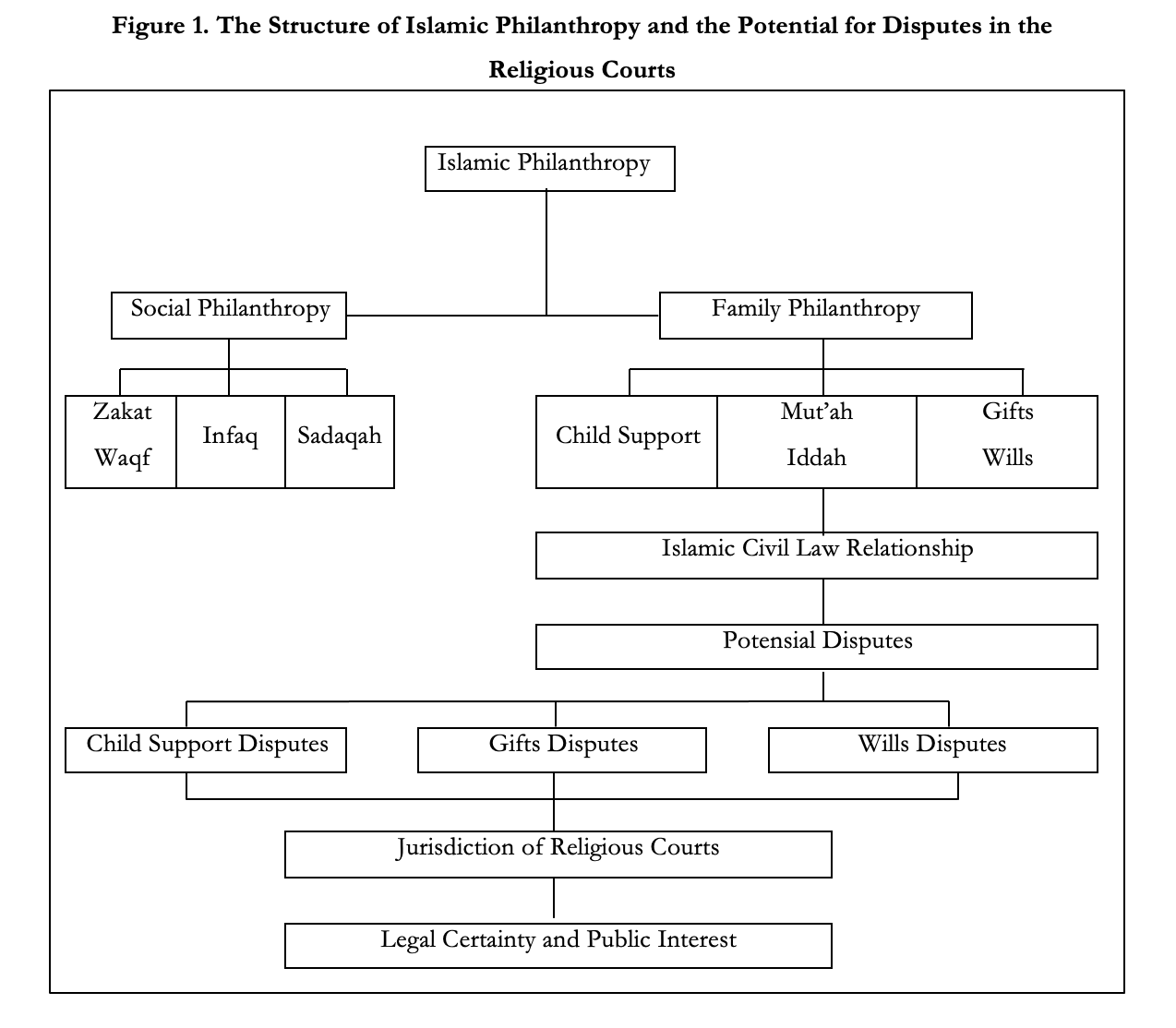
Islamic philanthropy has traditionally been understood primarily through the instruments of zakat, infak, sedekah and wakaf as part of Islamic social finance. This perspective has meant that the instruments within Islamic family law have not yet been extensively studied as part of Islamic philanthropy. This study aims to analyse the construction of Islamic philanthropy within family law and to identify potential disputes arising within the jurisdiction of the Religious Courts. This study is a normative legal study employing a conceptual approach and a statutory approach. Legal materials were obtained through a literature review and analysed qualitatively using a descriptive-analytical method. The results of the study indicate that Islamic philanthropy encompasses not only the instruments of zakat, infak, sedekah, and waqf, but also various family law instruments such as child maintenance, spousal maintenance, mut’ah, iddah maintenance, gifts, and wills. Based on these findings, Islamic philanthropy can be constructed into two dimensions: social philanthropy and family philanthropy. This framework implies an expansion of the scope of disputes concerning Islamic philanthropy falling within the jurisdiction of the Religious Courts, extending beyond zakat and waqf to include disputes arising from the implementation of maintenance, mut’ah, iddah maintenance, gifts, and wills. This research contributes to broadening the perspective of Islamic philanthropy studies and clarifies the position of the Religious Courts in resolving disputes arising from the practice of Islamic philanthropy.
Downloads
Article Details

This work is licensed under a Creative Commons Attribution-ShareAlike 4.0 International License.
Authors continue to retain the copyright to the article if the article is published in the Jurnal Hadratul Madaniyah. They will also retain the publishing rights to the article without any restrictions.
Authors who publish in this journal agree to the following terms:
- Any article on the copyright is retained by the author(s).
- The author grants the journal the right of first publication with the work simultaneously licensed under a Creative Commons Attribution License that allows others to share work with an acknowledgment of the work authors and initial publications in this journal.
- Authors can enter into separate, additional contractual arrangements for the non-exclusive distribution of published articles (e.g., post-institutional repository) or publish them in a book, with acknowledgment of their initial publication in this journal.
- Authors are permitted and encouraged to post their work online (e.g., in institutional repositories or on their websites) before and during submission. This can lead to productive exchanges and earlier and greater citations of published work.
- The article and any associated published material are distributed under the Creative Commons Attribution-ShareAlike 4.0 International License.
References
Agustar, A., & Arafah, S. (2024). Contemporary Issues of Islamic Family Law. Al-Manāhij: Jurnal Kajian Hukum Islam, 18(1), 17–36.
Anoraga, B. (2023). Crowdfunding for Inter-Faith Peace: Youth, Networked Social Movement, and Muslim Philanthropy NGOs in Contemporary Indonesia. Indonesian Journal of Islam and Muslim Societies, 13(2), 307–338. https://doi.org/10.18326/ijims.v13i2.307-338
Busriyanti, Pujiono, Mursalim, & Chamdan, U. (2025). Marriage Law Reform in Indonesia A Maqasid al-usrah Perspective on Legal Adaptation. Al-Istinbath: Jurnal Hukum Islam, 10(2), 631–649. https://doi.org/10.29240/jhi.v10i2.12739
Fallas, A. (2023). Charity and philanthropy in Middle East history. History Compass, 21. https://doi.org/10.1111/hic3.12760
Faure, L. (2024). European Muslim Charities: From British Roots to an Original French Islamic Philanthropy. Journal of Muslim Philanthropy and Civil Society, 8(2), 54–75.
Friedl, P. (2025). The Normative Model BT - Reasonable Expectations of Privacy: With Special Regard to European Privacy and Data Protection Law (P. Friedl (ed.); pp. 105–213). Springer Nature Switzerland. https://doi.org/10.1007/978-3-031-84881-0_6
Hamzani, A. I., Widyastuti, T. V., Khasanah, N., & Rusli, M. H. M. (2024). Implementation approach in legal research. International Journal of Advances in Applied Sciences, 13(2), 380–388. https://doi.org/10.11591/ijaas.v13.i2.pp380-388
Harahap, I., Batubara, C., Tambunan, K., & Hakim, A. (2024). The Power of Zakat in Contemporary Development: How Islamic Philanthropy Alleviates the Economic Impact of Toll Road Projects on MSMEs. MILRev: Metro Islamic Law Review, 3(2), 174–197. https://doi.org/10.32332/milrev.v3i2.9391
Hasan, S. (2024). Philanthropy and Social Justice in Islam: Principles, Prospects, and Practices. SSRN Electronic Journal. https://doi.org/10.2139/ssrn.4709876
Hughes, M. A., & Siddiqui, S. A. (2024). From Islamic Charity to Muslim Philanthropy: Definitions Across Disciplines. Religion Compass, 18(10), 1–10. https://doi.org/10.1111/rec3.70002
Khasanah, K., Ansori, & Sobirin, M. (2023). Distributing Philanthropic Funds to Indonesian Muslims amid the Pandemic through a Maṣlaḥah view: Weaving Social Safety Nets or Fortifying the Healthcare System? Al-Manahij: Jurnal Kajian Hukum Islam, 17(2), 263–274. https://doi.org/10.24090/mnh.v17i2.10226
Makhrus, M., Hasan, I., & Budi Santoso, S. E. (2024). Islamic Philanthropy and Social Services in Improving Community Welfare in Indonesia. Islamic Economics Journal, 10(2), 150–162. https://doi.org/10.21111/iej.v10i2.10930
Masykuroh, E., Hidayati, N., & Cahyani, Y. T. (2025). Islamic Corporate Philanthropy in Islamic Banking: Implementation of Zakat Regulation and Sharia Compliance in Indonesia. In Justicia Islamica (Vol. 22, Issue 1). https://doi.org/10.21154/justicia.v22i1.10397
Maula, B. S. (2023). The Concept of Ṣulḥ and Mediation in Marriage Conflict Resolution in Religious Courts: A Comparative Study between Contemporary Indonesian Family Law and Classical Islamic Law. El-Aqwal : Journal of Sharia and Comparative Law, 2(1), 73–86. https://doi.org/10.24090/el-aqwal.v2i1.7777
Mufid, M., & Muhammad, A. A. (2023). Islamic Philanthropy and Public Policy: A Study of Zakat Fatwas from the New Order Era to the Post-Reform Era. Jurnal Hukum Islam, 21(2), 201–230. https://doi.org/10.28918/jhi_v21i2_01
Nugroho, S. A., & Aini, Q. (2023). A Bibliometric Analysis of Islamic Work Ethic Using VOSviewer. HIV Nursing, 3(1), 97–124. https://hivnursing.net/index.php/hiv/article/view/1370
Osseilan, E., & James, R. N. (2023). Philanthropy, Demographics, and Growth in US Islamic Nonprofits: Evidence from IRS Form 990. Journal of Muslim Philanthropy and Civil Society, 7(1), 44–68. https://doi.org/10.2979/jmpcs.7.1.03
Ridho, H., Sodiqin, A., & Mujib, A. (2025). The Evolution of Islamic Philanthropy in Indonesia’s Digital Age (2016–2023). Al-Ahkam, 35(1), 31–58. https://doi.org/10.21580/AHKAM.2025.35.1.23721
Rochmatullah, M. (2025). Do You Think This is Philanthropy? Think Again. Journal of Management, Spirituality & Religion, 22. https://doi.org/10.51327/TPHW3488
Rokhim, A., Umiarso, & Taufiq, H. N. (2025). Construction of the philanthropic movement model of the Lembaga Dakwah Islam Indonesia (LDII) in Indonesia. Cogent Arts and Humanities, 12(1). https://doi.org/10.1080/23311983.2025.2579160
Safingah, K., Nurchamidah, & Nurlaela. (2025). The Role of Islamic Philanthropy in the Development of Religious Education: A Contemporary Literature Review. Journal of Research in Islamic Education, 7(2), 699–711. https://doi.org/10.25217/jrie.v7i2.6581
Saidon, R., Md Ismail, M. A., Ismail, A. T., Bahari, N., & Haron, N. H. (2023). Philanthropy and Legal Aid: A Case Study. International Journal of Academic Research in Business and Social Sciences, 13(7), 1–10. https://doi.org/10.6007/ijarbss/v13-i7/17805
Shuaib, A. A., & Sohail, M. (2021). The role of Islamic social finance in societal welfare: a case study of selected IFBOs in southwest Nigeria. International Journal of Islamic and Middle Eastern Finance and Management, 15(1), 83–99. https://doi.org/10.1108/IMEFM-06-2019-0229
Soh, N. S. M., Ismail, H., Hassan, N. M., Ayob, M. A. S., & Sairi, F. M. (2022). Cultivation Of Islamic Philanthropy Concept through High Impact Educational Practices in Universiti Teknologi MARA. Asian Journal of University Education, 18(2), 336–347. https://doi.org/10.24191/ajue.v18i2.17989
Solikin, N. (2023). The Construction Of Family Law In The Compilation Of Islamic Law In Indonesia: A Review of John Rawls’s Concept of Justice and Jasser Auda’s Maqashid al-Shari’a. 23(1), 315–340.
Sulasih. (2020). Altruism As a Motive For Implementing Community Welfare Programs Through Islamic Philantropic Funds: Case Study of Baitul Maal Hidayatullah Empowerment Actors. Ijtimā’iyya: Journal of Muslim Society Research, 4(1), 90–101.
Ubaidilah, N., & Husna, A. (2023). Regulation of Maintenance in Islamic Family Law. International Journal of Health, Economics, and Social Sciences, 5(4), 601–612. https://doi.org/10.56338/ijhess.v5i4.6639
Umarji, O., Wasif, R., Siddiqui, S., & Noor, Z. (2024). Philanthropy Under Uncertainty: Muslim Religious Giving During the COVID-19 Pandemic. Journal of Public and Nonprofit Affairs, 10(3), 322–341. https://doi.org/10.20899/jpna.c7vvvv81
Undang-Undang Republik Indonesia Nomor 3 Tahun 2006 Tentang Perubahan atas Undang-Undang Nomor 7 Tahun 1989 Tentang Peradilan Agama, 4 650 (2006).
Usman, H., Mulia, D., Chairy, C., & Widowati, N. (2020). Integrating trust, religiosity and image into technology acceptance model: the case of the Islamic philanthropy in Indonesia. Journal of Islamic Marketing, 13(2), 381–409. https://doi.org/10.1108/JIMA-01-2020-0020