Hermeneutics of Surah Maryam 22–26: Integrating Qur’anic Exegesis with Midwifery from a Holistic Perspective
Article Sidebar
Main Article Content
Abstract
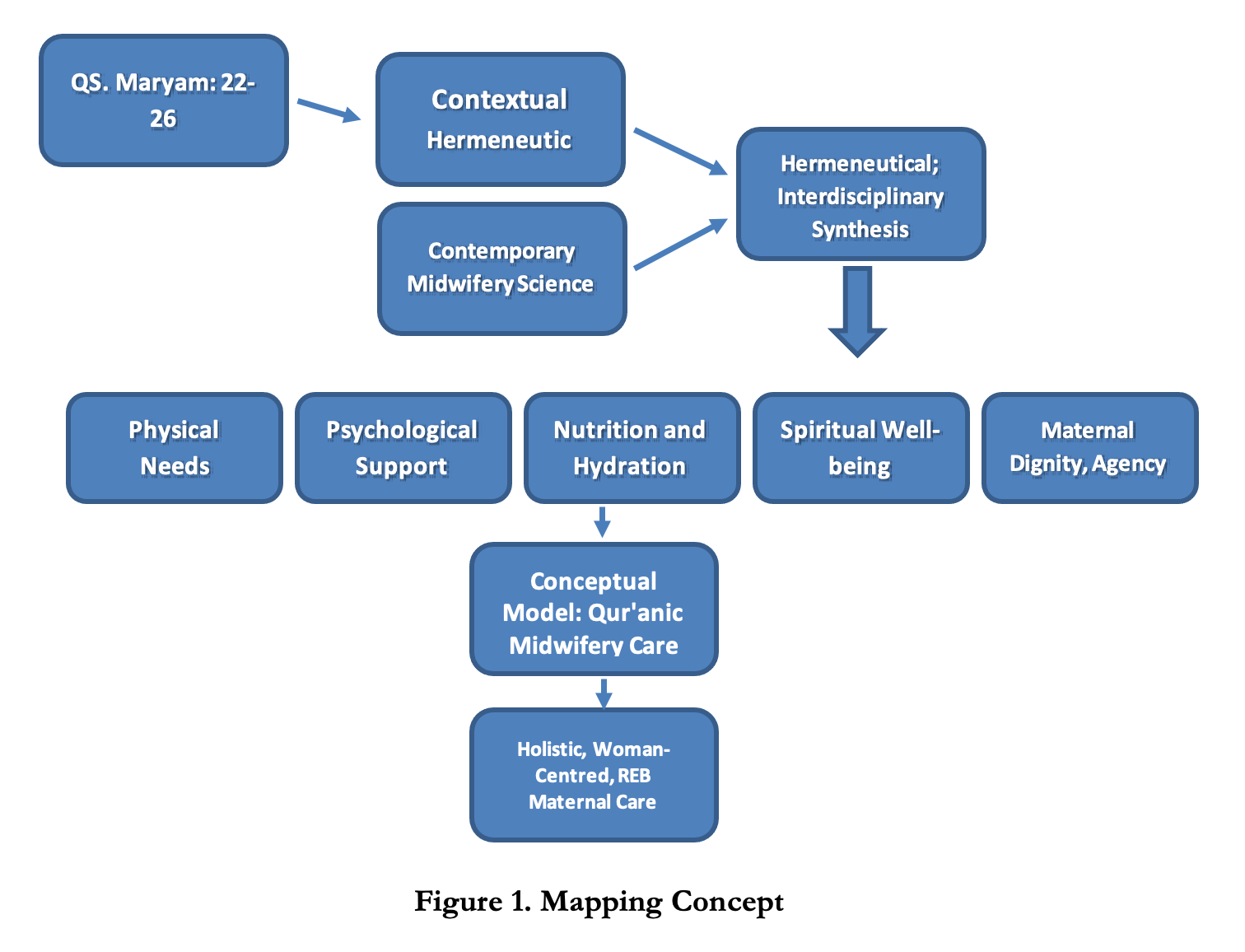
Maternal and infant mortality rates, alongside the growing trend toward biomedical-oriented midwifery practices, highlight the need for a holistic model of maternal care. The Qur’an, particularly Surah Maryam (19): 22–26, represents the comprehensive experiences of pregnancy, childbirth, and the postpartum period, yet has rarely been studied as a conceptual foundation for Islamic midwifery. This study aims to formulate a conceptual model of Qur’anic-Based Intranatal Care (Qur’anic Midwifery Care) through a hermeneutic analysis of Surah Maryam (19): 22–26. Employing a literature review with Abdullah Saeed’s contextual hermeneutics and Ian G. Barbour’s integration approach, primary exegetical works were analyzed alongside contemporary midwifery literature. The results indicate that Surah Maryam, verses 22–26, contain principles of maternal care that are holistic in nature. These principles are elaborated in the five main dimensions of Qur’anic Midwifery Care: meeting physical needs, providing psychological support, ensuring proper nutrition, fostering spiritual well-being, and respecting the dignity of the mother as the central figure in the processes of pregnancy, childbirth, and the postpartum period. These five dimensions are strongly aligned with the principles of woman-centered care, respectful maternity care, and evidence-based midwifery. This study contributes by proposing the concept of Qur’anic Midwifery Care as a conceptual model for midwifery services that integrates the values of the Qur’an with modern, evidence-based midwifery practices. This model is expected to serve as the foundation for the development of Islamic maternal care that is more holistic, humanistic, and contextual.
Downloads
Article Details

This work is licensed under a Creative Commons Attribution-ShareAlike 4.0 International License.
Authors continue to retain the copyright to the article if the article is published in the Jurnal Hadratul Madaniyah. They will also retain the publishing rights to the article without any restrictions.
Authors who publish in this journal agree to the following terms:
- Any article on the copyright is retained by the author(s).
- The author grants the journal the right of first publication with the work simultaneously licensed under a Creative Commons Attribution License that allows others to share work with an acknowledgment of the work authors and initial publications in this journal.
- Authors can enter into separate, additional contractual arrangements for the non-exclusive distribution of published articles (e.g., post-institutional repository) or publish them in a book, with acknowledgment of their initial publication in this journal.
- Authors are permitted and encouraged to post their work online (e.g., in institutional repositories or on their websites) before and during submission. This can lead to productive exchanges and earlier and greater citations of published work.
- The article and any associated published material are distributed under the Creative Commons Attribution-ShareAlike 4.0 International License.
References
Abu Abdillah Muhammad bin Ahmad bin Abu Bakr bin Farh al-Anshari al-Khazraji al-Andalusi al-Qurthubi. (2006). al-Jami’ li Ahkam al-Qur’an. Ar-Risalah.
Akin, B., Bay Özçalık, H., & Çankaya, S. (2025). The Effect of Listening to the Surah Maryam in the First Stage of Childbirth on Traumatic Childbirth Perception, Post-traumatic Stress, and Postpartum Depression in Türkiye. Journal of Religion and Health, 64(1), 536–548. https://doi.org/10.1007/s10943-024-02137-x
al-Maraghi, A. M. (1993). Tafsir Al-Maraghi Jil. 3. Toha Putra.
Ashur, T. ibn. (1984). Tafsir at-Tahrir wa at-Tanwir. Dar at-Tunisiyyah li an-Nasyr.
Azis, dkk., F. P. (2024). Parturition in Q.S Maryam: 22-26 According to the Tafsir of the Ministry of Religion of the Republic of Indonesia. Journal of ‘Ulūm Al-Qur’Ān and Tafsīr Studies, 3(1), 4–10. DOI:10.54801/juquts.v3i1.274
Barbour, I. G. (1990). Religion in an Age of Science. Harper & Row.
Berhanuddin, Q. F., Othman, M. S., Mustapha, N. F., & Wan Sulong, W. M. (2021). Revisiting Maryam through Thematic-Structural Study. International Journal of Academic Research in Business and Social Sciences, 11(12). https://doi.org/10.6007/IJARBSS/v11-i12/11156
Frih, B., Mkacher, W., Bouzguenda, A., Jaafar, H., ALkandari, S. A., Ben Salah, Z., Sas, B., Hammami, M., & Frih, A. (2017). Effects of listening to Holy Qur’an recitation and physical training on dialysis efficacy, functional capacity, and psychosocial outcomes in elderly patients undergoing haemodialysis. Libyan Journal of Medicine, 12(1), 1372032. https://doi.org/10.1080/19932820.2017.1372032
Hamka. (n.d.). Tafsir Al-Azhar. Pustaka Nasional PTE LTD Singapura.
Hanif, A., Ubaidillah, U., & Marpuah, S. (2024). Pengaosan Al Qur’an within Tingkeban Tradition in Trenggalek, Indonesia. KARSA Journal of Social and Islamic Culture, 32(2), 146–169. https://doi.org/10.19105/karsa.v32i2.12388
Ikhlasiah, dkk., M. (2022). Aspects of Spirituality in Midwifery services at Az Zahra Clinic Tangerang Primary Health Services. Malaysian Journal of Medicine and Health Sciences, 187, 131–136. https://medic.upm.edu.my/upload/dokumen/2022012610321125_0922.pdf
International Confederation of Midwives. (2025). Philosophy and Model of Midwifery Care. 8 July 2025. https://internationalmidwives.org/resources/philosophy-and-model-of-midwifery-care/
International Federation of Gynecology and Obstetrics. (n.d.). Ethical Framework for Respectful Maternity Care During Pregnancy and Childbirth. Retrieved July 25, 2026, from www.figo.org
Kementerian Agama RI. (2020). Tafsir al-Qur’an Tematik: Kesehatan dalam Perspektif al-Qur’an. Lajnah Pentashihan Mushaf al-Qur’an.
Marmi dan Rina Nuraeni. (2026). Islamic Perspectives on Holistic Postpartum Care: Bridging Faith, Maternal Health, and Midwifery Practice. Jurnal Indonesia Sehat, 5(1). DOI: 10.58353/jurinse/v5i1.351
Medforth, Janet, dkk. (2017). Oxford handbook of midwifery (3rd ed.). Oxford University Press.
Ministry of Public Health Afghanistan. (2017). Rescpectful Maternity Care (RMC) Resource Package: Facilitator’s Guide. https://platform.who.int/docs/default-source/mca-documents/policy-documents/operational-guidance/afg-mn-32-01-operationalguidance-2017-eng-523476805-respectful-maternity-care-providers.pdf
Mirza, Y. Y. (2025). The Islamic Mary: Maryam Through the Centuries. Fortress Press.
Nasr, S. H. (n.d.). The Study Quran: A New Translation and Commentary. Harper One.
Quthb, S. (2000). Tafsir Fi Zhilalil Qur’an: Di Bawah Naungan Al-Qur’an (Surah Al-Fatihah-Al-Baqarah). Gema Insani.
Rafique, R., Anjum, A., & Raheem, S. S. (2019). Efficacy of Surah Al-Rehman in Managing Depression in Muslim Women. Journal of Religion and Health, 58(2), 516–526. https://doi.org/10.1007/s10943-017-0492-z
Saeed, A. (2006). Interpreting the Qur’an: Towards a Contemporary Approach. Routledge.
Saeed, A. (2014). Reading the Qur’an in the Twenty-First Century: A Contextualist Approach. Routledge.
Shihab, M. Q. (2002). Tafsir Al-Mishbah: Pesan, Kesan, dan Keserasian Al-Qur’an. Lentera Hati.
Trisiani, D., Ferina, F., Indrayani, D., & H. Abdul-Mumin, K. (2024). Spiritual Aspects of Pregnancy and Childbirth Based on an Islamic Perspective. Jurnal Kajian Peradaban Islam, 7(2), 121–126. https://doi.org/10.47076/jkpis.v7i2.242
United Nations Children’s Fund. (2021). Prevention of malnutrition in women before and during pregnancy and while breastfeeding. UNICEF.
Walsh, D. (Ed.). (2007). Evidence-based Care for Normal Labour and Birth. Routledge. https://doi.org/10.4324/9780203961711
WHO. (2016). WHO Recommendations on Antenatal Care for a Positive Pregnancy Experience. WHO.
World Health Organization. (n.d.). Making Childbirth a Positive Experience. WHO. Retrieved July 25, 2026, from https://www.who.int/activities/making-childbirth-a-positive-experience
World Health Organization. (2018). WHO Recommendations: Intrapartum Care for a Positive Childbirth Experience. WHO.