Internalising the Values of Patience and Gratitude through the Practice of Istighosah in Developing Students’ Academic Resilience at MTsN 1 Pamekasan
Article Sidebar
Main Article Content
Abstract
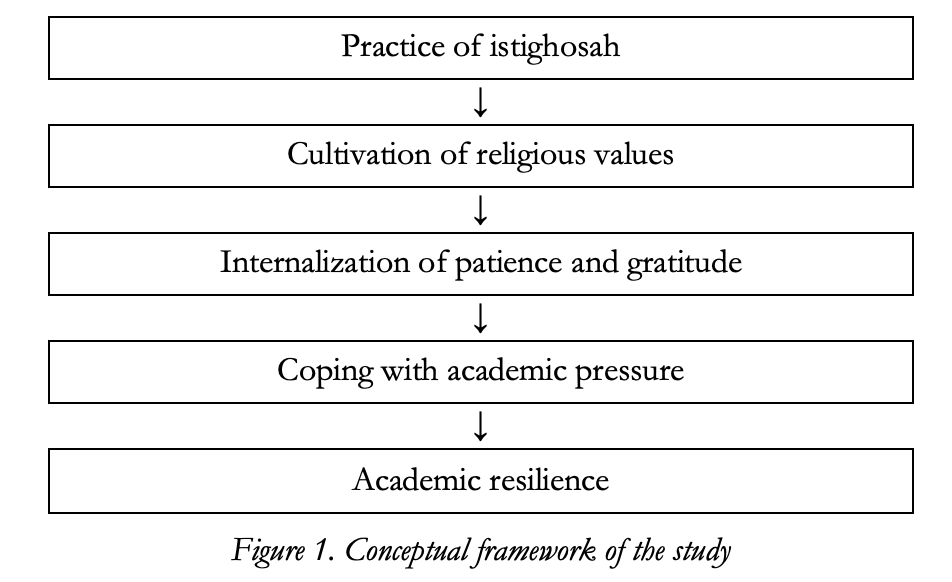
Academic pressure has increasingly become a concern in adolescent education because students are required to persist in learning while responding to academic demands and emotional challenges. This study aims to describe the process of internalizing the values of patience and gratitude through istighosah practices and to examine how these values are reflected in students' academic resilience at MTsN 1 Pamekasan. Employing a qualitative case study approach, data were collected through non-participatory observation, semi-structured interviews with the school principal, an Akidah Akhlak teacher, a homeroom teacher, and students, as well as documentation. The findings indicate that istighosah functions as part of the school's religious habituation and is conducted on Jumat Legi/Manis, following the Javanese pasaran calendar, which recurs approximately every five weeks rather than on a fixed weekly or monthly schedule. Activities include Dhuha prayer, Qur'anic recitation, Yasin, tahlil, and collective supplication. The internalization of patience is reflected in students' persistence in completing academic tasks even when they experience complaints or pressure. Gratitude is expressed verbally, particularly through expressions such as “Alhamdulillah” after receiving good academic results, and is reinforced through peer interaction. The findings also show that the influence of istighosah should not be understood as a single direct cause of academic resilience. Rather, patience and gratitude appear to operate together with Akidah Akhlak instruction, peer support, teacher guidance, and the broader school environment. Thus, istighosah can be understood as one medium through which religious values are habituated and reflected in students' efforts to persist in academic activities.
Downloads
Article Details

This work is licensed under a Creative Commons Attribution-ShareAlike 4.0 International License.
Authors continue to retain the copyright to the article if the article is published in the Jurnal Hadratul Madaniyah. They will also retain the publishing rights to the article without any restrictions.
Authors who publish in this journal agree to the following terms:
- Any article on the copyright is retained by the author(s).
- The author grants the journal the right of first publication with the work simultaneously licensed under a Creative Commons Attribution License that allows others to share work with an acknowledgment of the work authors and initial publications in this journal.
- Authors can enter into separate, additional contractual arrangements for the non-exclusive distribution of published articles (e.g., post-institutional repository) or publish them in a book, with acknowledgment of their initial publication in this journal.
- Authors are permitted and encouraged to post their work online (e.g., in institutional repositories or on their websites) before and during submission. This can lead to productive exchanges and earlier and greater citations of published work.
- The article and any associated published material are distributed under the Creative Commons Attribution-ShareAlike 4.0 International License.
References
Al-Jauziyyah, I. Q. (2010). 'Uddah al-Shābirīn wa Dhakhīrah al-Syākirīn (K. Suhardi, Trans.). Pustaka Al-Kautsar.
Cassidy, S. (2016). The Academic Resilience Scale (ARS-30): A new multidimensional construct measure. Frontiers in Psychology, 7, 1787.
Creswell, J. W., & Creswell, J. D. (2023). Research design: Qualitative, quantitative, and mixed methods approaches (6th ed.). SAGE Publications.
Daulay, N. (2024). The Determinants of Academic Resilience among Undergraduate Students Post COVID-19. Psikologika: Jurnal Pemikiran Dan Penelitian Psikologi, 29(1), 143–158.
Herdiansyah, D., & Fauziah, M. (2024). Descriptive Study: The Prevalence of Academic Resilience of Junior High School Students and Its Implications in Guidance and Counseling. Educational Guidance and Counseling Development Journal, 7(1), 38–48. https://doi.org/10.24014/egcdj.v7i1.29162
Faizi, N. (2023). Resiliensi Akademik Dalam Perspektif Psikologi Islam. 9(4).
Lickona, T. (1992). Educating for Character: How Our Schools Can Teach Respect and Responsibility. Bantam. https://books.google.co.id/books?id=Cx0nJf7KZAcC
Ma`arif, M. A., Muqorrobin, F. M., Kartiko, A., Sirojuddin, A., & Rofiq, A. (2024). Developing Islamic Character Values Through Student Habituation. Al-Hayat: Journal of Islamic Education, 8(1), 337. https://doi.org/10.35723/ajie.v8i1.501
Mulasi, S., Syabuddin, S., & Syahminan, S. (2023). Sabar dalam perspektif Al-Qur’an; Eksplorasi nilai sabar dalam menuntut ilmu. Islamika: Jurnal Ilmu-Ilmu Keislaman, 23(2), 180–195.
Nurizah, A. K., & Amrullah, M. (2024). Religious Character Formation Through Islamic Habituation in Primary Education: Pembentukan Karakter Religius Melalui Pembiasaan Islam dalam Pendidikan Dasar. Indonesian Journal of Islamic Studies, 12(4). https://doi.org/10.21070/ijis.v12i4.1741
Rahmasari, D., Jannah, M., & Puspitadewi, N. W. S. (2014). Harga Diri dan Religiusitas dengan Resiliensi Pada Remaja Madura Berdasarkan Konteks Sosial Budaya Madura. Jurnal Psikologi Teori Dan Terapan, 4(2), 130–139. https://doi.org/10.26740/jptt.v4n2.p130-139
Ross, H. O., Hasanah, M., Roidah, W., Raisatunnisa, R., Russandari, S. M. N., Hanifah, A., & Qudsyi, H. (2022). A Quasi-Experimental Study of Gratitude Journaling on Studentsâ€TM Academic Resilience. Jurnal Kependidikan : Jurnal Hasil Penelitian Dan Kajian Kepustakaan Di Bidang Pendidikan, Pengajaran, Dan Pembelajaran, 8(1), 102–113. https://doi.org/10.33394/jk.v8i1.4704
Ryan, R. M., & Deci, E. L. (2020). Intrinsic and extrinsic motivation from a self-determination theory perspective: Definitions, theory, practices, and future directions. Contemporary Educational Psychology, 61, 101860. https://doi.org/10.1016/j.cedpsych.2020.101860
Saldaña, J. (2021). The Coding Manual for Qualitative Researchers. SAGE. https://books.google.co.id/books?id=p6UIzgEACAAJ
Steare, T., Muñoz, C. G., Sullivan, A., & Lewis, G. (2023). The association between academic pressure and adolescent mental health problems: A systematic review. Journal of Affective Disorders, 339, 302–317.
Suharti, V., & Nugraha, S. (2023). Dukungan sosial dan resiliensi akademik selama pembelajaran daring dengan mediasi efikasi diri akademik pada siswa smk. Jurnal Psikologi Malahayati, 5(2).
Wijaya, H. E., Laili, L., & Anshory, A. (2025). The underpinning mechanism between patience and academic procrastination: The mediating role of self-regulated learning among undergraduate students. Jurnal Kajian Peradaban Islam, 8(1), 36–45.
World Health Organization. (2025, September 1). Mental health of adolescents.