Customary Payments and the Recognition of “Anak Jantan” and “Anak Betino” in Koto Petai, Kerinci: An Empirical Analysis of Maslahah Mursalah
Article Sidebar
Main Article Content
Abstract
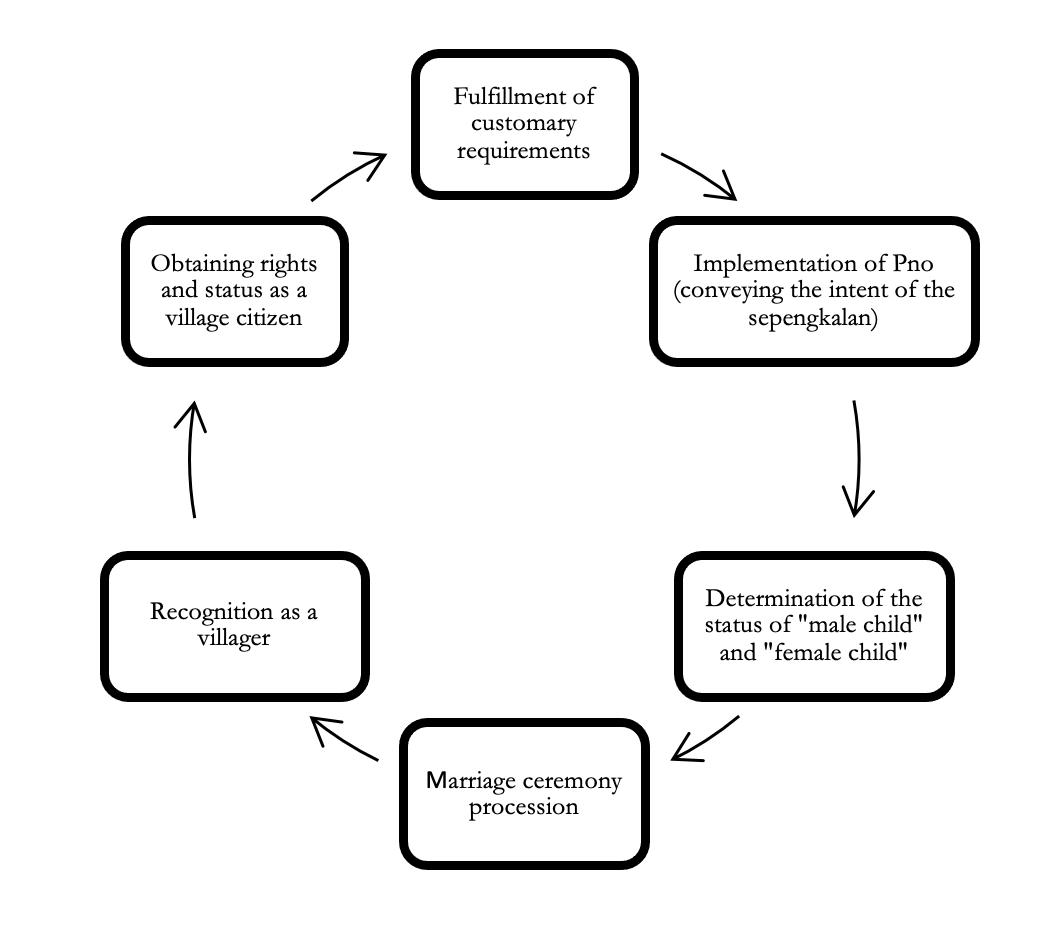
This study examines the determination of “anak jantan” and “anak betino” status through customary payments within the context of marriage in the community of Koto Petai Village, Kerinci Regency. The research aims to analyze the mechanisms for establishing this status, its legal implications, and its benefits through the lens of the Islamic legal principle of maslahah mursalah. Employing an empirical legal research method with a sociology-of-law approach, data were gathered through interviews with customary leaders, village officials, and community members, and subsequently analyzed qualitatively in relation to the research focus and the theory of maslahah mursalah. The findings indicate that: (1) the determination of status is achieved by fulfilling customary requirements, carrying out the pno by the sepengkalan, and obtaining formal recognition from the Ninik Mamak; (2) this status grants the couple a recognized position within the wife’s kinship group kelebu, enables their participation in customary and social life, and entails an obligation to adhere to customary regulations; and (3) the practice serves the public interest maslahah by providing clarity regarding a couple’s standing, ensuring orderly kinship relations, and sustaining customary institutions. This study clarifies the interplay between customary payments, the recognition of social status, and the promotion of public welfare within the customary marriage practices of the Kerinci community.
Downloads
Article Details

This work is licensed under a Creative Commons Attribution-ShareAlike 4.0 International License.
Authors continue to retain the copyright to the article if the article is published in the Jurnal Hadratul Madaniyah. They will also retain the publishing rights to the article without any restrictions.
Authors who publish in this journal agree to the following terms:
- Any article on the copyright is retained by the author(s).
- The author grants the journal the right of first publication with the work simultaneously licensed under a Creative Commons Attribution License that allows others to share work with an acknowledgment of the work authors and initial publications in this journal.
- Authors can enter into separate, additional contractual arrangements for the non-exclusive distribution of published articles (e.g., post-institutional repository) or publish them in a book, with acknowledgment of their initial publication in this journal.
- Authors are permitted and encouraged to post their work online (e.g., in institutional repositories or on their websites) before and during submission. This can lead to productive exchanges and earlier and greater citations of published work.
- The article and any associated published material are distributed under the Creative Commons Attribution-ShareAlike 4.0 International License.
References
Ahmad Madani, Rembrandt, Y. (2025). The Legal Status of Keduhei Customary in Marriages in the Sebukar Village Community, Kerinci Regency. 25(1). https://doi.org/https://doi.org/10.32939/islamika.v25i1.4950
Aini, U. M. (2024). Views on inter-ethnic marriage in society. 1, 152–173. https://jim.ar-raniry.ac.id/jupsi
Amor Seta Gilang Pratama, Mavil Tomi, D. R. (2022). Gong Betino and Gong Jantan: Gender Constuction in Kerinci Bamboo Gong Musical Instrument .22(2), 44–54. https://doi.org/10.33153/keteg.v22i2.4673
Annisa Dea Mudrika, Novia Astari, Y. D. S. (2023). Marriage in Gayo Custom: Tradition and Culture. 3(2), 50–56. https://doi.org/https://doi.org/10.57251/hij.v3i2.1465
Annisa, M. F. (2026). Obligations of a Partner. wawancara.
Ansori, A. (2025). Integration of Islamic Jurisprudence and Minangkabau Customary Law in a Modern Context: The Role of Ninik Mamak According to Community Perception.14(3), 178–191. https://doi.org/https://doi.org/10.30651/mqsd.v14i3.27903
Arif, M. (2026). Mechanism for Determining the Status of “anak jantan” and “anak betino. wawancara.
Dafizki, A. M., & , Edi Rosman, B. (2023). The Budendo Pelaky Nikah Tradition Contributes to the Perspective of the Sociology of Islamic Law 1(2), 140–147. https://doi.org/https://doi.org/10.30983/usraty.v1i2.7530
Fachry Rizki Andy La Rante, F. G. (2026). A Review of the 'Urf' on the Tradition of Paying 20 Goats Before Marriage in Koto Iman Village, Kerinci Regency. 7(1), 185–198. https://ejurnals.com/ojs/index.php/jahk/article/view/4852
Fidlilal, M., Rakhmat, I., Farudin, M., & Priluckito, S. D. (2025). Analysis of Customary Marriage Law of the Pulau Buaya Village Community, Alor in the Customary Kinship System from an Islamic Law PerspectivIslam. https://doi.org/https://doi.org/10.62383/federalisme.v2i1.480
Haifa, N. M., Nabilla, I., Rahmatika, V., & Hidayatullah, R. (2025). Identification of Research Variables, Types of Data Sources in Research. https://doi.org/https://doi.org/10.62383/dilan.v2i2.1563
Husni, M., Pakarti, A., Solehudin, E., Saujan, I., & Shakibiciu, S. (2025). The Role and Application of ’ Urf as a Source of Islamic Law : A Historical Review and Fiqhiyah Rules. 2(September), 175–192. https://doi.org/https://doi.org/10.63142/an-nisa.v2i3.300
Irsyad Al Fikri Ys, A. F. (2025). The Role of Maslahah Mursalah in Contemporary Islamic Legislation: School Analysis and Policy Implications 3. https://doi.org/10.15575/ejil.v3i2.1936
Itmamiy, A. L., Ekonomi, H., & Hasan, Z. (2022). Maslahah Theory in Islamic Economics ( FIqh Muamalah ). 4(2), 65–81. https://doi.org/https://doi.org/10.55606/ai.v4i2.379
Juniarti, Y. (2022). A Analysis of Interfaith Marriage Registration in Indonesia according to Law 1974. 1, 71–76.
Mufadhol, A. T., & Nuraeni, N. (2025). The Istinbath Ahkam Method in Solving Contemporary Problems : Case Study on Fatwa and Ijtihad .3. https://doi.org/https://doi.org/10.5281/zenodo.16935179
Muh. Adistira Hidayat, U. S. (n.d.). Maslahah Mursalah and Its Application in Family Law 5, 45–61. https://doi.org/https://doi.org/10.52431/minhaj.v5i1.2233
Pajri, A., & Fitrah, Y. (2023). Character Education Values in the Traditional Marriage Tradition and the Perceptions of the Tigo Luhah Semurup Kerinci Community : A Study of the Sociology of Literature 13(2), 713–723. https://doi.org/https://doi.org/10.23969/literasi.v13i2.8117
Putri, E. A. (2021). The Validity of Marriage Based on a Positive Legal Perspective in Indonesia. 15(1), 151–165. https://doi.org/https://doi.org/10.31599/krtha.v15i1.541
Quran.nu. (n.d.). Al-Anbiya Ayat 107. https://quran.nu.or.id/al-anbiya/107
Raden, M. (2026). Customary Money, wawancara.
Sholehudin, M. (2025). Legall Research Methodology (p. 43).
Sinta, T. (2023). The Significanse of Al-Ghazaali’s Maslahah Concept to the Development of Usul Fiqh And Islamic Law. 15(2), 195–208. https://doi.org/https://doi.org/10.37252/annur.v15i1.444
Sofwan. (2026). Acceptance of a Spouse as a Village Resident. wawancara.
Sumarna, D., & Kadriah, A. (2023). Qualitative Research on Empirical Law. 16(02), 101–113. https://doi.org/https://doi.org/10.59582/sh.v16i02.730
Suyaman, P. (2024). Maslahah Mursalah as One of the Istinbath Methods. 18(2). https://doi.org/https://doi.org/10.31599/krtha.v18i2.2692
Syaparudin. (2017). Islamic Microeconomics: Caring for the Public Interest vs. Not Caring for the Public Interest
Undari Sulung, M. M. (2024). Understanding Research Data Sources : Primary, Secondary, and Tertiary. 5(September), 110–116. https://doi.org/https://doi.org/10.47827/jer.v5i3.238