Implementation Model For Islamic Religious Education using a “Moving Class” system to enhance student Motivation and Academic Achievement at SMP IT Sahabat Alam
Article Sidebar
Main Article Content
Abstract
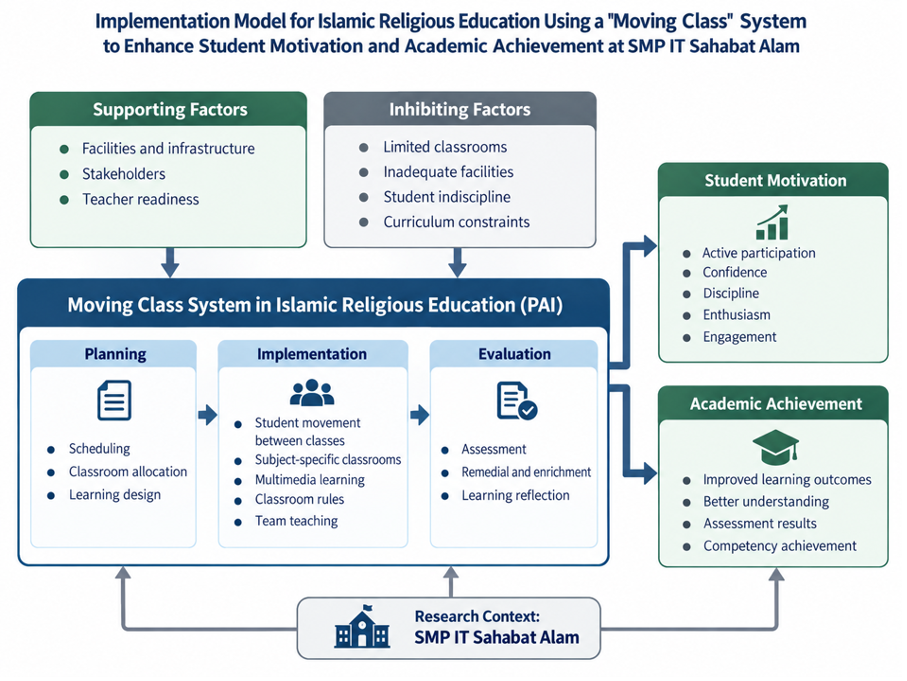
A "moving class" system is an approach to teaching and learning that introduces a fresh atmosphere into the educational process. This system is characterized by student mobility, where students move between different classrooms according to a predetermined subject schedule. The moving class concept centers on the student, providing a dynamic environment tailored to the specific subject being studied. Such an approach plays a significant role in educational development, contributing to efforts to improve the quality of human life. Research findings indicate that SMP IT Sahabat Alam does not currently implement a "moving class" system which would require a dedicated classroom for each individual subject. Instead, the school employs a unique pedagogical approach centered on nature, with learning activities adapted to the specific subject matter. Furthermore, SMP IT Sahabat Alam incorporates various Islamic religious education activities such as Quranic studies, "Quran Nights," and “Tadabur Alam” (nature-based reflection) all of which are integrated into their Islamic religious education curriculum and take place outside of the standard classroom setting and regular school hours.
Downloads
Article Details

This work is licensed under a Creative Commons Attribution-ShareAlike 4.0 International License.
Authors continue to retain the copyright to the article if the article is published in the Jurnal Hadratul Madaniyah. They will also retain the publishing rights to the article without any restrictions.
Authors who publish in this journal agree to the following terms:
- Any article on the copyright is retained by the author(s).
- The author grants the journal the right of first publication with the work simultaneously licensed under a Creative Commons Attribution License that allows others to share work with an acknowledgment of the work authors and initial publications in this journal.
- Authors can enter into separate, additional contractual arrangements for the non-exclusive distribution of published articles (e.g., post-institutional repository) or publish them in a book, with acknowledgment of their initial publication in this journal.
- Authors are permitted and encouraged to post their work online (e.g., in institutional repositories or on their websites) before and during submission. This can lead to productive exchanges and earlier and greater citations of published work.
- The article and any associated published material are distributed under the Creative Commons Attribution-ShareAlike 4.0 International License.
References
Barrett, P., Davies, F., Zhang, Y., & Barrett, L. (2015). The impact of classroom design on pupils' learning: Final results of a holistic, multi-level analysis. Building and Environment, 89, 118–133. DOI: https://doi.org/10.1016/j.buildenv.2015.02.013
Cheryan, S., Ziegler, S. A., Plaut, V. C., & Meltzoff, A. N. (2014). Designing classrooms to maximize student achievement. Policy Insights from the Behavioral and Brain Sciences, 1(1), 4–12. DOI: https://doi.org/10.1177/2372732214548677
Creswell, J. W., & Poth, C. N. (2018). Qualitative Inquiry and Research Design: Choosing Among Five Approaches (4th ed.). SAGE Publications.
Echols, J. M., & Shadily, H. (1992). Kamus Inggris-Indonesia (Edisi revisi). Jakarta: Gramedia.
Haidar, P. D. (2004). Pendidikan Islam dalam sistem pendidikan nasional di Indonesia. Jakarta: Kencana.
Hasnadi, & Nurmalina. (2022). Sistem pembelajaran moving class sebagai upaya dalam meningkatkan motivasi belajar peserta didik. Al-Ikhtibar: Jurnal Ilmu Pendidikan, 9(1), 12–19. https://doi.org/10.32505/ikhtibar.v9i1.3862
https://jdih.kemenkeu.go.id/api/download/fullText/2003/20TAHUN2003UU.htm
Korpershoek, H., Harms, T., de Boer, H., van Kuijk, M., & Doolaard, S. (2016). A meta-analysis of the effects of classroom management strategies and classroom management programs on students' academic, behavioral, emotional, and motivational outcomes. Review of Educational Research, 86(3), 643–680.DOI: https://doi.org/10.3102/0034654315626799
Lazowski, R. A., & Hulleman, C. S. (2016). Motivation interventions in education: A meta-analytic review. Review of Educational Research, 86(2), 602–640.DOI: https://doi.org/10.3102/0034654315617832
Nata, A. (2009). Perspektif Islam tentang strategi pembelajaran (Cetakan ke-1). Jakarta: Kencana Prenada Media Group.
Republik Indonesia. (2003). Undang-Undang Republik Indonesia Nomor 20 Tahun 2003 tentang Sistem Pendidikan Nasional.
Republik Indonesia. (2005). Peraturan Pemerintah Republik Indonesia Nomor 19 Tahun 2005 tentang Standar Nasional Pendidikan. Jakarta: Sekretariat Negara Republik Indonesia.
Sardiman, A. M. (2018). Interaksi dan motivasi belajar-mengajar. Depok: Rajawali Pers.
Suparji. (2012). Korelasi antara implementasi moving class dengan motivasi belajar siswa. Cakrawala Pendidikan, 31(2), 217–227. https://doi.org/10.21831/cp.v5i2.1558
Supriyanto, D. (2014). Meningkatkan proses pembelajaran melalui moving class. Modeling: Jurnal Program Studi PGMI, 1(1).
Syarif, A., Ariyadi, A., Mazrur, M., & Erawati, D. (2023). Starategi Manajemen Mutu Sekolah Melalui Fungsi Pengorganisasian Di Smp Islam Terpadu Al Ghazali Modern School Palangka Raya: School Quality Management Strategies Through Organizing Functions At Integrated Islamic Smp Al Ghazali Modern School Palangka Raya. Jurnal Hadratul Madaniyah, 10(1), 1-10.
Uno, H. B. (2016). Teori motivasi dan pengukurannya: Analisis di bidang pendidikan. Jakarta: Bumi Aksara.
Vembye, M. H., Weiss, F., & Bhat, B. H. (2024). The effects of co-teaching and related collaborative models of instruction on student achievement: A systematic review and meta-analysis. Review of Educational Research, 94(3).DOI: https://doi.org/10.3102/00346543231186588
Yin, R. K. (2018). Case Study Research and Applications: Design and Methods (6th ed.). SAGE Publications.