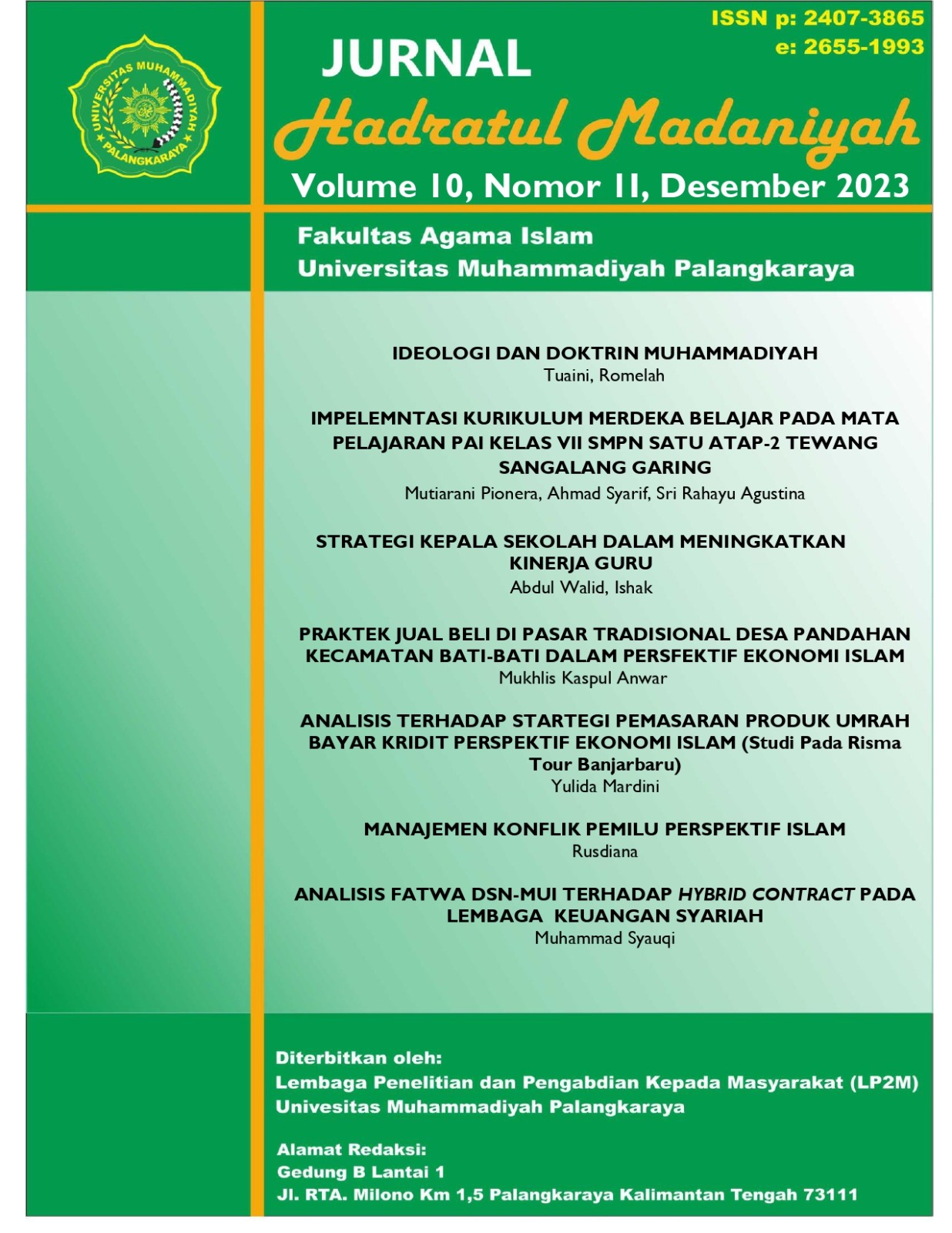
PRAKTEK JUAL BELI DI PASAR TRADISIONAL DESA PANDAHAN KECAMATAN BATI-BATI DALAM PERSFEKTIF EKONOMI ISLAM
Article Sidebar
Main Article Content
Abstract
This research was motivated by the existence of a traditional market in Pandahan Village, Bati-bati District, which is a traditional market with an Islamic nuanced system. Therefore, this study aims to find out how the practice of buying and selling practices of traditional markets in Pandahan Village, Bati-bati District, from an Islamic economic perspective. This type of research is field research conducted with qualitative assessment. The location of the study is at the Traditional Market of Pandahan Village which is located at Jl. A. Yani km 28 RT 04 Pandahan Village, Bati-bati District, Tanah Laut Regency, Kalimantan Province, South Kalimantan. The results showed that , the traders of the traditional market of Pandahan Village, Bati-bati District apply the practice of buying and selling with a perfect contract system, the right to vote (khiyar), voluntary, without containing elements of coercion, bringing benefits and avoiding mudharat in society, avoiding garar, avoiding riba
Downloads
Article Details

This work is licensed under a Creative Commons Attribution-ShareAlike 4.0 International License.
Authors continue to retain the copyright to the article if the article is published in the Jurnal Hadratul Madaniyah. They will also retain the publishing rights to the article without any restrictions.
Authors who publish in this journal agree to the following terms:
- Any article on the copyright is retained by the author(s).
- The author grants the journal the right of first publication with the work simultaneously licensed under a Creative Commons Attribution License that allows others to share work with an acknowledgment of the work authors and initial publications in this journal.
- Authors can enter into separate, additional contractual arrangements for the non-exclusive distribution of published articles (e.g., post-institutional repository) or publish them in a book, with acknowledgment of their initial publication in this journal.
- Authors are permitted and encouraged to post their work online (e.g., in institutional repositories or on their websites) before and during submission. This can lead to productive exchanges and earlier and greater citations of published work.
- The article and any associated published material are distributed under the Creative Commons Attribution-ShareAlike 4.0 International License.
References
Abbas Mirakhor, Hossein Askari, Zamir Iqbal. 2015. Introduction To Islamic Economic Theory And Aplication. Singapore: John Wiley & Sons Singapore Pte. Ltd.
Aida. 2023. Wawancara Pedagang.
Aidil Fitri. 2023. Wawancara Pedagang.
Al-Amruzi, M. Fahmi. 2015. “Membumikan Hukum Islam Di Indonesia.” Al-Banjari Volume 14 (5).
Apriliana, Eka Sri, and Ariyadi Ariyadi. "Kenaikan Harga Ayam Pada Masa Covid-19 di Kota Palangkaraya (Analisis Pemikiran Ibnu Taimiyah tentang Regulasi Harga)." Jurnal Hadratul Madaniyah 7.1 (2020): 15-19.
Ali. 2023. Wawancara Pedagang.
Ariyadi, Ariyadi. "Bisnis Dalam Islam: Business in Islam." Jurnal Hadratul Madaniyah 5.1 (2018): 13-26.
Azhari, Fathurrahman. 2016. “Dinamika Perubahan Sosial Dan Hukum Islam.” At-Tahrir 16 (1).
Azra, Azyumardi. 2013. Jaringan Ulama Timur Tengah Dan Kepulauan Nusantara Abad XVII & XVIII Akar Pembaruan Islam Indonesia. Depok: Prenada Media Group.
Baidillah. 2023. Wawancara Pedagang.
Dalhat, Yusuf. 2015. “Introduction To Research Methodology In Islamic Studies.” Journal Of Islamic Studies And Culture 3 (2).
Hamdah. 2023. Wawancara Pedagang.
Hasan, Ahmadi. 2014. “Prospek Pengembangan Ekonomi Syariah Di Masyarakat Banjar Kalimantan Selatan.” Ahkam 14 (2).
Hayat, Bahrul. 2012. “Kontribusi Islam Terhadap Masa Depan Peradaban Di Asia Tenggara.” MIQOT XXXVI (1).
Helda. 2023. Wawancara Pedagang Ikan.
Imam Nawawi. 2023. Wawancara Pedagang.
Meirison. 2017. “The Development Of Islamic Economics In Farious Part Of The World.” JEBI (Jurnal Ekonomi Dan Bisnis Islam) 2 (2).
Mudhiah, Kharidatul. 2015. “Analisis Sejarah Pemikiran Ekonomi Islam Masa Klasik.” Iqtishadia 8 (2).
Muin, Rahmah. 2017. “Praktek Jual Beli Batu Bata Dalam Perspektif Ekonomi Islam (Studi Kasus Desa Parappe Kecamatan Campalagian Kabupaten Polewali Mandar).” J-ALIF Jurnal Penelitian Hukum Ekonomi Syariah Dan Sosial Budaya Islam 2 (2).
Nirmala, Rizka. 2023. “Kepala Seksi Kesejahteraan Rakyat.” Balai Desa Pandahan.
Poniman. 2015. “DialektikaAgamadanBudaya.” Nuansa: Jurnal Studi Islam Dan Kemasyarakatan 8 (2).
Rahman, Muh. Fudhail. 2018. “Nature and Gharar Limits In Maliyah Transactions.” SALAM; Jurnal Sosial & Budaya Syari 5 (3).
Rahmi, Ain. 2015. “Mekanisme Pasar Dalam Islam.” Jurnal Ekonomi Bisnis Dan Kewirausahaan 4 (2).
Raudatul Jannah. 2021. “Karakter Religius Dalam Budaya Kelahiran Masyarakat Banjar Kalimantan Selatan.” Muaʾṣarah: Jurnal Kajian Islam Kontemporer 3 (2).
Selamat. 2023a. “Pedagang Pasar Tradisional Desa Pandahan Kecamatan Bati-Bati.” Pasar Tradisional Desa Pandahan.
———. 2023b. wawancara dengan masyarakat yang berdagang di pasar pagi Desa Pandahan Kecamatan Bati-Bati Kabupaten Tanah Laut.
Syarifuddin. 2023. Wawancara pedagang.
Syaikhu, Syaikhu, Ariyadi Ariyadi, and Norwili Norwili. "Fikih muamalah: memahami konsep dan dialektika kontemporer." (2020).
Tim Akademik. 2018. Universitas Islam Kalimantan Beyond Imagination Pemikiran Syekh Muhammad Arsyad Al-Banjari. Banjarmasin: WD Group.
Umy Yati. 2023. wawancara Pedagang.
Wahhab, Muhammad Abdul. 2019. Gharar Dalam Transaksi Modern. Jakarta: Rumah Fiqih Publishing.
Yulianti. 2015. “Konsep Dan Peran Strategis Ekonomi Syariah Terhadap Isu Kemiskinan.” Iqtishadia 8 (1).