Pendampingan Pendirian Madrasah Unggulan Bilingual Global: Implementasi Peningkatan Mutu Berkelanjutan Pendidikan pada MI Ma’arif 04 Desa Gentasari Kecamatan Kroya Kabupaten Cilacap Mentoring for the Establishment of a Global Bilingual Leading Madrasah: Implementation of Continuous Quality Improvement of Education at MI Ma'arif 04, Gentasari Village, Kroya District, Cilacap Regency
Article Sidebar
Main Article Content
Abstract
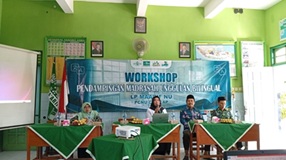
This article discusses a community service program aimed at supporting the establishment of a globally competitive bilingual flagship madrasah at MI Ma'arif 04 in Gentasari Village, Kroya Sub-district, Cilacap. This program is part of an effort to enable the madrasah to compete with other educational institutions, particularly in addressing global education challenges. It also focuses on empowering the community in education by leveraging existing potential to develop a high-quality, competitive madrasah. The program involves active participation from the entire madrasah community and broad public engagement, including various stakeholders. The mentoring activities cover numerous aspects, ranging from planning and preparing facilities and infrastructure to developing a globally-oriented bilingual curriculum, teacher training, and public outreach and school promotion. This program is expected to improve the quality of education at MI Ma'arif 04 Gentasari in a sustainable manner, thereby generating positive impacts on social change and community development.
Downloads
Article Details

This work is licensed under a Creative Commons Attribution-ShareAlike 4.0 International License.
Authors who publish with this journal agree to the following terms:
- Any article on the copyright is retained by the author(s).
- Author grant the journal, right of first publication with the work simultaneously licensed under a Creative Commons Attribution License that allows others to share work with acknowledgment of the work authors and initial publications in this journal.
- Authors are able to enter into a separate, additional contractual arrangements for non-exclusive distribution of published articles of work (eg, post-institutional repository) or publish it in a book, with acknowledgment of its initial publication in this journal.
- Authors are permitted and encouraged to post their work online (e.g., in institutional repositories or on their websites) prior to and during the submission process, as can lead to productive exchanges, as well as earlier and greater citation of published work.
- The article and any associated published material is distributed under the Creative Commons Attribution-ShareAlike 4.0 International License
References
APJII. (2022). Laporan survei penetrasi dan perilaku pengguna internet Indonesia 2022. Asosiasi Penyelenggara Jasa Internet Indonesia.
Baran, E. (2014). A review of research on mobile learning in teacher education. Educational Technology & Society, 17(4), 17–32.
Davis, F. D. (1989). Perceived usefulness, perceived ease of use, and user acceptance of information technology. MIS Quarterly, 13(3), 319–340. https://doi.org/10.2307/249008
Kementerian Komunikasi dan Informatika. (2017). Survei penggunaan TIK 2017: Penggunaan ponsel oleh remaja. Kementerian Komunikasi dan Informatika.
Kementerian Pendidikan dan Kebudayaan. (2022). Survei nasional kompetensi digital tenaga pendidik. Kementerian Pendidikan dan Kebudayaan.
Kukulska-Hulme, A., & Traxler, J. (2023). Mobile learning: The next generation. Routledge.
Prasetyo, A., & Suharto, T. (2017). Pengaruh penggunaan smartphone terhadap konsentrasi belajar siswa. Jurnal Pendidikan dan Kebudayaan, 2(2), 123–137.
Prensky, M. (2021). Digital natives, digital immigrants: A decade later. Journal of Online Learning and Teaching, 17(1), 12–25. https://doi.org/10.24059/jolt.v17i1.2458
Setyawan, D. (2018). Survei KPAI: 97 persen siswa SMP dan SMA pernah mengakses pornografi. Komisi Perlindungan Anak Indonesia. https://www.kpai.go.id/publikasi/survei-kpai-97-persen-siswa-smp-dan-sma-pernah-mengakses-pornografi
Sung, Y.-T., Chang, K.-E., & Liu, T.-C. (2016). The effects of integrating mobile devices with teaching and learning on students’ learning performance: A meta-analysis and research synthesis. Computers & Education, 94, 252–275. https://doi.org/10.1016/j.compedu.2015.11.008
Thomas, K. M., & O’Bannon, B. W. (2019). Mobile phones in the classroom: Pre-service teachers answer the call. Computers & Education, 141, 103617. https://doi.org/10.1016/j.compedu.2019.103617
Tondeur, J., Scherer, R., Baran, E., Siddiq, F., Valtonen, T., & Sointu, E. (2021). Teacher educators as gatekeepers: Preparing the next generation of teachers for technology integration in education. British Journal of Educational Technology, 52(2), 731–748. https://doi.org/10.1111/bjet.13094
Zhang, Y., & Zhu, J. (2025). Influence of pre-service training on STEM teachers’ attitudes toward ICT-enhanced teaching: Mediating roles of perceived ease of use and perceived usefulness. Behavioral Sciences, 15(10), 1328. https://doi.org/10.3390/bs15101328
eMarketer. (2019). Smartphone users in Indonesia, 2016–2019. eMarketer.