Pelatihan Teknik Perbanyakan Tanaman Alpukat Secara Vegetatif dengan Metode Grafting di Desa Ternadi Kabupaten Kudus Training on Vegetative Propagation Techniques of Avocado Plants Using the Grafting Method in Ternadi Village, Kudus Regency
Article Sidebar
Main Article Content
Abstract
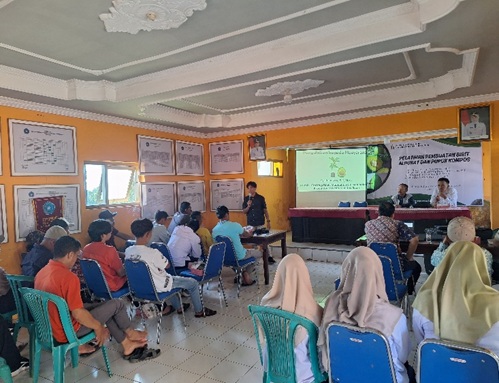
Avocado is one of the horticultural commodities with high economic value, yet its productivity remains low due to the limited cultivation technology applied by farmers. One of the main challenges is the long period before the plant starts bearing fruit. Vegetative propagation through grafting is considered a solution to this problem, as it can accelerate fruiting and produce superior seedlings genetically identical to the parent plant. This community service activity aimed to enhance farmers' capacity in Ternadi Village, Kudus Regency, through training in avocado grafting techniques. The implementation methodology included field observations, training through counseling and interactive discussions, and hands-on grafting practice by participants. A total of 37 farmers participated in the training, which was supplemented by pre- and post-tests to evaluate knowledge gains. The results showed a significant increase, with the average knowledge score rising from 72% to 100% after the training. Participants also demonstrated improved skills in independently performing the grafting technique. This training not only enriched the participants’ technical knowledge but also supported the development of Ternadi Village as an agro-tourism destination centered on avocado farming. In conclusion, a learning method that integrates theory and practice proved effective in enhancing farmers' knowledge and skills. It is recommended to continue the program by offering advanced training in nursery management and product marketing strategies to provide greater economic value to the community.
Downloads
Article Details

This work is licensed under a Creative Commons Attribution-ShareAlike 4.0 International License.
Authors who publish with this journal agree to the following terms:
- Any article on the copyright is retained by the author(s).
- Author grant the journal, right of first publication with the work simultaneously licensed under a Creative Commons Attribution License that allows others to share work with acknowledgment of the work authors and initial publications in this journal.
- Authors are able to enter into a separate, additional contractual arrangements for non-exclusive distribution of published articles of work (eg, post-institutional repository) or publish it in a book, with acknowledgment of its initial publication in this journal.
- Authors are permitted and encouraged to post their work online (e.g., in institutional repositories or on their websites) prior to and during the submission process, as can lead to productive exchanges, as well as earlier and greater citation of published work.
- The article and any associated published material is distributed under the Creative Commons Attribution-ShareAlike 4.0 International License
References
Alviana, Erika Dwi, Tri Pujiana, Dwi Arianti, and Helvi Yanfika. 2019. Komunikasi Dalam Penerapan Sistem Jajar Legowo di Desa Murni Jaya Kecamatan Tumijajar Kabupaten Tulang Bawang Barat. Mimbar Agribisnis: Jurnal Pemikiran Masyarakat Ilmiah Berwawasan Agribisnis, 5(2):156. https://doi.org/10.25157/ma.v5i2.1906.
Ardana, I. Gusti Made Kusuma, Ni Luh Made Pradnyawathi, and Hestin Yuswanti. 2022. Study of Grafting Time on the Success of Grafting on Wani Ngumpen Bali (Mangifera caesia Jack. Var. Ngumpen Bali. Jurnal Agroekoteknologi Tropika, 11(1):20–29. https://garuda.kemdiktisaintek.go.id/documents/detail/2707616
Christian, Albert, Enisya Putri Surya, Meliani Br Sembiring, and Mhd. Ihsan Syahaf Nasution. 2022. Pemanfaatan Media Audio Visual sebagai Sumber Belajar Sejarah di Madrasah Aliyah Tahfizhil Qur’an. Biology Education, Sains and Technology, 5(2):338–43. https://jurnal.uisu.ac.id/index.php/best/article/download/6028/4506
Dastama, Ramdy, Hendri Sahputra, and Evi Julianita Harahap. 2022. Pengaruh Panjang Entres Terhadap Keberhasilan Sambung Pucuk Pada Tanaman Alpukat (Persea americana Mill.). Agrinula : Jurnal Agroteknologi Dan Perkebunan, 5(1):20–29. https://doi.org/10.36490/agri.v5i1.223.
Liemendy, Vanessa Gabrielle, Widiwurjani, and Nora Augustine. 2024. Pelatihan Teknik Perbanyakan Mangga Secara Sambung Pucuk di Desa Cukurgondang Kecamatan Grati Kota Pasuruan. INTEGRITAS : Jurnal Pengabdian, 8(2):397–405. https://doi.org/10.36841/integritas.v8i2.5159
Nion, Y. A., Kamillah, K., Mulyani, R. B., Supriati, L., Djaya, A. A., Saraswati, D., ... & Erniaty, E. (2025). Pelatihan Budidaya Cabai Rawit untuk Kebutuhan Rumah Tangga di Provinsi Kalimantan Tengah: Training of Cayenne Pepper Cultivation for Household Needs in Central Kalimantan Province. PengabdianMu: Jurnal Ilmiah Pengabdian kepada Masyarakat, 10(7), 1632-1640. https://doi.org/10.33084/pengabdianmu.v10i7.9127
Rebin, Rebin, Karsinah Karsinah, and Ni L. P. Indriyani. 2020. Pengaruh Jumlah Mata Entres Terhadap Pertumbuhan Benih Sambung Pucuk Tiga Varietas Mangga Komersial. Jurnal Budidaya Pertanian, 16(1):71–76. https://doi.org/10.30598/jbdp.2020.16.1.71.
Suminah, Arip Wijayanto, Hanifah Ihsaniyati, dan Eksa Rusdiyana. 2018. Pemberdayaan Kelompok Wanita Tani Empon-Empon Di Desa Miri Kecamatan Kismantoro, Kabupaten Wonogiri. Prosiding SEMNASTAN 0(0):173–83. https://www.semanticscholar.org/paper/PEMBERDAYAAN-KELOMPOK-WANITA-TANI-EMPON-EMPON-DI-Suminah-Wijianto/9542d7e8f5dd81117ab6c1ce077b632c64f67ec2
Suryani, Suryani, Ida Rindaningsih, and Hidayatulloh. 2023. Pelatihan Dan Pengembangan Sumber Daya Manusia. PERISAI: Jurnal Pendidikan Dan Riset Ilmu Sains, 2(3):363–70. https://doi.org/10.32672/perisai.v2i3.154.
Wanadi, Muhammad Thansan, and Rr Sri Karuniari Nuswardhani. 2024. Analisis Pendapatan Usaha Tani Alpukat di Desa Wonorejo Kecamatan Lawang Kabupaten Malang. Jurnal Pertanian, Peternakan, Perikanan, 2(1). https://doi.org/10.3766/hibrida.v1i2.3753.
Widianti, Berliana, Didik Hariyono, and Sisca Fajriani. 2022. Studi Pertumbuhan Pada Tiga Jenis Tanaman Alpukat (Persea americana Mill). PLANTROPICA: Journal of Agricultural Science, 007(1):48–53. https://doi.org/10.21776/ub.jpt.2022.007.1.6.