Pemberdayaan Guru Fisika SMA melalui Pelatihan dan Pendampingan Pengembangan Alat Peraga Berbasis Mikrokontroler Empowerment of High School Physics Teachers through Training and Assistance in the Development of Microcontroller-based Teaching Aids in Palangka Raya
Article Sidebar
Main Article Content
Abstract
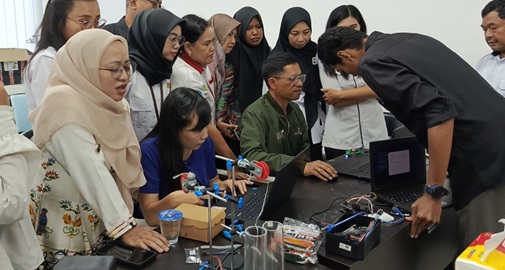
The challenges of Physics learning with abstract materials and the limited teaching aids make classroom instruction suboptimal, affecting students' interests and learning outcomes in Physics lessons. To help overcome this, this community service program is carried out to improve the competence of physics teachers in designing and using microcontroller-based learning media. The training consisted of three main sessions: the introduction to Arduino and ESP8266, the assembly of viscosity and temperature props, and the design of the practicum. The results of the training showed an increase in teachers' knowledge from an average of 1.67 to 4.01, with an N-Gain of 0.70, and in skills from 1.72 to 4.37, with an N-Gain of 0.81. The trainees responded positively with an average satisfaction score of 4.75 on a scale of 5. These results show that the training is considered relevant, useful, and well implemented. The next phase of service is assistance in the application of teaching aids in partner schools and practicum modules that can be used independently by teachers.
Downloads
Article Details

This work is licensed under a Creative Commons Attribution-ShareAlike 4.0 International License.
Authors who publish with this journal agree to the following terms:
- Any article on the copyright is retained by the author(s).
- Author grant the journal, right of first publication with the work simultaneously licensed under a Creative Commons Attribution License that allows others to share work with acknowledgment of the work authors and initial publications in this journal.
- Authors are able to enter into a separate, additional contractual arrangements for non-exclusive distribution of published articles of work (eg, post-institutional repository) or publish it in a book, with acknowledgment of its initial publication in this journal.
- Authors are permitted and encouraged to post their work online (e.g., in institutional repositories or on their websites) prior to and during the submission process, as can lead to productive exchanges, as well as earlier and greater citation of published work.
- The article and any associated published material is distributed under the Creative Commons Attribution-ShareAlike 4.0 International License
References
Azmi, I., Pangga, D., Ahzan, S., & Mirawati, B. (2024). Pelatihan Penyusunan Alat Peraktikum Sederhana bagi Asisten Laboratorium Fisika. Jurnal Pengabdian Magister Pendidikan IPA, 7(4), 1833-1841. https://doi.org/10.29303/jpmpi.v7i4.10023
Boimau, I., Mellu, R.N.K., & Manuain, M.R. 2020. Rancang Bangun Alat Praktikum Viskometer Berbasis Arduino. Wahana Fisika, 5(1), 28–40. https://doi.org/10.17509/wafi.v5i1.23903
Fransisca, V. D. (2023). Mengintegrasikan sistem teknologi dalam manajemen sarana dan prasarana untuk pendidikan yang lebih modern. Proceedings Series of Educational Studies. https://conference.um.ac.id/index.php/pses/article/view/7910
Haussler, P., & Hoffmann, L. A. 2000. Curricular frame for physics education: Development, comparison with students' interests, and impact on students' achievement and self‐concept. Science education, 84(6), 689-705. https://doi.org/10.1002/1098-237X(200011)84:6%3C689::AID-SCE1%3E3.0.CO;2-L
Hidayah, N., Talakua, P., Azis, D. A., & Maipauw, M. M. (2025). Development of Interactive Learning Media Based on Augmented Simulation Using PhET for Magnetic Field Material. Jurnal Pendidikan dan Ilmu Fisika, 5(1), 40-53. https://doi.org/10.52434/jpif.v5i1.42588
Kurniawati, N., Kerelius, S., Hakim, L., Wardani, D.A.P., Krestina, W.N, & Setiawan D.T. 2020. Pengaruh Variasi Waktu Paparan Gelombang Ultrasonik dalam Mengurangi Jumlah Bakteri coliform pada Sampel Air Sungai Kahayan. Risalah Fisika, 4(1), 9–13. https://doi.org/10.35895/rf.v4i1.168
Marlina, E., Afroni, M. J., Noerhayati, E., Choirotin, I., Yunior, Y. T. K., Badri, F., & Ingsih, I. S. (2021). Kredensial Mikro Mahasiswa Indonesia Technopreneurship Berbasis Internet Of Things (Iot). Unisma Press. https://eprints2.undip.ac.id/id/eprint/25512/7/Joshua%20Marcello_dapus.pdf
Maulia, A., Baihaqi, N., Faiz, N. F., Rizki, M., & Aribowo, D. (2024). Simulasi Pengukuran Suhu dan Kelembaban Ruangan Menggunakan Arduino Uno dan DHT22 pada Wokwi. Jurnal Teknik Mesin, Industri, Elektro dan Informatika, 3(4), 200-213. https://doi.org/10.55606/jtmei.v3i4.4544
Muchlis, F., Sulisworo, D., & Toifur, M. 2018. Pengembangan alat peraga fisika berbasis internet of things untuk praktikum Hukum Newton II. Jurnal Pendidikan Fisika, 6(1), 13-20. https://doi.org/10.55606/jtmei.v3i4.4544
Mustofa, I. (2021). Manajemen strategi pemberdayaan masyarakat:(evaluasi program pengabdian kepada masyarakat tematik pemberdayaan umat stai darussalam nganjuk). INTIZAM: Jurnal Manajemen Pendidikan Islam, 5(1), 29-48. https://doi.org/10.56393/jpkm.v6i1.3952
Qomariyah, N., Wirawan, R., Minardi, S., & Handayana, I. 2020. Pendalaman konsep fisika menggunakan alat peraga berbasis mikrokontroler pada siswa SMA. SELAPARANG: Jurnal Pengabdian Masyarakat Berkemajuan, 4(1): 486-490. https://doi.org/10.31764/jpmb.v4i1.3225
Rohimat, J., Kamil, M., & Saripah, I. (2025). Dampak Model Pelatihan Partisipatif Berbasis Komunitas Belajar Terhadap Kinerja Guru SMAN 1 Gunungsindur. Jurnal Ilmiah Global Education, 6(2), 1018-1034. https://doi.org/10.55681/jige.v6i2.3722
Sari, P. (2018). Evaluasi pelaksanaan revitalisasi posyandu dan pelatihan kader sebagai bentuk pengabdian masyarakat (Studi Kasus Di Rw 06 Desa Cileles Kecamatan Jatinangor Tahun 2017). Jurnal Pengabdian Kepada Masyarakat, 2(2), 93-97. https://jurnal.unpad.ac.id/pkm/article/view/16552
Tumper, R. 2006. Factors affecting junior high school students' interest in physics. Journal of science Education and Technology, 15(1), 47-58. https://doi.org/10.1007/s10956-006-0355-6?urlappend=%3Futm_source%3Dresearchgate.net%26utm_medium%3Darticle
Wahyuni, I., Maison, M., & Pathoni, H. 2021. Analisis minat belajar siswa pada mata pelajaran fisika di SMA Negeri 2 Kota Jambi. Physics and Science Education Journal (PSEJ), 22-28. https://doi.org/10.30631/psej.v1i1.711
Yusuf, M., & Sodik, M. (2023). Penggunaan teknologi Internet of Things (IoT) dalam pengelolaan fasilitas dan infrastruktur lembaga pendidikan Islam. PROPHETIK: Jurnal Kajian Keislaman, 1(2), 65-82. https://doi.org/10.35457/prophetik.v1i2.3233