Penguatan Kosakata Bahasa Inggris bagi Siswa SDN 27 Palembang Melalui Cerita Anak Multimodal
Enhancing English Vocabulary Learning among Elementary Students at SDN 27 Palembang through Indonesian Multimodal Children's Stories
DOI:
https://doi.org/10.33084/pengabdianmu.v11i9.12269Keywords:
English, Children stories, Vocabularies, Multimodal Text, Elementary SchoolAbstract
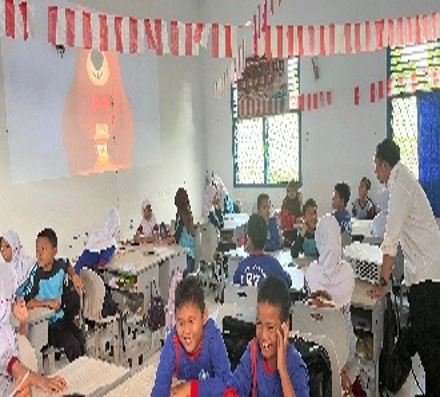
This community service activity focused on improving students' English vocabulary mastery at SDN 27 Palembang through the implementation of multimodal children's story texts. Vocabulary is a crucial component in language mastery; however, many students face difficulties in understanding and using English vocabulary due to the absence of English instruction at the elementary school level since 2013. This program aimed to enhance the vocabulary skills of early-grade students at SDN 27 Palembang using selected multimodal children's stories. The method used in this service activity involved socialization and demonstration sessions. A total of 27 fifth-grade students participated in the activity. In the socialization phase, the implementing team provided a theoretical session on multimodal texts in children’s stories. Additionally, the team discussed scheduling and follow-up implementation during this stage. The next phase was the classroom implementation using multimodal children’s stories, preceded by a pre-test to assess students' vocabulary skills. The program concluded with a post-test. The pre-test and post-test results showed an improvement in students' vocabulary knowledge. A 22.44% increase was recorded from the total participants. Students became more active and motivated in learning English. They were able to better understand and use English vocabulary after participating in learning sessions that used multimodal children’s stories. However, the program faced time limitations. With only four meetings held, the program's impact was limited. Therefore, it is recommended that teachers implement a more structured and regular multimodal story-based learning program to achieve more significant results.
Downloads
References
Anugrahmawaty, D. (2025, October 17). Perkuat kompetensi global, Bahasa Inggris akan wajib pada sekolah dasar mulai tahun ajaran 2027/2028. Kementerian Pendidikan Dasar dan Menengah. https://kemendikdasmen.go.id/siaran-pers/13897-perkuat-kompetensi-global-bahasa-inggris-akan-wajib-pada-sekolah-dasar-mulai-ta-20272028
Ardaya, A. C., Rahmadani, S. A., & Alfarisy, F. (2022). Penerapan pembelajaran Bahasa Inggris berdasarkan kebijakan Kurikulum 2013 di Sekolah Dasar Negeri 155 Gresik. Jurnal Pendidikan Indonesia, 3(1), 25–33. https://doi.org/10.59141/japendi.v3i01.481
Aziz, A. F. (2011). Korelasi antara penguasaan kosakata dengan kemampuan berbicara Bahasa Jepang siswa kelas XI Bahasa SMA Negeri 1 Purwareja Klampok Banjarnegara [Undergraduate thesis, Universitas Negeri Semarang].
Dari, T. R. W., Sholikhah, H. A., Alrefi, A., & Izzah, F. N. (2024). Minutes of English Songs Program in enhancing elementary school students’ vocabulary size. Abdi Dosen: Jurnal Pengabdian pada Masyarakat, 8(4), 1619–1629. https://doi.org/10.32832/abdidos.v8i4.2489
Dinas Pendidikan dan Kebudayaan Kabupaten Tegal. (2014). Mata pelajaran SD berdasarkan struktur Kurikulum 2013. https://dikbud.tegalkab.go.id/mata-pelajaran-sd-berdasarkan-struktur-kurikulum-2013/
EF Education First. (2025). EF English Proficiency Index 2025. https://www.ef.com/wwen/epi/
Kementerian Pendidikan, Kebudayaan, Riset, dan Teknologi Republik Indonesia. (2021). Capaian pembelajaran Bahasa Inggris SD Kurikulum Merdeka. https://guru.kemdikbud.go.id/kurikulum/referensi-penerapan/capaian-pembelajaran/sd-sma/bahasa-inggris/fase-a/
Lie, A. (2023). Bahasa Inggris dalam kurikulum SD. Pusat Standar dan Kebijakan Pendidikan. https://pskp.kemendikdasmen.go.id/gagasan/detail/bahasa-inggris-dalam-kurikulum-sd
McCarthy, M., & O’Dell, F. (2010). Test your English vocabulary in use: Elementary with answers (2nd ed.). Cambridge University Press.
Munafiah, N., Nirmala, I., Ferianto, Astuti, R., & Munir, M. (2024). Mengajar dengan cerita: Pendekatan berbasis narasi dalam pendidikan prasekolah yang menyenangkan dan ramah anak. Kiddo: Jurnal Pendidikan Islam Anak Usia Dini, 458–467. https://doi.org/10.19105/kiddo.v1i1.12754
Susanto, Y. D. T. (2017). Hubungan penguasaan kosakata dengan keterampilan berbicara dan menulis siswa kelas IV SDN Gugus Pangeran Diponegoro Kecamatan Ngaliyan [Undergraduate thesis, Universitas Negeri Semarang].
Wahyuningrum, D. W., Sumardi, & Setyaningsih, E. (2024). Exploring multimodal text practice among junior high school EFL teachers: A case study. International Journal of Educational Research and Social Sciences, 5(3), 420–429. https://doi.org/10.51601/ijersc.v5i3.810
Watcyn-Jones, P., & Johnston, O. (2002). Test your vocabulary. Pearson Education.
Yatri, I., Latifah, N., & Ninawati, M. (2024). Assessing the effectiveness of multimodal text-based whole-language learning materials for children. Al-Ishlah: Jurnal Pendidikan, 16(4), 5040–5052. https://doi.org/10.35445/alishlah.v16i4.5908
Downloads
Published
Issue
Section
License
Copyright (c) 2026 Tita Ratna Wulan Dari, Rita Inderawati, Sary Silvhiany, Machdalena Vianty, Amrullah Amrullah, Hariswan Putera Jaya, Hesti Wahyuni Anggraini, Muhammad Yazir, Firma Pradesta Amanah, Hasbi Thaufik Oktodila, Syafrizal Azzali, Fathimah Nurul Izzah, Jasmine Melati, Shakira Nadia

This work is licensed under a Creative Commons Attribution-ShareAlike 4.0 International License.
Authors who publish with this journal agree to the following terms:
- Any article on the copyright is retained by the author(s).
- Author grant the journal, right of first publication with the work simultaneously licensed under a Creative Commons Attribution License that allows others to share work with acknowledgment of the work authors and initial publications in this journal.
- Authors are able to enter into a separate, additional contractual arrangements for non-exclusive distribution of published articles of work (eg, post-institutional repository) or publish it in a book, with acknowledgment of its initial publication in this journal.
- Authors are permitted and encouraged to post their work online (e.g., in institutional repositories or on their websites) prior to and during the submission process, as can lead to productive exchanges, as well as earlier and greater citation of published work.
- The article and any associated published material is distributed under the Creative Commons Attribution-ShareAlike 4.0 International License