Diversifikasi Produk Berbasis Batang Pisang, Penguatan Pemasaran Digital, dan Branding pada Usaha Panti Asuhan Abadi Aisyiyah Kota Pare-pare Product Diversification Using Banana Pseudostem, Digital Marketing Enhancement, and Branding in the Business of Abadi Aisyiyah Orphanage, Parepare City
Article Sidebar
Main Article Content
Abstract
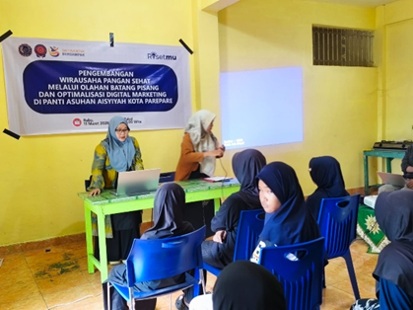
This community service program aimed to enhance the capacity of an orphanage-based micro-enterprise through product diversification, digital marketing support, and brand strengthening. The partner was Abadi Aisyiyah Orphanage in Parepare City, which manages a banana chips business. The program was implemented through initial observation, training on the utilization of banana pseudostem, digital marketing assistance, packaging and branding development, and program evaluation. The results showed an improvement in participants’ knowledge, with the mean score increasing from 50.00 to 80.50, a completion rate of 90%, and a normalized gain score of 0.61. The program also produced a new product in the form of banana pseudostem chips, activated digital marketing channels, and improved the partner’s brand and packaging concepts. In addition, the estimated monthly turnover increased from IDR 1,450,000 to IDR 2,050,000. These findings indicate that integrating product innovation, marketing digitalization, and branding can strengthen business readiness while supporting entrepreneurial learning in the orphanage environment.
Downloads
Article Details

This work is licensed under a Creative Commons Attribution-ShareAlike 4.0 International License.
Authors who publish with this journal agree to the following terms:
- Any article on the copyright is retained by the author(s).
- Author grant the journal, right of first publication with the work simultaneously licensed under a Creative Commons Attribution License that allows others to share work with acknowledgment of the work authors and initial publications in this journal.
- Authors are able to enter into a separate, additional contractual arrangements for non-exclusive distribution of published articles of work (eg, post-institutional repository) or publish it in a book, with acknowledgment of its initial publication in this journal.
- Authors are permitted and encouraged to post their work online (e.g., in institutional repositories or on their websites) prior to and during the submission process, as can lead to productive exchanges, as well as earlier and greater citation of published work.
- The article and any associated published material is distributed under the Creative Commons Attribution-ShareAlike 4.0 International License
References
Affandi, Y., Ridhwan, M. M., Trinugroho, I., & Adiwibowo, D. H. (2024). Digital adoption, business performance, and financial literacy in ultra-micro, micro, and small enterprises in Indonesia. Research in International Business and Finance, 70, 102376. https://doi.org/10.1016/j.ribaf.2024.102376
Badan Pusat Statistik Kota Parepare. (2025). Pertumbuhan ekonomi Kota Parepare tahun 2024. Parepare: Badan Pusat Statistik Kota Parepare. https://pareparekota.bps.go.id/id/pressrelease/2025/03/04/176/pertumbuhan-ekonomi-kota-parepare-tahun-2024.html
Barretta, L., David, M. L. S., & Lourenção, M. (2025). Tales or labels? The impact of storytelling and geographical indication label on consumers' attitudes towards brazilian canastra cheese. Food Quality and Preference, 124, 105683. https://doi.org/10.1016/j.foodqual.2025.105683
Bou-Mitri, C., Abdessater, M., Zgheib, H., & Akiki, Z. (2021). Food packaging design and consumer perception of the product quality, safety, healthiness and preference. Nutrition & Food Science, 51(1), 71–86. https://doi.org/10.1108/NFS-02-2020-0032
Endris, E., & Kassegn, A. (2022). The role of micro, small and medium enterprises (MSMEs) to the sustainable development of sub-Saharan Africa and its challenges: A systematic review of evidence from Ethiopia. Journal of Innovation and Entrepreneurship, 11, 20. https://doi.org/10.1186/s13731-022-00221-8
Food and Agriculture Organization. (1998). Food quality and safety systems: A training manual on food hygiene and the hazard analysis and critical control point (HACCP) system. Rome: FAO. https://openknowledge.fao.org/handle/20.500.14283/w8088e
Gayathry, K. S., & John, J. A. (2024). Physical, functional and bioactive properties of microencapsulated powders from banana pseudostem and inflorescence extracts. Food Production, Processing and Nutrition, 6, 74. https://doi.org/10.1186/s43014-024-00289-y
Idrus, I., Jumriani, J., Damis, S., Ramli, S. N., & Sahlan, M. (2024). Pemberdayaan masyarakat melalui pengelolaan usaha kripik bawang berbasis ekonomi kreatif warga Panti Asuhan Abadi Aisyiyah Kota Parepare. RESONA: Jurnal Ilmiah Pengabdian Masyarakat, 8(2), 283–288. https://doi.org/10.35906/resona.v8i2.2183.
iNews.id. (2018). Wali Kota Parepare perkenalkan kota industri tanpa cerobong asap.
Institut Teknologi Bacharuddin Jusuf Habibie. (n.d.). Monumen Cinta Sejati Habibie & Ainun.
Moretti, M. M. S., Borgonovi, T. F., Todorov, S. D., & Penna, A. L. B. (2025). Banana pseudostem by-product: A sustainable source of prebiotics and protection for probiotic lactic acid bacteria under gastrointestinal conditions. Fermentation, 11(8), 476. https://doi.org/10.3390/fermentation11080476
Mori, R., & Seo, Y. (2025). Unpacking consumer motivations for upcycled food purchases in Japan. Food and Humanity, 4, 100562. https://doi.org/10.1016/j.foohum.2025.100562
Munandar, J. M., Cahyadi, E. R., & Andrianto, M. S. (2025). The impacts of business sustainability factors on competitiveness and marketing performance: An exploratory approach to the case of Indonesian micro-, small, and medium enterprises. Sustainability, 17(10), 4593. https://doi.org/10.3390/su17104593
Media Indonesia. (2021). Kota Cinta, kota industri tanpa cerobong asap.
Pillai, G. S., Morya, S., Khalid, W., Khalid, M. Z., Almalki, R. S., & Siddeeq, A. (2024). Banana pseudostem: An undiscovered fiber enriched sustainable functional food. Journal of Natural Fibers, 21(1), 2304004. https://doi.org/10.1080/15440478.2023.2304004
Santoso, E. L., Vivian, W., & Prasetyaningtyas, S. W. (2022). Analysis of digital marketing processes to improve business performance: Foods and beverages MSMEs in Indonesia. Journal of Social Science, 3(1), 66–78. https://doi.org/10.46799/jss.v3i1.278
Sostar, M., Korov, T., & Pjero, E. (2025). The impact of packaging type and branding on consumer quality perception and preferences. International Review of Management and Marketing, 15(5), 283–296. https://doi.org/10.32479/irmm.19336
Tatik, T., & Setiawan, M. (2025). Does social media marketing important for MSMEs performance in Indonesia? Asia Pacific Journal of Marketing and Logistics, 37(1), 99–114. https://doi.org/10.1108/APJML-08-2023-0734
Umar, F., Sari, R. W., Thasim, S., Hasnaeni, H., & Ananda, S. R. (2024). Penguatan branding aspek gizi dan sertifikasi halal untuk meningkatkan mutu dan daya saing UMKM. Jurnal Abmas Negeri (JAGRI), 5(1), 77–85. https://doi.org/10.36590/jagri.v5i1.1280
Wibawa, B. M., Baihaqi, I., Nareswari, N., Mardhotillah, R. R., & Pramesti, F. (2022). Utilization of social media and its impact on marketing performance: A case study of SMEs in Indonesia. International Journal of Business and Society, 23(1), 19–34. https://doi.org/10.33736/ijbs.4596.2022
World Health Organization. (2026). Five keys to safer food. Geneva: WHO