Strategi Penguatan Kompetensi dan Keterampilan Guru dalam Integrasi Science, Technology, Mathematics Untuk Asesmen Kompetensi Minimum
Strategies for Strengthening Teachers' Competence and Skills in Integrating Science, Technology, and Mathematics for the Minimum Competency Assessment
DOI:
https://doi.org/10.33084/pengabdianmu.v11i10.12618Keywords:
AKM, Teacher Competence, STEM, TrainingAbstract
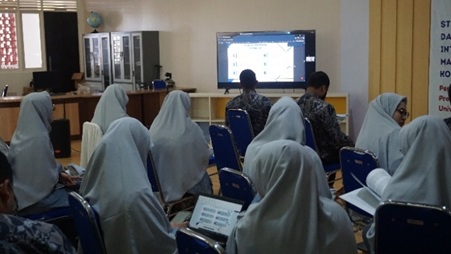
The quality of education in Indonesia still faces challenges in literacy and numeracy, as reflected in the results of the Program for International Student Assessment (PISA). The transformation of the National Examination into the Minimum Competency Assessment (AKM) requires teachers to master the skills needed to design competency-based assessments. However, teachers at SMA Al Izzah Batu City still need to strengthen their understanding and skills in integrating Science, Technology, and Mathematics (STeM) into teaching and assessment practices. This community service program aimed to enhance teachers' competence through structured activities, including socialization, training, and problem-solving simulations supported by the Safe Exam Browser (SEB). The implementation method consisted of needs identification, module development, pre-test, training in literacy and numeracy integration, simulation practices, post-test, and evaluation. The results showed a significant improvement in teachers' understanding after the training. The average pre-test score of 63.33 increased to 85.56 in the post-test. A paired-samples t-test confirmed a statistically significant difference (p < 0.001), with an effect size of 1.698, categorized as very large. These findings indicate that the program successfully strengthened teachers' competence in integrating STEM for AKM. Furthermore, the program contributes to achieving Sustainable Development Goals (SDGs) No. 4 on quality education while also preparing teachers to adapt to globalization and the rapid development of artificial intelligence technologies.Downloads
References
Apriliani, D. (2024). Penggunaan Artificial Intelligence dalam pembelajaran bahasa Indonesia. DIKBASTRA: Jurnal Pendidikan Bahasa Dan Sastra, 7(1). https://doi.org/10.22437/dikbastra.v7i1.33262
Hewi, L., Shaleh, M., & IAIN Kendari, P. (2020). Refleksi Hasil PISA (The Programme For International Student Assesment): Upaya Perbaikan Bertumpu Pada Pendidikan Anak Usia Dini). 04(1), 30–41. https://e-journal.hamzanwadi.ac.id/index.php/jga/article/view/2018
Putri, I. S., & Jazuli, A. (2025). Problematika Proses Berpikir Kritis Siswa SMK pada Pembelajaran Matematika Materi Sinus dan Cosinus. Jurnal Cendikia: Jurnal Pendidikan Matemarika, 09(01), 460–474. https://doi.org/10.31004/cendekia.v9i2.3965
Rahmawati, L., & Juandi, D. (2022). PEMBELAJARAN MATEMATIKA DENGAN PENDEKATAN STEM: SYSTEMATIC LITERATURE REVIEW. Teorema: Teori Dan Riset Matematika, 7(1), 149. https://doi.org/10.25157/teorema.v7i1.6914
Septiani Putri, I., Jazuli, A., & Magister Pendidikan Matematika, P. (2024). Problematika Proses Berpikir Kritis Siswa SMK pada Pembelajaran Matematika Materi Sinus dan Cosinus. 09, 460–474. https://doi.org/10.31004/cendekia.v9i1.3965
Subayani, N. W. (2022). Implementasi STEM (Science, Technology, Engineering and Mathematics) dalam Kurikulum PGSD. DIDAKTIKA : Jurnal Pemikiran Pendidikan, 28(2(1)), 49. https://doi.org/10.30587/didaktika.v28i2(1).4435
Sulistiono, E., Tjandrakirana, T., & Rahayu, Y. S. (2014). Peningkatan kemampuan berpikir kritis siswa menggunakan perangkat pembelajaran ipa smp berorientasi penyelesaian masalah. Jurnal Pena Sains, 1(2). https://garuda.kemdiktisaintek.go.id/documents/detail/433639
Thibaut, L., Ceuppens, S., De Loof, H., De Meester, J., Goovaerts, L., Struyf, A., Boeve-de Pauw, J., Dehaene, W., Deprez, J., De Cock, M., Hellinckx, L., Knipprath, H., Langie, G., Struyven, K., Van de Velde, D., Van Petegem, P., & Depaepe, F. (2018). Integrated STEM Education: A Systematic Review of Instructional Practices in Secondary Education. European Journal of STEM Education, 3(1). https://doi.org/10.20897/ejsteme/85525
Downloads
Published
Issue
Section
License
Copyright (c) 2026 Suliyanto Suliyanto, Dita Amelia, Marisa Rifada, Abel Febrian Dadi, Anggita Nariswari, Dinda Rahma Alya, Pradita Padya Pramesty, Selvina Cindy Kusumaningrum

This work is licensed under a Creative Commons Attribution-ShareAlike 4.0 International License.
Authors who publish with this journal agree to the following terms:
- Any article on the copyright is retained by the author(s).
- Author grant the journal, right of first publication with the work simultaneously licensed under a Creative Commons Attribution License that allows others to share work with acknowledgment of the work authors and initial publications in this journal.
- Authors are able to enter into a separate, additional contractual arrangements for non-exclusive distribution of published articles of work (eg, post-institutional repository) or publish it in a book, with acknowledgment of its initial publication in this journal.
- Authors are permitted and encouraged to post their work online (e.g., in institutional repositories or on their websites) prior to and during the submission process, as can lead to productive exchanges, as well as earlier and greater citation of published work.
- The article and any associated published material is distributed under the Creative Commons Attribution-ShareAlike 4.0 International License