Pemberdayaan Masyarakat melalui Pemanfaatan Limbah Daun Melon Menjadi Herbal Wash di Greenhouse PCM Kembaran, Banyumas Community Empowerment through the Utilization of Melon Leaf Waste into Herbal Hand Wash in the PCM Kembaran Greenhouse, Banyumas
Article Sidebar
Main Article Content
Abstract
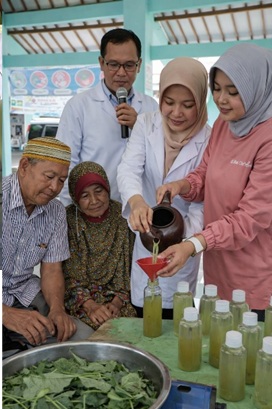
This community service program aimed to empower local communities in utilizing melon leaf waste (Cucumis melo) to produce herbal hand wash as a natural alternative to hand hygiene products. The main problems faced by the community included suboptimal management of organic waste and limited use of local resources to produce value-added products. The methods consisted of education, hands-on training, and assistance with the production process, including melon leaf extraction, formulation, and packaging. The results demonstrated a significant improvement in participants’ knowledge and skills, with production capability increasing from 20% to 90% and process understanding reaching 100%. The herbal wash product produced was safe for use and showed potential as an eco-friendly hygiene product. This program highlights that a practice-based empowerment approach is effective in enhancing community capacity while supporting sustainable waste management.
Downloads
Article Details

This work is licensed under a Creative Commons Attribution-ShareAlike 4.0 International License.
Authors who publish with this journal agree to the following terms:
- Any article on the copyright is retained by the author(s).
- Author grant the journal, right of first publication with the work simultaneously licensed under a Creative Commons Attribution License that allows others to share work with acknowledgment of the work authors and initial publications in this journal.
- Authors are able to enter into a separate, additional contractual arrangements for non-exclusive distribution of published articles of work (eg, post-institutional repository) or publish it in a book, with acknowledgment of its initial publication in this journal.
- Authors are permitted and encouraged to post their work online (e.g., in institutional repositories or on their websites) prior to and during the submission process, as can lead to productive exchanges, as well as earlier and greater citation of published work.
- The article and any associated published material is distributed under the Creative Commons Attribution-ShareAlike 4.0 International License
References
Bilan, Y., Mishchuk, H., Roshchyk, I., & Kmecova, I. (2020). An analysis of intellectual potential and its impact on the social and economic development of European countries. Journal of Competitiveness, 12(1), 22–38. https://doi.org/10.7441/joc.2020.01.02
Brunton, L.L., Hilal-Dandan, R., & Knollmann, B.C. (2018). Goodman and Gilman’s the pharmacological basis of therapeutics (13th ed.). New York: McGraw-Hill. https://accessmedicine.mhmedical.com/content.aspx?sectionid=165936845&bookid=2189
Chandra, S., Singh, R., & Kumari, N. (2020). Herbal soap formulation and evaluation. Journal of Pharmaceutical Sciences, 8(2), 45–52. https://doi.org/10.22271/phyto.2024.v13.i4a.14990
Cushnie, T.P.T., & Lamb, A.J. (2016). Antimicrobial activity of flavonoids. International Journal of Antimicrobial Agents, 26(5), 343–356. https://doi.org/10.1016/j.ijantimicag.2005.09.002
Daglia, M. (2012). Polyphenols as antimicrobial agents. Current Opinion in Biotechnology, 23(2), 174–181. https://doi.org/10.1016/j.copbio.2011.08.007
Fithri Mufriantie, Jabal Tarik Ibrahim, Nur Ocvanny Amir, Pelatihan Pembuatan Lilin Aromaterapi Berbahan Minyak Jelantah di Kelompok PKK Kendalsari Tulusrejo Lowokwaru Kota Malang, PengabdianMu: Jurnal Ilmiah Pengabdian kepada Masyarakat. 9, 3 (2024). https://doi.org/10.33084/pengabdianmu.v9i3.6373
Francis, G., Kerem, Z., Makkar, H.P.S., & Becker, K. (2002). The biological action of saponins in animal systems. British Journal of Nutrition, 88(6), 587–605. https://doi.org/10.1079/bjn2002725
Geissdoerfer, M., Savaget, P., Bocken, N.M.P., & Hultink, E.J. (2017). The circular economy – a new sustainability paradigm? Journal of Cleaner Production, 143, 757–768. https://doi.org/10.1016/J.JCLEPRO.2016.12.048
Hall, J.E. (2021). Guyton and Hall textbook of medical physiology (14th ed.). Philadelphia: Elsevier.
Katzung, B.G. (2021). Basic and clinical pharmacology (15th ed.). New York: McGraw-Hill.
Kaza, S., Yao, L., Bhada-Tata, P., & Van Woerden, F. (2018). What a waste 2.0: A global snapshot of solid waste management. Washington DC: World Bank. https://doi.org/10.1596/978-1-4648-1329-0
Kolb, D.A. (2015). Experiential learning: Experience as the source of learning and development (2nd ed.). New Jersey: Pearson. https://www.academia.edu/3432852/Experiential_learning_Experience_as_the_source_of_learning_and_development
Mukherjee, P.K., Nema, N.K., Maity, N., & Sarkar, B.K. (2016). Phytochemical and therapeutic potential of Cucurbitaceae family. Journal of Ethnopharmacology, 189, 75–90. https://doi.org/10.1016/j.fitote.2012.10.003
Nursiah, Putir PE, Madiyawati M, Rosdiana, Maryani. Pelatihan Pembuatan Sabun Cair dengan Penambahan Ekstrak Tanaman Lahan Rawa Gambut Galam (Melaleuca leucadendron Linn.) dan Telang Ternate (Clitoria ternatea) bagi Siswa SMK 1 Palangka Raya. PengabdianMu. 2024;9(5):761–769. https://doi.org/10.33084/pengabdianmu.v9i5.6176
Novrianti N, Purnamawati N, Anggreana V, Alwiah S, Harmiyati H, Mildawati R. Edukasi Green Chemistry: Daur Ulang Minyak Jelantah menjadi Sabun sebagai Upaya Pengurangan Limbah Rumah Tangga. PengabdianMu. 2025. https://doi.org/10.33084/pengabdianmu.v10i11.10752
Patel, D.K., Kumar, R., Laloo, D., & Hemalatha, S. (2012). Diabetes mellitus: Medicinal plants of Cucurbitaceae family. Asian Pacific Journal of Tropical Disease, 2(1), S437–S441. https://doi.org/10.1016/s2221-1691(12)60067-7
Prince, M. (2020). Does active learning work? A review of the research. Medical Education, 54(4), 321–331. https://doi.org/10.1002/j.2168-9830.2004.tb00809.x
Rani, P., Kumar, N., Perinbam, K., & Sharma, V. (2023). Green synthesis of silver nanoparticles using Cucumis melo leaf extract. Molecules, 28(3), 1123. https://doi.org/10.3390/molecules28134995
Rang, H.P., Ritter, J.M., Flower, R.J., & Henderson, G. (2021). Rang and Dale’s pharmacology (9th ed.). London: Elsevier. https://dokumen.pub/rang-dales-pharmacology-9th.html
Sagar, N.A., Pareek, S., Sharma, S., Yahia, E.M., & Lobo, M.G. (2018). Fruit and vegetable waste: Bioactive compounds and their utilization. Journal of Food Science and Technology, 55(2), 432–443. https://doi.org/10.1111/1541-4337.12330
Sasidharan, S., Chen, Y., Saravanan, D., Sundram, K.M., & Yoga Latha, L. (2018). Extraction, isolation and characterization of bioactive compounds. Food and Chemical Toxicology, 120, 1–10. https://doi.org/10.4314/ajtcam.v8i1.60483
Satorov, S., Mavlonazarova, S., Yusufi, S., & Dushenkov, V. (2024). Antibacterial and antifungal properties of plant polyphenols. Journal of Drug and Alcohol Research, 13, 1–10. https://doi.org/10.5772/intechopen.101664
Septiana Ambarwati, N.A., Hidayati, N.A., & Hutapea, H.P. (2024). Pelatihan pembuatan sabun herbal sereh wangi. SAFARI: Jurnal Pengabdian Masyarakat Indonesia, 5(1), 12–18. https://ejournalunwmataram.org/index.php/jaltn/article/download/1732/1014
Silverthorn, D.U. (2019). Human physiology: An integrated approach (8th ed.). Boston: Pearson.
UNDP. (2020). Sustainable development goals report. New York: United Nations Development Programme.
UNICEF. (2021). Handwashing with soap: Global progress report. New York: United Nations Children’s Fund.
Waluyo, & Kharisma, D.B. (2023). Circular economy and food waste management in Indonesia. Journal of Environmental Management, 45(2), 100–110. https://doi.org/10.1080/23311886.2023.2202938?
WHO. (2020). WHO guidelines on hand hygiene in health care. Geneva: World Health Organization