Penerapan Teknologi Tepat Guna Pengolahan Limbah Perikanan menjadi Nutrisi Tanaman dan Pupuk Organik Implementation of Appropriate Technology for Fishery Waste Processing into Plant Nutrients and Organic Fertilizer
Article Sidebar
Main Article Content
Abstract
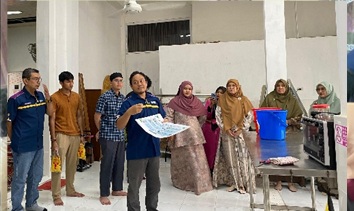
Fish processing activities generate organic waste, including fish scales and processing residues, which may cause environmental pollution if not properly managed. However, these wastes have the potential to be used as plant nutrients and organic fertilizers, adding economic value. This community service program aimed to improve the knowledge and skills of members of the Aceh Fish Jelly Production Cooperative in processing fishery waste by applying appropriate technology based on community empowerment. The program was implemented through socialization, training, demonstrations, hands-on practice, and mentoring. Fish scales were processed into calcium powder for plant nutrition, while fish processing residues were converted into liquid organic fertilizer through a fermentation process. Evaluation was conducted using initial and final assessments as well as observations of participants’ practical skills. The results showed an increase in the average score from 58.60 in the initial assessment to 82.93 in the final assessment, representing a 41.52% improvement. In addition, all participants achieved a high skill category after completing the training and were able to independently produce calcium powder and liquid organic fertilizer from fishery waste. The application of appropriate technology for processing fishery waste was effective in enhancing community knowledge and skills, reducing the potential for environmental pollution, and promoting the conversion of waste into useful, economically valuable products.
Downloads
Article Details

This work is licensed under a Creative Commons Attribution-ShareAlike 4.0 International License.
Authors who publish with this journal agree to the following terms:
- Any article on the copyright is retained by the author(s).
- Author grant the journal, right of first publication with the work simultaneously licensed under a Creative Commons Attribution License that allows others to share work with acknowledgment of the work authors and initial publications in this journal.
- Authors are able to enter into a separate, additional contractual arrangements for non-exclusive distribution of published articles of work (eg, post-institutional repository) or publish it in a book, with acknowledgment of its initial publication in this journal.
- Authors are permitted and encouraged to post their work online (e.g., in institutional repositories or on their websites) prior to and during the submission process, as can lead to productive exchanges, as well as earlier and greater citation of published work.
- The article and any associated published material is distributed under the Creative Commons Attribution-ShareAlike 4.0 International License
References
Alegre, A. B., Alegre, J. M. D., & Maguate, G. S. (2023). Fish wastewater and fish scale: A corn soil enhancer. International Journal of Scientific Research and Management, 11(11), 10–22. https://doi.org/10.18535/ijsrm/v11i11.fa01
Ciptono, E. B., & Khoir, M. (2022). Composition analysis of bokashi organic fertilizer from fish flour fishery waste. Journal of Fisheries Research, 2(1), 1–8. https://ejournal.unwaha.ac.id/index.php/agaricus/article/view/2767/1264
Devi, N. L., Singh, A. H., Nongthombam, J., Kumar, S., & Chaudhary, K. (2024). Fish waste compost: A fertilizer for organic agriculture. Agricultural Science Review, 46(11), 778–785. https://doi.org/10.9734/jeai/2024/v46i113098
Hasibuan, I., Prihanani, & Puspitasari, M. (2021). Parameter kematangan fisik, kimia, dan biologis pupuk bokashi ikan rucah (Physical, chemical, and biological maturity parameters of fish waste bokashi). Jurnal Akuakultur, 19(2), 212–219. https://doi.org/10.32663/ja.v
Huldiansyah, D., Tajri, F., Hermawan, M. I., Widyono, M. A., Chaerani, A. D., Az-Zahra, F., Milano, N. C., & Anggraeni, N. (2022). Pemberdayaan masyarakat melalui program pengolahan makanan inovatif berbasis ikan di RT 32 Manggar Baru Kota Balikpapan. Jurnal Pengabdian Masyarakat, 5(4), 2306–2321. https://prosiding.unimus.ac.id/index.php/semnas/article/view/1228
Kristina, P., Saputra, E., Marbun, R., Situmengan, M., Sianturi, H. U., Hutauruk, R., Tinambunan, T., Purba, W., Sinurat, D. S., Siagian, N., Mulyadi, A. R., Marbun, W. M., Lumbantoruan, E. H., & Rahayuningsih, S. E. A. (2024). Pemberdayaan sumber daya alam di bidang perikanan sebagai mata pencaharian masyarakat Kelurahan Petuk Katimpun. Jurnal Pengabdian Kepada Masyarakat, 9(5), 883–888. https://doi.org/10.33084/pengabdianmu.v9i5.6175
Manalu, J., Haryati, K., Aris, K., & Manalu, A. (2024). Management of fishery waste into liquid organic fertilizer in Hamadi Jayapura. Abdimas: Jurnal Pengabdian Masyarakat Universitas Merdeka Malang, 9(4), 912–921. https://doi.org/10.26905/abdimas.v9i4.13862
Murdaningsih, & Rahayu, P. S. (2021). Aplikasi pupuk organik cair limbah ikan pada tanaman mentimun (Cucumis sativus L.). Jurnal Pertanian Berkelanjutan, 14(1), 1–10. https://doi.org/10.37478/agr.v14i1.969
Mulyono, S.E., Tria Riasih, T., Candra, M. F. S., Islamia, H. 2023. Pemanfaatan Limbah Pengolahan Ikan Menjadi Pupuk Organik Cair (POC) di Desa Randu Putih. Jurnal Peradaban Masyarakat, 3 (5), 185-188. https://doi.org/10.55182/jpm.v3i5.306
Nurul, S., Irwan, R., Yuwono, N. W., Utami, R. N., & Ilmiah, H. H. (2025). Peningkatan kapasitas masyarakat melalui pengolahan limbah organik untuk pupuk tanaman di pekarangan perkotaan (Community capacity building through treatment of organic waste for plant fertilizer at urban home garden Pekarangan). Jurnal Pengabdian Lingkungan, 9(2), 164–172. https://doi.org/10.29244/agrokreatif.9.2.164-172
Radziemska, M., Daria, M., Dana, V., Martin, A., & Zbigniew, B. (2019). Valorization of fish waste compost as a fertilizer for agricultural use. Waste and Biomass Valorization, 10(9), 2537–2545. https://doi.org/10.1007/s12649-018-0288-8
Ranasinghe, R., Kannagara, B., & Ratnayake, R. (2021). Hydrolysis of fish waste using fruit wastes of Ananas comosus and Carica papaya for the formulation of liquid fertilizers. International Journal of Recycling of Organic Waste in Agriculture, 10(2), 129–143. https://doi.org/10.30486/IJROWA.2021.1891960.1034
Rinaldi, K., Fathurrahman, F., Vaulina, S., Rafli, M. A., & Yulia, D. (2025). Community empowerment through processing salai patin fish waste into organic fertilizer in Koto Mesjid Village. Dinamisia: Jurnal Pengabdian Kepada Masyarakat, 9(1), 301–310. https://doi.org/10.31849/dinamisia.v9i1.22992
Sahubawa, L. 2018. Teknologi Pengolahan Limbah Hasil Perikanan. Yogyakarta: Gadjah Mada University Press.
Setiani, V., Dewi, T. U., Nindyapuspa, A., Kristina, D. M., & Devi, Y. N. (2023). The effect of addition EM4 solution on vermicomposting fish waste to increase CNPK regosol soil. Jurnal Presipitasi, 20(3), 713–726. https://doi.org/10.14710/presipitasi.v20i3.713-726
Suwandi, S., Supriadi, A., Purwanto, B. 2014. Pembuatan Pupuk Organik Cair dari Limbah Jeroan Ikan Patin (Pangasius sp.). Jurnal Teknologi Hasil Perikanan, 3(1), 11-20. https://garuda.kemdiktisaintek.go.id/documents/detail/5888095
Tray, E., Sheehan, T., Brophy, D., Eyto, E. D., Crowley, Q. G., Maoileidigh, N. O., & Bradbury, I. (2024). Examining fish scale biomineral from Atlantic salmon populations. Journal of Fish Biology, 105(4), 1951–1955. https://doi.org/10.1111/jfb.15904