Meningkatkan Keterampilan Saé Tiba Meka Siswa/I SDK Lungar dan SMPN 10 Satar Mese sebagai Wujud Hospitalitas Intersubjektif dalam Budaya Manggarai
Enhancing the Saé Tiba Meka Skills of Students at SDK Lungar and SMPN 10 Satar Mese as a Manifestation of Intersubjective Hospitality in Manggarai Culture
DOI:
https://doi.org/10.33084/pengabdianmu.v11i9.13355Keywords:
Intersubjective Hospitality, Adak Tiba Meka, Saé Tiba Meka, Manggarai Culture, Traditional Arts EducationAbstract
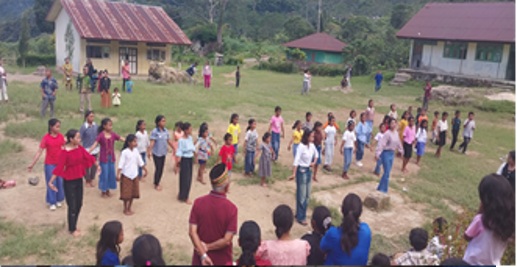
This Community Service Program (PkM), conducted by the team from UNIKA Santu Paulus Ruteng, aims to enhance students' traditional Saé Tiba Meka performance skills at SDK Lungar and SMPN 10 Satar Mese, thereby strengthening the values of intersubjective hospitality embedded in Manggarai culture. The program is expected to foster students’ self-confidence, physical and psychomotor development, teamwork, and a sense of responsibility for preserving local cultural heritage. In general, the program addresses issues related to inadequate treatment of guests, while specifically responding to the shortage of qualified trainers and the limited understanding of authentic dance movements and traditional gong-and-drum musical accompaniment. The program was implemented through a structured three-stage approach: (1) a preparation stage, during which the team established communication with community partners, designed socialization materials, and strengthened its technical mastery of the dance movements; (2) an implementation stage consisting of a socialization phase and a training phase aimed at developing proficiency in Saé Tiba Meka skills; and (3) an evaluation stage conducted regularly at the end of each training session and comprehensively at the conclusion of the entire program. Through mastery of the Saé Tiba Meka dance tradition, students are expected to internalize the philosophical values of their local culture, particularly those expressed through performing arts and movement, and to improve the quality of hospitality and guest reception practices in their daily lives.
Downloads
References
Agier, M. (2021). The stranger as my guest: A critical anthropology of hospitality. Polity Press. https://doi.org/10.1093/ijrl/eeac001
Amat, A., dkk. (2024). Pelestarian nilai sakralitas musik tradisional dalam ritus adat. Jurnal Budaya Nusantara, 11(1), 34–45. https://doi.org/10.3390/INFO13060277
Bahri, S., & Abdilah, A. (2022). Keberlanjutan destinasi pariwisata internasional berbasis kearifan lokal di Nusa Tenggara Timur. Jurnal Riset Pariwisata, 5(2), 112–125. https://ejournal.undiksha.ac.id/index.php/MKG/oai?metadataPrefix=oai_dc&from=2020-11-11&verb=ListRecords
Bandem, I. M., & de Boer, F. (1995). Balinese dance in transition. Oxford University Press.
Banio, A., & Malchrowicz-Mośko, E. (2019). Dance in tourism from an anthropological perspective. International Journal of Culture and History, 5(2), 15–20. https://doi.org/10.2478/tour-2019-0002
Bringle, R. G., & Hatcher, J. A. (1996). Implementing service-learning in higher education. The Journal of Higher Education, 67(2), 221–239.Dais-Mohadali, S. (2025). Embodied Traditions: A Qualitative Exploration of Cultural Identity Through Indigenous Physical Education Practices. 7(SI2), 452–467. https://doi.org/10.63931/ijchr.v7isi2.189
Derrida, J. (2000). Of hospitality (R. Bowlby, Penerj.). Stanford University Press. https://www.academia.edu/279793/Jacques_Derridas_Philosophy_of_Hospitality
Diamond, J. (2010). Social intervention project lifecycle: From preparation to evaluation impact. Academic Press. https://doi.org/10.3390/ijerph192013357?urlappend=%3Futm_source%3Dresearchgate.net%26utm_medium%3Darticle
Fitts, P. M., & Posner, M. I. (1967). Human performance. Brooks/Cole.
Garcia, J. (2024). A Ynanong Dance Literature Development for Cultural Empowerment of Ynanong Tribe. 1(1), 21–33. https://doi.org/10.62718/vmca.ssl-wjhdsr.1.1.sc-0624-020
Guittap, J. P. A., & Rabago, J. K. M. (2025). An Ethnochoreological Study on the Role of the Empanada Festival Dance in Preserving the Local Identity of the Bataquenos of Batac, Ilocos Norte. Journal of Scientific Research and Reports, 31(8), 876–885. https://doi.org/10.9734/jsrr/2025/v31i83431
Goffman, E. (1959). The presentation of self in everyday life. Anchor Books. https://www.researchgate.net/publication/384827912_Erving_Goffman_The_Presentation_of_Self_in_Everyday_Life
Hanna, J. L. (1987). To dance is human: A theory of nonverbal communication. University of Chicago Press. https://doi.org/10.2307/851611
Hawkins, A. M. (1991). Moving from within: A new method for dance making. A Cappella Books. http://archive.org/details/movingfromwithin0000hawk
Hawkins, A. M. (2003). Bergerak menurut kata hati: Metoda baru dalam menciptakan tari (I. W. Dibia, Penerj.). Ford Foundation & Masyarakat Seni Pertunjukan Indonesia. https://doi.org/10.21831/imaji.v20i2.45108
Herin, F. N., dkk. (2026). Evaluasi pelayanan keselamatan fasilitas publik pada destinasi wisata alam. Kompas.
Hormat, S. (2023). Adak Tiba Meka: Tatacara dan etika menerima tamu masyarakat Manggarai. Penerbit Nusa Indah. https://doi.org/10.34007/jehss.v5i3.1509
Humas Polri. (2026). Laporan penindakan agen perjalanan ilegal dan kriminalitas di kawasan destinasi wisata. Divisi Humas Kepolisian Republik Indonesia. https://repository.unpas.ac.id/view/subjects/G.html
Kielsmeier, J. C., & Willits, R. (1993). The core cycle of community projects: Phase 1 to phase 3. National Youth Leadership Council. https://doi.org/10.2307/23036112
Kompas. (2025). Dampak maraknya penipuan travel agen ilegal terhadap citra pariwisata daerah. Kompas.
Kurniawati, D. (2018). Metodologi pengabdian masyarakat: Pendekatan program berbasis kebutuhan mitra. Penerbit Universitas Pendidikan Indonesia. https://doi.org/10.30598/pakem.6.1.90-101
Mauss, M. (1925). Essai sur le don: Forme et raison de l'échange dans les sociétés archaïques. L'Année Sociologique. https://journals.openedition.org/lectures/520
Mauss, M. (2002). The gift: The form and reason for exchange in archaic societies (I. Cunnison, Penerj.). Routledge. (Karya asli diterbitkan tahun 1925). https://doi.org/10.4324/9781003572350
Menggo, S., dkk. (2021). Merajut keharmonisan dan relasi sosial melalui tradisi lisan Tiba Meka. Jurnal Kajian Budaya, 9(3), 201–214.
Murgiyanto, S. (1993). Ketika cahaya memudar: Sebuah kritik tari. Deviri Ganan.
Murgiyanto, S. (2002). Kritik tari: Pengetahuan dan apresiasi. Dewan Kesenian Jakarta.
Ndiung, S., & Bayu, G. W. (2019). Penanaman nilai kesopanan dan identitas kultural pada generasi muda melalui tradisi lokal Manggarai. Jurnal Pendidikan dan Kebudayaan, 4(2), 145–158.
Pandor, P. (2015). Etnografi komunikasi dalam ritus adat masyarakat Manggarai. Jurnal Pendidikan Bahasa dan Sastra, 14(2), 88–99.
Pitt-Rivers, J. (1977). The fate of Shechem, or the politics of sex: Essays in the anthropology of the Mediterranean. Cambridge University Press. https://www.booksamillion.com/product/A18951817849?id=9777193244449
Plataran Editorial. (2026). Makna sakralitas menerima tamu dalam perspektif kebudayaan nusantara. Plataran Culture Portal.
Purnama, H. (2025). Sinergitas model kolaborasi hexahelix dalam inovasi sosial di Indonesia. Rajawali Pers. https://repository.lppm.unila.ac.id/view/subjects/H1.type.html
Richard, G. (2018). Cultural tourism: Global and local perspectives. Routledge.
Rossi, P. H., Freeman, H. E., & Lipsey, M. W. (1999). Evaluation: A systematic approach (edisi ke-6). Sage Publications. https://books.google.co.id/books/about/Evaluation.html?id=7fxGAAAAMAAJ&redir_esc=y
Royce, A. P. (2002). The anthropology of dance. Indiana University Press.
Scribd. (2025). Analisis fungsi filosofis dan estetis tarian Saé Tiba Meka Manggarai. Scribd Digital Repository.
Sukur, M., & Gunas, T. (2026). Manajemen strategis berbasis komunitas lokal dalam merawat kearifan lokal di era modernisasi. Jurnal Administrasi Publik, 14(1), 56–69. https://repository.unpas.ac.id/view/subjects/G.html
Sumandiyo Hadi, Y. (2003). Koreografi: Bentuk-teknik-isi. Cipta Media.
Sumandiyo Hadi, Y. (2007). Seni tari: Pengkajian, teks, dan konteks. Pustaka Book Publisher.
UNICEF. (2020). Standard Operating Procedures (SOP): Community-based program management cycle. UNICEF Operational Guidelines. https://www.unicef.org/laos/media/10206/file/SOP%20Child%20Protection%202023.pdf
Downloads
Published
Issue
Section
License
Copyright (c) 2026 Inosensius Sutam, Fransiskus Jemadi, Monika Suryani Sritanu, Maria Felisandria Jediut, Laurensia Yuni Andini, Modestus Andriano Junino Jehati, Ignasius Greving, Leliana Lindawati, Fridolina Aswinda Karlota

This work is licensed under a Creative Commons Attribution-ShareAlike 4.0 International License.
Authors who publish with this journal agree to the following terms:
- Any article on the copyright is retained by the author(s).
- Author grant the journal, right of first publication with the work simultaneously licensed under a Creative Commons Attribution License that allows others to share work with acknowledgment of the work authors and initial publications in this journal.
- Authors are able to enter into a separate, additional contractual arrangements for non-exclusive distribution of published articles of work (eg, post-institutional repository) or publish it in a book, with acknowledgment of its initial publication in this journal.
- Authors are permitted and encouraged to post their work online (e.g., in institutional repositories or on their websites) prior to and during the submission process, as can lead to productive exchanges, as well as earlier and greater citation of published work.
- The article and any associated published material is distributed under the Creative Commons Attribution-ShareAlike 4.0 International License