Pelatihan Membuat Kompos dengan Metode Keranjang Takakura untuk Mendukung Vertikultur di Lahan Pekarangan
Takakura Basket Composting Training to Support Verticulture in Home Gardens
DOI:
https://doi.org/10.33084/pengabdianmu.v11i9.13501Keywords:
Home garden, Home organic waste, Organic composting, Takakura basket, VerticultureAbstract
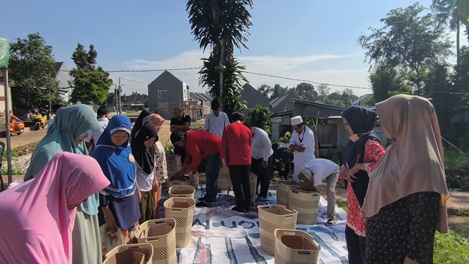
Household organic waste management and the optimization of limited yard land are two interrelated issues in dense urban settlements. This community service program aimed to enhance the knowledge, practical skills, and commitment of residents in Kampung Cinangka RT/RW 001/003, Kedaung Village, Sawangan District, Depok City, West Java, in processing household organic waste into compost using the Takakura Basket method, while utilizing the resulting compost to support vegetable cultivation through verticultural techniques in home gardens. The program was designed using the Stanford d.school Design Thinking model, implemented through five sequential stages: Empathize, Define, Ideate, Prototype, and Test. Training activities were conducted in two sessions: Takakura composting training (17 May 2025) and verticultural training (14 September 2025), each supplemented with pre- and post-tests to evaluate knowledge improvement. Normalized Gain (N-Gain) analysis revealed a Medium category improvement (g = 0.67) for the Takakura session and a High category improvement (g = 0.70) for the verticultural session. All participants successfully mastered the practical skills of composting and verticulture within a single training session, demonstrating high enthusiasm and commitment to independent application. Physical outputs included the distribution of Takakura Basket and verticultural installations to participants, as well as a custom-made iron rack as permanent communal green area infrastructure. This program produced a mutually reinforcing dual impact: (1) reduction of household organic waste volume diverted to the final disposal site; and (2) improvement of household food security through productive utilization of home garden space.Downloads
References
Adriani, A., Suleyman, S., Ishak, L., Sidayat, M., & Nurjannah, S. (2024). Penerapan vertikultur untuk mendukung keberlanjutan lingkungan. Community Development Journal: Jurnal Pengabdian Masyarakat, 5(6), 12597–12600. https://doi.org/10.31004/cdj.v5i6.40276
Badan Pusat Statistik Kota Depok. (2024). Kota Depok dalam Angka 2024. BPS Kota Depok. https://depokkota.bps.go.id/id/publication/2024/02/28/59aeb93e714a788f1c4d908d/kota-depok-dalam-angka-2024.html
Brown, T. (2009). Change by Design: How Design Thinking Transforms Organizations and Inspires Innovation. HarperCollins. https://doi.org/10.23860/MGDR-2019-04-02-08
Dhokhikah, Y., Trihadiningrum, Y., & Sunaryo, S. (2015). Community participation in household solid waste reduction in Surabaya, Indonesia. Resources, Conservation and Recycling, 102, 153–162. https://doi.org/10.1016/j.resconrec.2015.06.013
Ekawandani, N., & Kusuma, A. A. (2018). Pengomposan sampah organik (kubis dan kulit pisang) dengan menggunakan EM4. Jurnal TEDC, 12(1), 38–43. http://ejournal.poltektedc.ac.id/index.php/tedc/article/view/129
Ghufron, M. A., Rozak, R. R., Fitrianingsih, A., Matin, M. F., & Amin, A. K. (2017). Pelatihan pengolahan sampah organik menjadi kompos dengan media keranjang Takakura. J-ABDIPAMAS: Jurnal Pengabdian Kepada Masyarakat, 1(1), 98–108. https://doi.org/10.30734/j-abdipamas.v1i1.112
Hake, R. R. (1998). Interactive-engagement versus traditional methods. American Journal of Physics, 66(1), 64–74. https://doi.org/10.1119/1.18809
Harlis, Yelianti, U., Budiarti, R. S., & Hakim, N. (2019). Pelatihan pembuatan kompos organik metode keranjang Takakura sebagai solusi penanganan sampah di lingkungan kost mahasiswa. DEDIKASI: Jurnal Pengabdian Masyarakat, 1(1), 1–8. https://doi.org/10.32332/1598
Hidayati, N., Rosawanti, P., Arfianto, F., & Hanafi, N. (2018). Pemanfaatan lahan sempit untuk budidaya sayuran dengan sistem vertikultur. PengabdianMu: Jurnal Ilmiah Pengabdian kepada Masyarakat, 3(1), 40–46. https://doi.org/10.33084/pengabdianmu.v3i1.28
Kusumaningtiar, D. A., Vionalita, G., Swamilaksita, P. D., & Anggara, T. R. (2022). Sustainable community empowerment with household organic waste management. Piramida: Jurnal Pengabdian Masyarakat, 1(2), 50–55. https://journal.unimerz.com/index.php/piramida
Kusumo, R. A. B., Sukayat, Y., Heryanto, M. A., & Wiyono, S. N. (2020). Budidaya sayuran dengan teknik vertikultur untuk meningkatkan ketahanan pangan rumah tangga di perkotaan. Dharmakarya: Jurnal Aplikasi Ipteks untuk Masyarakat, 9(2), 89–92. https://doi.org/10.24198/dharmakarya.v9i2.23470
Kurniawan, T. A., & de Oliveira, J. A. P. (2014). Technology adaptation and assimilation of Takakura for promoting environmental protection in Surabaya (Indonesia) through city-level cooperation. In D. Vazquez-Brust, J. Sarkis, & J. J. Cordeiro (Eds.), Collaboration for Sustainability and Innovation: A Role for Sustainability Driven by the Global South. Greening of Industry Networks Studies, 3 (pp. 351–373). Springer. https://doi.org/10.37329/ganaya.v5i1.1601
Larasati, A. A., & Puspikawati, S. I. (2019). Pengolahan sampah sayuran menjadi kompos dengan metode Takakura. Ikesma: Jurnal Ilmu Kesehatan Masyarakat, 15(2), 60–68. https://doi.org/10.19184/ikesma.v15i2.14156
Mayasari, D. A. (2021). Atasi limbah organik melalui pelatihan pembuatan pupuk kompos metode keranjang Takakura kepada Kelompok Dawis Cempaka Semarang. Abdimasku: Jurnal Pengabdian Masyarakat, 4(1), 49–55. https://doi.org/10.33633/ja.v4i1.145
Noviana, L., & Sukwika, T. (2020). Pemanfaatan sampah organik sebagai pupuk kompos ramah lingkungan di Kelurahan Bhaktijaya Depok. Jurnal Pengabdian UntukMu NegeRI, 4(2), 237–241. https://doi.org/10.37859/jpumri.v4i2.2155
Prabowo, A., & Alif, M. I. (2023). Pemberdayaan masyarakat melalui kegiatan urban farming dan pengelolaan sampah di Kelurahan Gunung Samarinda Baru. PengabdianMu: Jurnal Ilmiah Pengabdian kepada Masyarakat, 8(6), 809–815. https://doi.org/10.33084/pengabdianmu.v8i6.5006
Rosmala, A., Mirantika, D., & Rabbani, W. (2020). Takakura sebagai solusi penanganan sampah organik rumah tangga. Abdimas Galuh, 2(2), 165–174. https://doi.org/10.25157/ag.v2i2.4088
Sari, N. P., Maharmi, B., Zaiyar, Setiani, Y., & Rini, S. (2021). Pelatihan pengelolaan sampah organik skala rumah tangga menggunakan metode keranjang Takakura. Dinamisia: Jurnal Pengabdian Kepada Masyarakat, 5(6), 1529–1534. https://doi.org/10.31849/dinamisia.v5i6.7858
Soliati, S. (2019). Community empowerment in managing waste through Takakura training. Empowerment, 8(1), 49–55. https://doi.org/10.22460/empowerment.v8i1p49-55.1158
Solikah, U. N., Rahayu, T., & Dewi, T. R. (2020). Optimalisasi urban farming dengan vertikultur sayuran. WASANA NYATA, 3(2), 168–173. https://doi.org/10.36587/wasananyata.v3i2.529
Solikah, U. N., Afifah, S. N., Ashari, R. A., & Paramita, H. (2023). Pemanfaatan lahan pekarangan dengan teknik vertikultur untuk mendukung ketahanan pangan keluarga. Janita: Jurnal Pengabdian kepada Masyarakat, 2(2), 68–73. https://doi.org/10.36563/pengabdian.v2i2.610
Tchobanoglous, G., Theisen, H., & Vigil, S. A. (1993). Integrated Solid Waste Management: Engineering Principles and Management Issues. McGraw-Hill. https://www.scirp.org/reference/referencespapers?referenceid=1959566
Downloads
Published
Issue
Section
License
Copyright (c) 2026 Risman Ramadwika, Rizky Lutfi Suprabowo, Mochammad Yunus Gerry Fitriadi, Fauzan Hamdani, Faujatul Hasanah

This work is licensed under a Creative Commons Attribution-ShareAlike 4.0 International License.
Authors who publish with this journal agree to the following terms:
- Any article on the copyright is retained by the author(s).
- Author grant the journal, right of first publication with the work simultaneously licensed under a Creative Commons Attribution License that allows others to share work with acknowledgment of the work authors and initial publications in this journal.
- Authors are able to enter into a separate, additional contractual arrangements for non-exclusive distribution of published articles of work (eg, post-institutional repository) or publish it in a book, with acknowledgment of its initial publication in this journal.
- Authors are permitted and encouraged to post their work online (e.g., in institutional repositories or on their websites) prior to and during the submission process, as can lead to productive exchanges, as well as earlier and greater citation of published work.
- The article and any associated published material is distributed under the Creative Commons Attribution-ShareAlike 4.0 International License