Langkah Awal Tani Berkelanjutan: Sosialisasi Pengendalian Hayati Hama Tikus dan Penyakit Tanaman Pangan Lahan Basah
Sustainable Farming Foundations: Educating Farmers on Biological Control of Rodent Pests and Wetland Plant Diseases
DOI:
https://doi.org/10.33084/pengabdianmu.v11i9.13618Keywords:
Plant-disturbing organisms, Plant diseases, Ricefield ratsAbstract
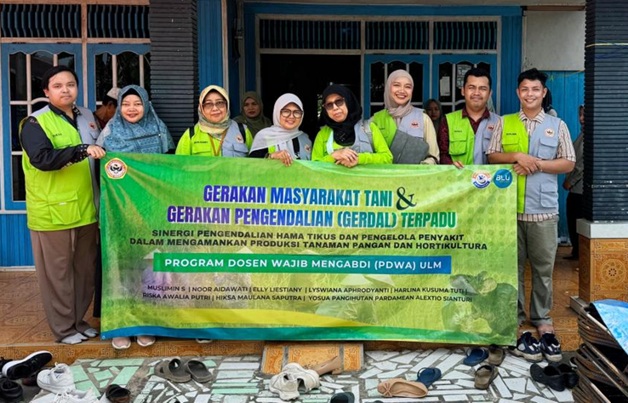
Food crops provide essential carbohydrates, proteins, and nutrients for human consumption. In Banjar Regency, the primary commodities include peatland paddy, sweet potatoes, and chili peppers. Beyond soil and water management challenges, pest and disease infestations (OPT) present the greatest threat to agricultural yields. This community service initiative aimed to educate farmers on the main issues caused by OPT and introduce effective management techniques to boost production. Through this outreach, farmers are expected to gain practical insights into rapid, precise pest control. The program used an educational approach to deliver basic information on OPT identification, economic losses, and control strategies. The activity was attended by an 8-member academic team, 9 representatives from the Astambul District Agricultural Extension Center (BPP), and 27 members of the Sinar Padi Sungai Tuan Ilir Farmers' Group as the community partners. In conclusion, the active multi-stakeholder participation and the high enthusiasm shown by the farmers' group demonstrate that the program was executed successfully. permitted to use abbreviations except for units of a quantity and use them to a minimum. In addition, farmers' groups are gaining a better understanding of the types of plant pests and diseases, as well as their control.
Downloads
References
Abdullah, S., Hamim, S., & Ermayuna, S. (2021). Stretegi Pembangunan Pertanian Tanaman Pangan di Lahan Gambut Desa Pulau Palas Kabupaten Indragiri Hilir. Pascasarjana Ilmu Administrasi Universitas Islam Riau, 1-83. https://repository.uir.ac.id/id/eprint/5678
Dewaha, R. A. J. I. B. (2023). Kearifan Lokal Petani Padi Sawah Dalam Pengelolaan Lahan 6Gambut (Studi Kasus di Desa Pematang Panjang Kecamtan Sungai Tabuk) (Doctoral dissertation, Universitas NU Kalimantan Selatan).
Driesche, V.R.G., and Hoddle, M.S. 2002. Classical Arthropod Biological Control: Measuring Success, Step by Step. Di dalam: Gurr G, Wratten S, editor. Biological Control: Measures of Success. Dordrecht: Kluwer Academic Publishers. https://doi.org/10.1007/978-94-011-4014-0_2
Hajek, A., Eilenberg, J. 2018. Natural Enemies: an Introduction to Biological Control. Cambridge: Cambridge University Press. https://doi.org/10.1017/9781107280267
Masganti, M., Anwar, K.,dan Susanti, M. A. (2017). Potensi dan pemanfaatan lahan gambut dangkal untuk pertanian. Jurnal Sumberdaya Lahan, 11(1), 43-52. https://10.21082/jsdl.v11n1.2017.43-52.
Naranjo, S.E. 2001. Conservation and evaluation of natural enemies in IPM systems for Bemisia tabaci. J Crop Prot. 20(9): 835–852. https://10.1016/S0261-2194(01)00115-6.
Sepe, M., & Djafar, M. I. (2018). Perpaduan tanaman refugia dan tanaman kubis pada berbagai pola tanam dalam menarik predator dan parasitoid dalam penurunan populasi hama. AGROVITAL: Jurnal Ilmu Pertanian, 3(2), 55-59. http://dx.doi.org/10.35329/agrovital.v3i2.206.
Sepe, M., Rosa, H. O., & Suhardi, S. (2025). Efficacy of Beauveria bassiana as a Biological Control Agent Against the Brown Planthopper Nilaparvata lugens in Rice Cultivation. Jurnal Biologi Tropis, 25(3), 2788-2794. https://10.29303/jbt.v25i3.9094
Sepe, M., Rosa, H. O., Salamiah, S., Abbas, S., Marsuni, Y., Pramudi, M. I., dan Trichoderma, V. (2023). Pelatihan Pembuatan Cendawan Trichoderma sp. dalam Mengendalikan Penyakit Akar Putih pada Perkebunan Karet di Desa Binturu, Kalimantan Selatan. JALUJUR: Jurnal Pengabdian Masyarakat, 2(2), 57-68. http://orcid.org/0000-0002-0062-9998.
Sepe, M., Rosa, H. O., & Aidawati, N. (2023). Training on Making Rat Empos Explosions, Application, and Introduction of Active Rat Holes in Binturu Village, Kelua District, Tabalong Regency, South Kalimantan. Altifani Journal: International Journal of Community Engagement, 3(2), 8-13. https://doi.org/10.30598/bakira.2026.7.1.54-61.
Stenberg, J.A., Sundh I., Becher, P.G., Björkman, C., Dubey, M., Egan, P.A., Friberg, H, Gil, J.F., Jonsson, M., Karlsson, M. 2021. When is it biological control? A framework of definitions, mechanisms, and classifications. J Pest Sci. 94:665–676. https://10.1007/s10340-021-01354-7.
Supangkat, G. (2022). Pendampingan sekolah lapang teknologi padi apung pada lahan gambut di desa muhuran, kota bangun, kutai kertanegara. Baktimu: Jurnal Pengabdian Kepada Masyarakat, 2(2), 225-242. https://jurnal.ittc.web.id/index.php/jipm/article/view/2421
Tampubolon, B., Harjanti, D. T., Adlika, N. M., & Christanto, L. M. H. (2020). Pemanfaatan lahan gambut menjadi lahan potensial untuk menjaga ketahanan pangan di Kalimantan Barat. Geodika: Jurnal Kajian Ilmu dan Pendidikan Geografi, 4(2), 182-191. https://doi.org/10.29408/geodika.v4i2.2765.
Wahyunto, K., Nugroho, S., Ritung, dan Sulaiman, Y. 2014. Indonesian peatland map: method, certainty, and uses. Hlm 81-96. Dalam Wihardjaka et al. (Eds.). Prosiding Seminar Nasional Pengelolaan Berkelanjutan Lahan Gambut Terdegradasi untuk Mitigasi GRK dan Peningkatan Nilai Ekonomi. Balitbangtan, Kementerian Pertanian. https://www.researchgate.net/publication/293821145_INDONESIAN_PEATLAND_MAP_METHOD_CERTAINTY_AND_USES
ZALFA, A. P. (2023). Analisis implementasi kebijakan restorasi gambut di taman hutan raya orang kayo hitam Provinsi Jambi. Skripsi. Universitas Lampung.Amrulloh, H., Mahmudah, M. 2020. Pembelajaran IPA SD/MI yang Menyenangkan. Malang: Pustaka Learning Center.
Downloads
Published
Issue
Section
License
Copyright (c) 2026 Muslimin Sepe, Noor Aidawati, Elly Liestiany, Lyswiana Aphrodyanti, Harlina Kusuma Tuti, Riska Awalia Putri, Yosua Pangihutan Pardamean Alextio Sianturi, Hiksa Maulana Saputra, Nadia Hazmi, Riadhatu Fi Tanzililhaq, Suhardi Suhardi

This work is licensed under a Creative Commons Attribution-ShareAlike 4.0 International License.
Authors who publish with this journal agree to the following terms:
- Any article on the copyright is retained by the author(s).
- Author grant the journal, right of first publication with the work simultaneously licensed under a Creative Commons Attribution License that allows others to share work with acknowledgment of the work authors and initial publications in this journal.
- Authors are able to enter into a separate, additional contractual arrangements for non-exclusive distribution of published articles of work (eg, post-institutional repository) or publish it in a book, with acknowledgment of its initial publication in this journal.
- Authors are permitted and encouraged to post their work online (e.g., in institutional repositories or on their websites) prior to and during the submission process, as can lead to productive exchanges, as well as earlier and greater citation of published work.
- The article and any associated published material is distributed under the Creative Commons Attribution-ShareAlike 4.0 International License