Program Aquatherapy menggunakan Model AQUA-STEP dalam Meningkatkan Mobilitas dan Keseimbangan Anak Berkebutuhan Khusus di SLB ABCD Kuncup Mas Banyumas
Aquatherapy Program Using the AQUA-STEP Model to Improve Mobility and Balance in Children with Special Needs at SLB ABCD Kuncup Mas Banyumas
DOI:
https://doi.org/10.33084/pengabdianmu.v11i9.13805Keywords:
AQUA-STEP, Children With Special Needs, Aquatherapy, Balance, MobilityAbstract
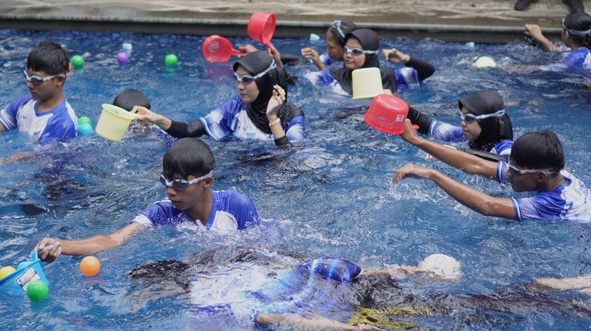
Children with special needs often experience limitations in mobility and balance that affect their daily activities and participation in learning. In addition, teachers in special schools have limited experience in implementing water-based exercise programs to improve students' motor abilities. This community service program aimed to improve teachers' knowledge and the mobility and balance of children with special needs through an Aquatherapy Program using the AQUA-STEP Model. The program was implemented at SLB ABCD Kuncup Mas Banyumas through socialization, teacher training, program implementation, mentoring, and evaluation. Teachers' knowledge was assessed using pre- and post-tests, while balance and mobility were evaluated using the Pediatric Balance Scale (PBS) and Timed Up and Go (TUG). The results showed significant improvements in teachers' knowledge (14.00 to 17.57; p<0.001), PBS scores (47.75 to 50.80; p=0.007), and TUG scores (5.70 to 6.55; p=0.002). The program also produced the AQUA-STEP handbook and training module to support sustainable implementation. The Aquatherapy Program using the AQUA-STEP Model effectively improved teachers' competence and the mobility and balance of children with special needs.
Downloads
References
Adar, S. (2017). The effect of aquatic exercise on spasticity, quality of life, and motor function in cerebral palsy. Turkish Journal of Physical Medicine and Rehabilitation, 63(3), 239–248. https://doi.org/10.5606/tftrd.2017.280
Becker, B. E. (2020). Aquatic Therapy in Contemporary Neurorehabilitation: an update. PM&R, 12(12), 1251–1259. https://doi.org/10.1002/pmrj.12435
Erden, A., Arslan, E. A., Dündar, B., Topbaş, M., & Cavlak, U. (2020). Reliability and validity of Turkish version of pediatric balance scale. Acta Neurologica Belgica, 121(3), 669–675. https://doi.org/10.1007/s13760-020-01302-9
Ferrari, A. J., Santomauro, D. F., Aali, A., Abate, Y. H., Abbafati, C., Abbastabar, H., Ashraf, M. (2024). Global incidence, prevalence, years lived with disability (YLDs), disability-adjusted life-years (DALYs), and healthy life expectancy (HALE) for 371 diseases and injuries in 204 countries and territories and 811 subnational locations, 1990–2021: a systematic analysis for the Global Burden of Disease Study 2021. The Lancet, 403(10440), 2133–2161. https://doi.org/10.1016/s0140-6736(24)00757-8
Gorter, J. W., & Currie, S. J. (2011). Aquatic Exercise Programs for Children and Adolescents with Cerebral palsy: What Do We Know and Where Do We Go? International Journal of Pediatrics, 2011, 1–7. https://doi.org/10.1155/2011/712165
Lai, C., Liu, W., Yang, T., Chen, C., Wu, C., & Chan, R. (2014). Pediatric aquatic therapy on motor function and enjoyment in children diagnosed with cerebral palsy of various motor severities. Journal of Child Neurology, 30(2), 200–208. https://doi.org/10.1177/0883073814535491
McLeskey, J., Maheady, L., Billingsley, B., Brownell, M. T., & Lewis, T. J. (2018). High leverage practices for inclusive classrooms. Routledge. https://doi.org/10.4324/9781315176093
Mulyani, J. D., Aryani, A. A., & Santiko, G. Y. (2026). Aquaterapi untuk anak berkebutuhan khusus menggunakan model AQUA-STEP (1st ed.). Banyumas, Indonesia: PT. Ganesha Kreasi Semesta. https://doi.org/10.33084/pengabdianmu.v11i9.13805
Ogonowska-Slodownik, A., Jakobowicz, O., Alexander, L., Marinho-Buzelli, A. R., Devion, C., & Morgulec-Adamowicz, N. (2024). Aquatic Therapy in Children and Adolescents with Disabilities: A Scoping Review. Children, 11(11), 1404. https://doi.org/10.3390/children11111404
Rehman, I. U., Nasralla, M., Sobnath, D., Khattak, M. a. K., & Ali, S. (2025). Improving Quality of Life for People with Disabilities Through Smart Technologies. IGI Global. https://doi.org/10.4018/979-8-3373-2033-5
Rohn, S., Pavlic, M. N., & Rosenbaum, P. (2021). Exploring the use of Halliwick aquatic therapy in the rehabilitation of children with disabilities: A scoping review. Child Care Health and Development, 47(6), 733–743. https://doi.org/10.1111/cch.12887
Ryan, J. M., Cassidy, E. E., Noorduyn, S. G., & O’Connell, N. E. (2017). Exercise interventions for cerebral palsy. Cochrane Database of Systematic Reviews, 2017(6), CD011660. https://doi.org/10.1002/14651858.cd011660.pub2
Dhote, S., Khatri, P., & Ganvir, S. (2012). Reliability of Modified timed up and go test in children with cerebral palsy. Journal of Pediatric Neurosciences, 7(2), 82–86. https://doi.org/10.4103/1817-1745.102564
Zhao, P., Zhu, G., Chen, S., Pan, Y., Chen, K., Huang, L., & Guo, L. (2024). Effects of Aquatic Exercise and Floor Curling on Balance Ability and Lower Limb Muscle Strength in Children with Intellectual disabilities: A Pilot Study in China. Children, 11(1), 85. https://doi.org/10.3390/children11010085
Downloads
Published
Issue
Section
License
Copyright (c) 2026 Jajang Dede Mulyani, Aisyah Apriliciciliana Aryani, Galih Yoga Santiko

This work is licensed under a Creative Commons Attribution-ShareAlike 4.0 International License.
Authors who publish with this journal agree to the following terms:
- Any article on the copyright is retained by the author(s).
- Author grant the journal, right of first publication with the work simultaneously licensed under a Creative Commons Attribution License that allows others to share work with acknowledgment of the work authors and initial publications in this journal.
- Authors are able to enter into a separate, additional contractual arrangements for non-exclusive distribution of published articles of work (eg, post-institutional repository) or publish it in a book, with acknowledgment of its initial publication in this journal.
- Authors are permitted and encouraged to post their work online (e.g., in institutional repositories or on their websites) prior to and during the submission process, as can lead to productive exchanges, as well as earlier and greater citation of published work.
- The article and any associated published material is distributed under the Creative Commons Attribution-ShareAlike 4.0 International License