Pelatihan Budidaya Cabai Rawit untuk Kebutuhan Rumah Tangga di Provinsi Kalimantan Tengah Training of Cayenne Pepper Cultivation for Household Needs in Central Kalimantan Province
Article Sidebar
Main Article Content
Abstract
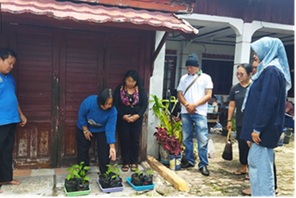
Cayenne pepper cultivation training to household needs is a collaboration between the Agrotechnology study program, Faculty of Agriculture, University of Palangka Raya with the Indonesian Phytopathology Association, Regional of Central Kalimantan, which has been carried out from April to December 2024 in the city of Palangka Raya and Bukit Bamba Village. The training was in counseling and also cultivation guidance through field visits for people who received chili seeds. Eighty percent of the plants distributed grew well, where 40% of the fruit could be consumed for household needs, and the cause of the failure of the chili harvest was that the plants were stolen, there were pest and disease attacks, and lack of patience or lack of interest in caring for the plants. The average successful chili harvest production per harvest per tree per week was 39 grams. This activity not only includes the distribution of cayenne pepper seeds, but also has a positive impact on the community. From the data obtained, as many as 82.14% of chili plants grew well, while 17.86% were lost, either due to theft or pest and disease attacks. The first harvest showed that 78.26% of the harvested chilies had been used for household needs, while the remaining 21.74% were still waiting for the harvest period. In terms of production, the average harvest per tree reached 39 grams, with the lowest yield of 18 grams and the highest of 66 grams. This achievement shows the great potential of cayenne pepper cultivation in increasing food security.
Downloads
Article Details

This work is licensed under a Creative Commons Attribution-ShareAlike 4.0 International License.
Authors who publish with this journal agree to the following terms:
- Any article on the copyright is retained by the author(s).
- Author grant the journal, right of first publication with the work simultaneously licensed under a Creative Commons Attribution License that allows others to share work with acknowledgment of the work authors and initial publications in this journal.
- Authors are able to enter into a separate, additional contractual arrangements for non-exclusive distribution of published articles of work (eg, post-institutional repository) or publish it in a book, with acknowledgment of its initial publication in this journal.
- Authors are permitted and encouraged to post their work online (e.g., in institutional repositories or on their websites) prior to and during the submission process, as can lead to productive exchanges, as well as earlier and greater citation of published work.
- The article and any associated published material is distributed under the Creative Commons Attribution-ShareAlike 4.0 International License
References
Abdullah, T., Phihatin, Rahman, A., Wiridannisa, N., & Melina. (2023). Uji ketahanan varietas cabai rawit (Capsicum frutescens L.) terhadap serangan lalat buah Bactrocera dorsalis (Hendel) (Diptera: Tephritidae). Agroland: Jurnal Ilmu-Ilmu Pertanian, 30(3), 257–265. https://doi.org/10.22487/agrolandnasional.v30i3.1759
Alam, A. S., Sari, W., & Achiviana, M. (2014). Uji ketahanan beberapa varietas cabai (Capsicum annum L.) terhadap penyakit layu Fusarium yang disebabkan cendawan Fusarium oxysporum f.sp capsici. Agroscience, 4(1), 78–81. https://doi.org/10.35194/agsci.v4i1.618
Arsi, Anafiotika, R., Suparman, S., Fauziah, Z., Zhafirah, A. M., Margareta, G., Rani, F. D., Wardani, A., & Yusniawan, M. T. (2023). Intensitas serangan hama dan penyakit cabai rawit di Provinsi Sumatera Selatan. Seminar Nasional Pertanian Pesisir (SENATASI), 2(1). Prosiding Jurusan Budidaya Pertanian Fakultas Pertanian Universitas Bengkulu.
Badan Pusat Statistik. (2021). Data pertanian Indonesia dan teknik budidaya tanaman hortikultura. Badan Pusat Statistik.
Badan Pusat Statistik. (2023). Data produksi pertanian di Kalimantan Tengah. Badan Pusat Statistik.
Balai Pengkajian Teknologi Pertanian Jambi. (2014). Hama dan penyakit pada tanaman cabai serta cara pengendaliannya. Balai Penelitian dan Pengembangan Pertanian, Kementerian Pertanian.
Direktorat Jenderal Hortikultura. (2020). Standar operasional prosedur budidaya cabai rawit. Kementerian Pertanian, Direktorat Sayuran dan Tanaman Obat.
Fariro, I., Dwi, N., Novikarumsari, & Utami, R. A. (2021). Upaya optimalisasi lahan pekarangan melalui pelatihan teknik budidaya cabai rawit terpadu dan inisiasi pembentukan KWT pada kelompok Hidayah Tani di Jember, Jawa Timur. PengabdianMu: Jurnal Ilmiah Pengabdian kepada Masyarakat, 6(4), 348–355. https://doi.org/10.33084/pengabdianmu.v6i4.1843
Hamnah, Aldwati, N., & Fitriyanti, D. (2021). Uji ketahanan beberapa varietas tanaman cabai rawit terhadap penyakit antraknosa. Jurnal Proteksi Tanaman Tropika, 4(1), 252–258. https://doi.org/10.20527/jptt.v4i1.66
Hidayat, M. S. (2024). Meningkatkan income keluarga petani melalui pendampingan usaha budidaya cabai rawit (Capsicum frutescens). Pena Dimas: Jurnal Pengabdian Masyarakat, 3(1), 18–27. http://dx.doi.org/10.33474/penadimas.v3i1.24818
Lagiman, & Supriyanta, B. (2021). Karakterisasi morfologi dan pemuliaan tanaman cabai. LPPM UPN “Veteran” Yogyakarta.
Lestiyani, A., Suryanti, & Wibowo, A. (2020). Respons sepuluh varietas cabai terhadap penyakit layu Fusarium. Agrivet, 26(2), 34–42.
Sondakh, N., & Rengku, J. O. (2017). Faktor-faktor yang memengaruhi peningkatan pendapatan usaha tani cabai rawit di Kabupaten Minahasa Selatan. Jurnal Bisnis dan Kewirausahaan, 13(2), 74–86