Pemanfaatan Limbah Kayu Menjadi Produk Bernilai Ekonomi The Utilization of Wood Waste Becomes Products of Economic Value
Article Sidebar
Main Article Content
Abstract
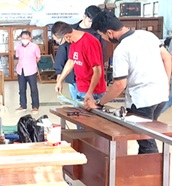
Wood waste is the remains of wood parts no longer considered economically valuable in product processes. However, if wood waste products are made at different times and places, they will produce new economic value products. Waste wood pieces are currently not utilized optimally due to the lack of knowledge and insight into technology and the development of creativity in the community regarding the use of wood waste. Partners in PKM are the SUKAYU (Suka Karya Kayu) group, which has just started a business with limited wood products, namely, placing flower pots. The problem partners face is limited knowledge, skills, equipment, and capital, so they cannot develop product innovations based on the high selling value and artistic value of wood waste. The method used is training on making chairs, shoe racks, and flower pots using applicative methods, mentoring, and evaluating activities. Training program held on August 16, 2022. After the training, there was an increase in the partners' knowledge and skills about wood waste and its use as wood products, and the partners were able to make several wood products from the waste. The outputs of the Community Partnership Program activities are wood products (chairs, shoe racks, and flower pots), publications in The Banjarmasin Post Online, scientific articles, and activity videos on YouTube.
Downloads
Article Details

This work is licensed under a Creative Commons Attribution-ShareAlike 4.0 International License.
Authors who publish with this journal agree to the following terms:
- Any article on the copyright is retained by the author(s).
- Author grant the journal, right of first publication with the work simultaneously licensed under a Creative Commons Attribution License that allows others to share work with acknowledgment of the work authors and initial publications in this journal.
- Authors are able to enter into a separate, additional contractual arrangements for non-exclusive distribution of published articles of work (eg, post-institutional repository) or publish it in a book, with acknowledgment of its initial publication in this journal.
- Authors are permitted and encouraged to post their work online (e.g., in institutional repositories or on their websites) prior to and during the submission process, as can lead to productive exchanges, as well as earlier and greater citation of published work.
- The article and any associated published material is distributed under the Creative Commons Attribution-ShareAlike 4.0 International License
References
Flexner, B. 2011. Wood Finishing 101: The Step-by-step Guide. Penguin.
Hunt, C. 2021. Finishing wood. Chapter 16 in FPL-GTR-282, 16-1.
Kasmudjo, 2010. Teknologi Hasil Hutan. Suatu Pengantar Identifikasi Kayu, Sifat-Sifat Kayu, Teknologi Pengolahan Hasil Hutan, Potensi dan Prospek. Cakrawala Media. Yogyakarta. https://pustaka.fisip.unand.ac.id/index.php?p=show_detail&id=104366&keywords=
Katsvanga, C. A., Mudyiwa, S. M. 2019. Training needs analysis and forestry curricula evaluation in professional and technical institutions in sub-Sahara Anglophone countries. African Forest Forum (AFF). https://lib.afforum.org/handle/2367-AFF/639
Mahdie, M. F., Subari, D., Sunardi, S., Ulfah, D. 2016. Pengaruh Campuran Limbah Kayu Rambai dan Api-api Terhadap Kualitas Biopellet Sebagai Energi Alternatif Dari Lahan Basah. Jurnal Hutan Tropis, 4(3), 246-253. http://dx.doi.org/10.20527/jht.v4i3.3618
Mahdie, M.F., Sari, N. M., Nisa, K., 2018. Ironwood and mixed wood sawdust biopellet prototype innovation as an alternative energy of the future. Journal of Biodiversity and Environmental Sciences (JBES), 12 (6) 79-90. https://innspub.net/ironwood-and-mixed-wood-sawdust-biopellet-prototype-innovation-as-an-alternative-energy-of-the-future/
Owoyemi, J. M., Zakariya, H. O., Elegbede, I. O. 2016. Sustainable wood waste management in Nigeria. Environmental & Socio-economic Studies, 4(3), 1-9. http://dx.doi.org/10.1515/environ-2016-0012
Patulak, I. M., Lahjie, A. M., Budiarso, E., Simarangkir, B. D. A. S. 2012. Optimalisasi Produksi Pada Industri Kayu Lamina Di Pt. cahaya Samtraco Utama Samarinda Dengan Menggunakan Software Lindo. Jurnal Hutan Tropis, 13(2). https://dx.doi.org/10.20527/jht.v13i2.1527
Rani, N. S. A., Krishnan, K. S., Saidun, Z., Ahmad, H. 2019. The relationship between entrepreneurship education and entrepreneurial intention of Universiti Kuala Lumpur–teknoputra alumni. Humanities & Social Sciences Reviews, 7(1), 147-155. https://doi.org/10.18510/hssr.2019.7118
Retantoko, C., Sulbi. 2016. Pemanfaatan limbah kayu jati dalam pembuatan karya seni kriya kayu berbentuk naga eropa. Jurnal Pendidikan Seni Rupa, 4(3). https://www.neliti.com/id/publications/250730/pemanfaatan-limbah-kayu-jati-dalam-pembuatan-karya-seni-kriya-kayu-berbentuk-nag
Retnowati, T. H. (2009). Teknik Finishing Kayu. Fakultas Bahasa dan Seni, Universitas Negeri Yogyakarta.
Royani, V. A., Mariska, Z., Wahyuni, S., Ningrat, J., & Suparyana, P. K. (2021). Wirausaha Mahasiswa Dalam Pemanfaatan Limbah Kayu Sebagai Produk Kerajinan Jam Tangan Ramah Lingkungan. Jurnal Aplikasi dan Inovasi Iptek, 3(1), 28-33. https://doi.org/10.52232/jasintek.v3i1.72
Sa'idah, N., Farida, Y. E., Widagdo, J. 2020. Pemanfaatan limbah kayu melalui puzzle wayang sebagai media pengenalan budaya untuk anak usia dini. E-Dimas: Jurnal Pengabdian kepada Masyarakat, 11(1), 66-70. https://www.neliti.com/id/publications/302075/pemanfaatan-limbah-kayu-melalui-puzzle-wayang-sebagai-media-pengenalan-budaya-un
Sari, N. M., Violet, V., Nisa, K., Syamsudin, S. 2021. Pengaruh Campuran Limbah Tunggak Kayu Tumih (Combretocarpus rotundatus (Miq) Danser) Dan Limbah Kayu Galam (Melaleuca cajuputi) Terhadap Karakteristik Briket Arang Kayu Khas Lahan Basah Di Kalimantan Selatan. Jurnal Hutan Tropis, 9(2), 432-444. http://dx.doi.org/10.20527/jht.v9i2.11295
Somadona, S., Sribudiani, E., & Valencia, D. E. 2020. Karakteristik balok laminasi kayu akasia (Acacia mangium) dan meranti merah (Shorea leprosula) berdasarkan susunan lamina dan berat labur perekat styrofoam. Wahana Forestra: Jurnal Kehutanan, 15(2), 53-64. https://doi.org/10.31849/forestra.v15i2.5039
Sumadi, M. F. (2021). Peran Pemerintah Daerah Dalam Pengembangan Usaha Mikro Kecil Dan Menengah (UMKM)“Handycraft Limbah Kayu Jati Sebagai Produk Unggulan Kabupaten Bojonegoro”(Studi Kecamatan Kasiman Kabupaten Bojonegoro) (Doctoral dissertation, UPN Jawa Timur). www.bps.go.id, 2022. Produksi Kayu Hutan (M3), 2018-2020. https://www.bps.go.id/indicator/60/167/1/produksi-kayu-hutan.html
Yakovleva, E., Titova, E. 2021. Recycling of forestry waste. In IOP Conference Series: Earth and Environmental Science, 875, No. 1, p. 012045). IOP Publishing. https://iopscience.iop.org/article/10.1088/1755-1315/875/1/012045