Edukasi Petani tentang Pentingnya Aplikasi Hatch and Carry Elaeidobius kamerunicus untuk Meningkatkan Produksi Kelapa Sawit Public Education on the Importance of Applying the Hatch and Carry Technique Elaeidobius kamerunicus to Improve Oil Palm Production
Article Sidebar
Main Article Content
Abstract
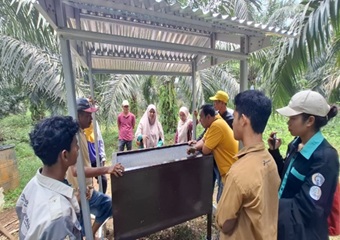
The area of oil palm plantations in Dharmasraya Regency is not in line with the amount of production obtained by farmers. This is due to the large number of parthenocarpic fruits caused by the few pollinators and male flowers, so the pollination process in oil palm plantations is not optimal. This activity aims to train farmers in Koto Beringin Village, Tiumang District. The activity method is carried out through counseling and demonstration plots on applying hatch & carry techniques for Elaeidobius kamerunicus to improve the pollination process so that oil palm production can increase. In this activity, farmers are expected to be able to produce products in the form of oil palm pollen and Elaeidobius kamerunicus breeding cages. From the activities that have been carried out, it is known that farmers' knowledge of hatch & carry techniques for Elaeidobius kamerunicus is still very minimal. Through counseling and demonstration plot activities, farmers have been able to breed Elaeidobius kamerunicus and collect oil palm pollen. From the results of observations in people's oil palm fields, it is known that after the application of the Hatch & Carry technique was carried out, there was an increase in the number of Elaeidobius kamerunicus pollinators from 524 individuals/Ha to 21,137 individuals/Ha and will continue to increase if the application of the Hatch & Carry technique continues to be carried out. If farmers apply the hatch & carry technique of Elaeidobius kamerunicus correctly, it can increase the number of pollinators that play a role in pollination.
Downloads
Article Details

This work is licensed under a Creative Commons Attribution-ShareAlike 4.0 International License.
Authors who publish with this journal agree to the following terms:
- Any article on the copyright is retained by the author(s).
- Author grant the journal, right of first publication with the work simultaneously licensed under a Creative Commons Attribution License that allows others to share work with acknowledgment of the work authors and initial publications in this journal.
- Authors are able to enter into a separate, additional contractual arrangements for non-exclusive distribution of published articles of work (eg, post-institutional repository) or publish it in a book, with acknowledgment of its initial publication in this journal.
- Authors are permitted and encouraged to post their work online (e.g., in institutional repositories or on their websites) prior to and during the submission process, as can lead to productive exchanges, as well as earlier and greater citation of published work.
- The article and any associated published material is distributed under the Creative Commons Attribution-ShareAlike 4.0 International License
References
Efendi dan Rezki. 2020. Desain Peningkatan Kapasitas Petani Melalui Aplikasi Teknologi Hatch and Carry Serangga Polinator Elaeidobius Kamerunicus Faust pada Perkebunan Kelapa Sawit. Jurnal pengabdian masyarakat (Indonesian Journal of Community Engagement). 6(1). Hal. 29 – 37. https://doi.org/10.22146/jpkm.41643
Harahap, I. Y., S. Sumaryanto, T. C. Hidayat, W. R. Fauzi, dan Y. Pangaribuan. 2017. Produksi Jenis Kelamin Tandan Bunga Kelapa Sawit dan Responsnya Terhadap Perlakuan Exogenous Hormon Tanaman yang Mengalami Kekeringan. Jurnal Penelitian Kelapa Sawit. 25 (1), 35 – 46. https://doi.org/10.22302/iopri.jur.jpks.v25i1.23
Prasetyo. A. E dan Susanto. A. 2012. Meningkatkan fruit set kelapa sawit dengan teknik hatch & carry Elaeidobius kamerunicus. Pusat Penelitian Kelapa Sawit. 61 halaman. https://www.researchgate.net/publication/339446491_Meningkatkan_Fruit_Set_Kelapa_Sawit_dengan_Teknik_Hatch_and_Carry_Elaeidobius_kamerunicus
Prastowo. 2003. Ini sebab buah partenokarpi pada tanaman kelapa sawit. Majalah Online Info Sawit.29 Mei 2023. https://www.infosawit.com/2023/05/29/ini-sebab-buah-partenokarpi-tanpa-biji-pada-tanaman-kelapa-sawit/
Sitepu. A. F, Yenni. Y, dan Sujadi. 2021. Mengenal fenomena feminine pada kelapa sawit. Warta PPKS, 26 (3): 154-161. http://dx.doi.org/10.22302/iopri.war.warta.v26i3.65
Susanto. A: R.Y. Purba dan A. E. Prasetyo. 2007. Elaeidobius kamerunicus: serangga penyerbuk kelapa sawit seri buku saku no 28. Pusat Penelitian Kelapa Sawit. 61 halaman. 52 halaman. https://www.researchgate.net/publication/339446482_Serangga_penyerbuk_Kelapa_Sawit_Elaeidobius_kamerunicus_Faust_agresivitas_dan_dinamika_populasi_di_Kalimantan_Tengah