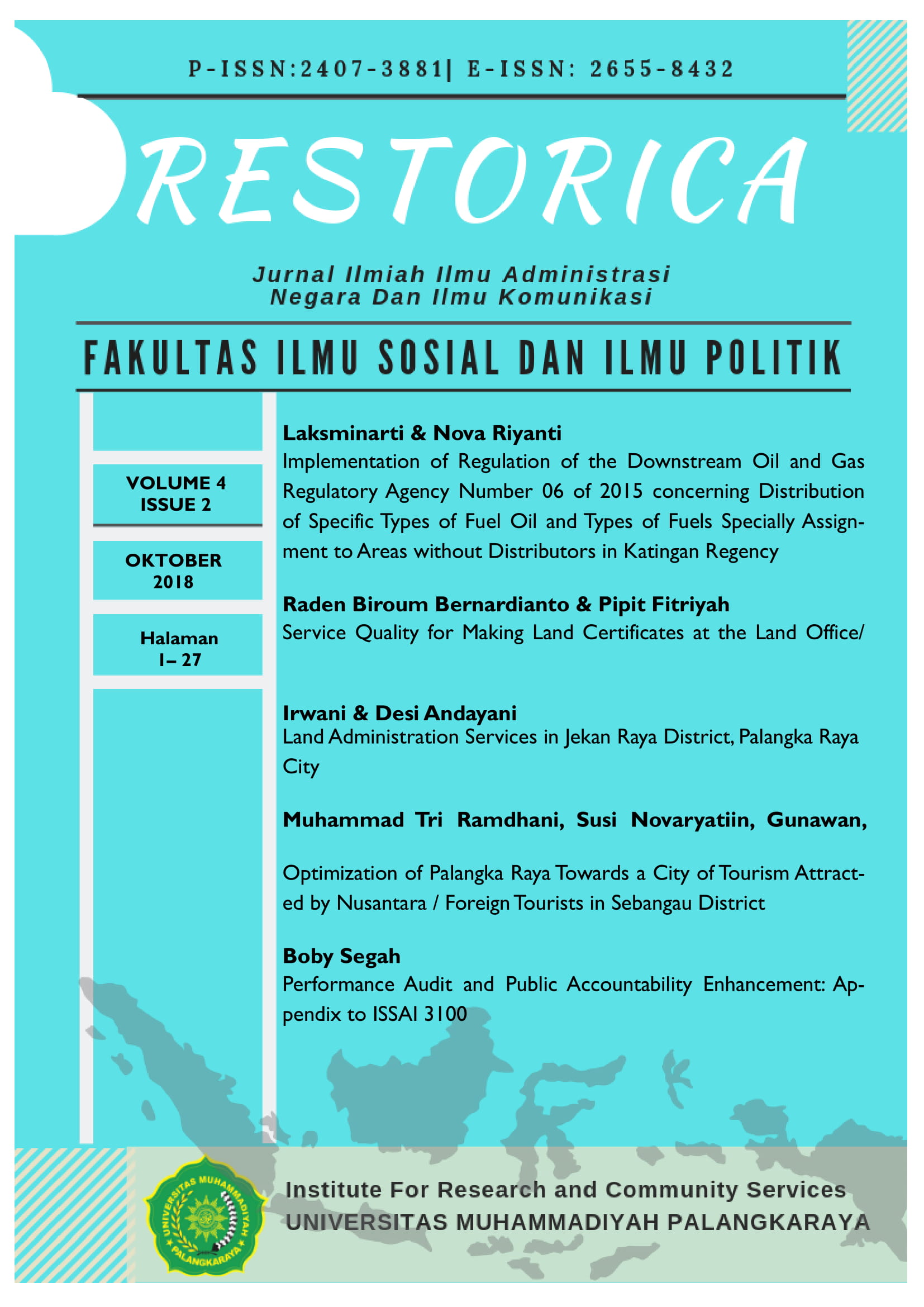
Optimalisasi Palangka Raya menuju Kota Wisata yang Diminati Wisatawan Nusantara/Mancanegara pada Kecamatan Sebangau Optimization of Palangka Raya Towards a City of Tourism Attracted by Nusantara / Foreign Tourists in Sebangau District
Article Sidebar
Main Article Content
Abstract
The efforts to develop tourism require involvement and readiness by all stakeholders to integrate the tourism management framework. Stakeholders in tourism development consist of three groups, namely the community, the private sector, and the government. Local people have tourism resources, so they need to be encouraged to use them optimally. However, the community does not yet have sufficient capacity to develop and manage these resources to be absorbed by the market, besides the market demand for quality and diversification of tourism products is very high. It is this demand that must be responded by tourism actors, especially industry, by making innovations and marketing alternative products. The Bangkirai Kereng area shows how nature and humans need each other and symbiosis with each other, give and receive each other, which is mediated by water (rivers and lakes) as the adhesive element. Water is the primary domain that affects everything around it. Another uniqueness of this lake or river in Kereng Bangkirai is black water because the bottom of the lake is black peat soil, which affects the color of the water. This phenomenon is only two in the world, namely on the Amazon plains in South America and on the island of Borneo, Indonesia. Then it would be better if this potential was explored again in a presentation that was of knowledge and knowledge. For example by creating a lake museum that shows the various types of black water lakes in the world, and gives more in-depth knowledge to the younger generation who come to the Bangkirai Kereng Area. The Sebangau National Park area is a tropical rainforest that is still left on the island of Borneo.
Downloads
Article Details
Authors who publish with this journal agree to the following terms:
- Any article on the copyright is retained by the author(s).
- Author grant the journal, right of first publication with the work simultaneously licensed under a Creative Commons Attribution License that allows others to share work with acknowledgment of the work authors and initial publications in this journal.
- Authors are able to enter into a separate, additional contractual arrangements for non-exclusive distribution of published articles of work (eg, post-institutional repository) or publish it in a book, with acknowledgment of its initial publication in this journal.
- Authors are permitted and encouraged to post their work online (e.g., in institutional repositories or on their websites) prior to and during the submission process, as can lead to productive exchanges, as well as earlier and greater citation of published work.
- The article and any associated published material is distributed under the Creative Commons Attribution-ShareAlike 4.0 International License
References
Damanik, J. & Teguh, F. 2012. Manajemen Destinasi Pariwisata: Sebuah Pengantar Ringkas. Yogyakarta: Kepel Press.
Sunaryo, B. 2013. Kebijakan Pembangunan Destinasi Pariwisata Konsep dan Aplikasinya di Indonesia. Yogyakarta: Gava Media.
Wardiyanto & Baiquni, M. 2011. Perencanaan & Pengembangan Pariwisata. Bandung: Lubuk Agung.