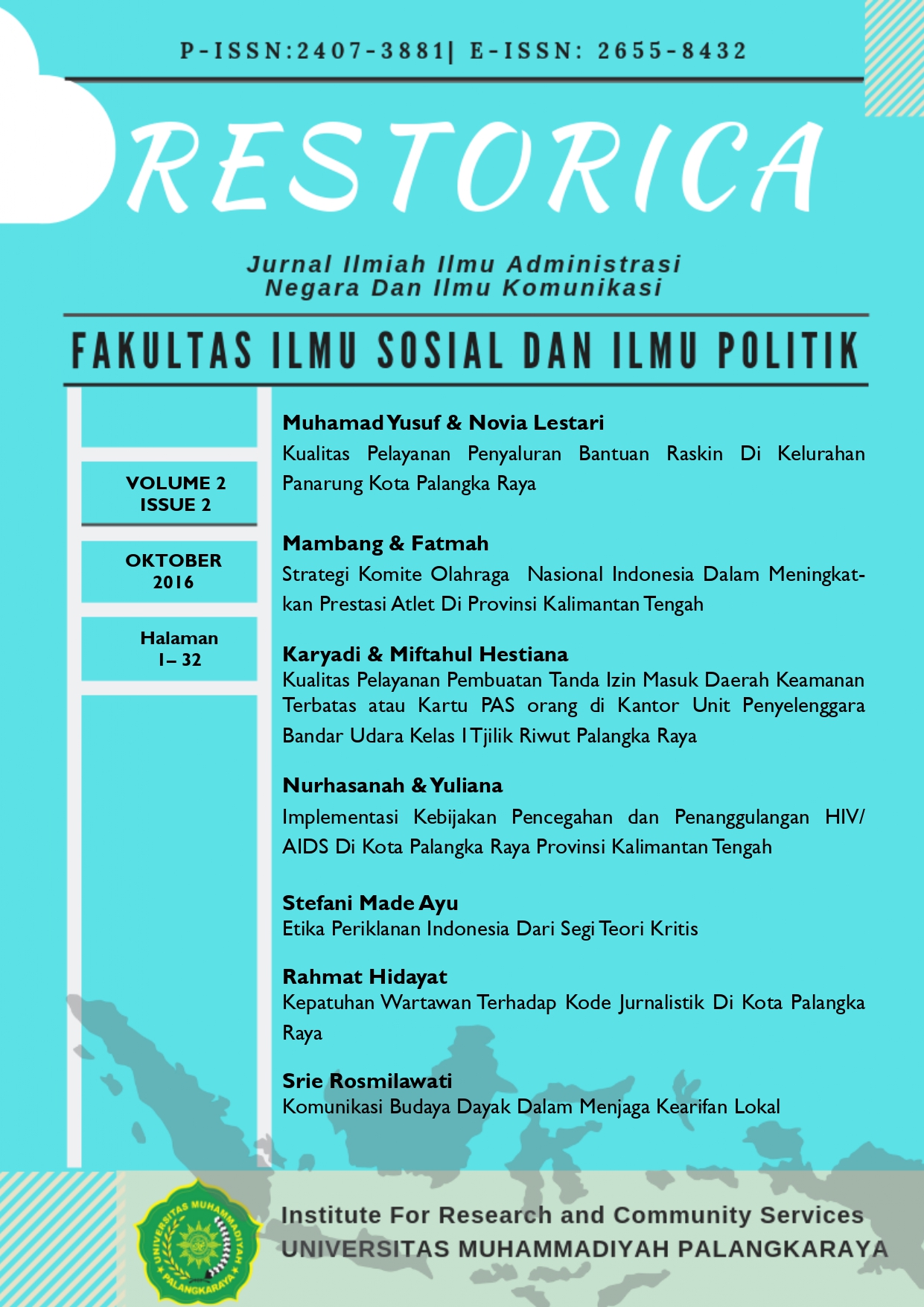
Kepatuhan Wartawan Terhadap Kode Etik Jurnalistik Di Kota Palangka Raya Journalists ' Compliance With The Code Of Journalistic Ethics In The City Of Palangka Raya
Article Sidebar
Main Article Content
Abstract
This research aims to determine what are the most common problems in the world of the journalistic code of ethics so that it can be a good picture of the press and uphold the rules of the press. Methods that Used in relation to this research, then the research Debitor is used using a qualitative approach by using the adulteration of primary data sources and secondary data sources. Primary data sources obtained by interviews to journalists are always insurers who perform journalistic tasks in the field of observations while the data sources of the Sukender legislation, code of Journalism Ethics, official documents, Books and tangible research results report the data materials in this study. The results of this scientific journal can be proved by the interview among journalists in the city of Palangka Raya who claimed to still be able to work and understand the implementation of the Code of journalistic ethics, specifically articles relating to independence Of the press in carrying out its work. In conclusion, in the world of the press itself still, need some improvement in addition to providing training to journalists but also strengthening the structure and ability of the press agencies themselves in Indonesia.
Downloads
Article Details
Authors who publish with this journal agree to the following terms:
- Any article on the copyright is retained by the author(s).
- Author grant the journal, right of first publication with the work simultaneously licensed under a Creative Commons Attribution License that allows others to share work with acknowledgment of the work authors and initial publications in this journal.
- Authors are able to enter into a separate, additional contractual arrangements for non-exclusive distribution of published articles of work (eg, post-institutional repository) or publish it in a book, with acknowledgment of its initial publication in this journal.
- Authors are permitted and encouraged to post their work online (e.g., in institutional repositories or on their websites) prior to and during the submission process, as can lead to productive exchanges, as well as earlier and greater citation of published work.
- The article and any associated published material is distributed under the Creative Commons Attribution-ShareAlike 4.0 International License
References
Bachtiar, Da’i. 2004. Kebebasan Pers vs delik Pers. Dalam dialog pers dan hulum. Dewan pers & Unesco.
Bambang, Harimurty. 2006. Makna Di Balik Keputusan Kasasi Tempo. Majalah Tempo. Jakarta
Cangara, Hafied. 1998. Pengantar Ilmu Komunukasi. Raja Grafindo Persada. Jakarta
Deddy, Mulyana. 2008. Komunikasi Efektif. Remaja Rosdakarya. Bandung
Deklrasi Universal Hak Asasi Manusia. 1999. Panduan Jurnalis, LSPP, Aidcom, The Asia Fondation.
Effendy, Onong Uchjana. 2009. Pengantar Ilmu Komunikasi. Rajawali Pers. Jakarta
Kansil, C.S.T, dan Cristie S.T. Kansil. 2000. Pengantar Ilmu Hukum dan Tata Hukum Indonesia. Jilid I. Jakarta. Balai Pustaka.
Luwarso, Lukas. 2003. Kebebasan Pers Penegakan Hukum, Dewan Pers & Unesco
Makarin, Novo Anwar. 2004. Kebebasan Pers Penegakan Hukum. Dewan Pers & Unseco
Panjaitan, Hinca IP. 2004. Mengoptimalkan Peran Dewan Pers dalam Dialog Pers dan Hukum, Dewan Pers & Unesco.
Samsul, Wahidin. 2000. Pers Bebas dan Bertanggung Jawab (Hasil Penelitian Fakultas Hukum Unlam) Banjarmasin.
Utrecht, E. 1957. Pengantar Dalam Hukum Indonesia. Ikhtiar. Jakarta
Zulharmans.1983. Kode etik. Jurnalistik Indonesia. Pustaka Madani. Jakarta.