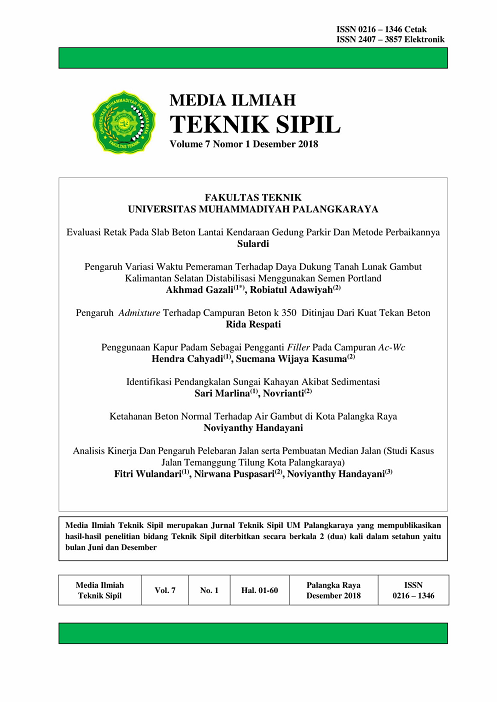
Identifikasi Pendangkalan Sungai Kahayan Akibat Sedimen
Identification of silting of the Kahayan River due to sediment
DOI:
https://doi.org/10.33084/mits.v7i1.683Keywords:
Sedimen, Metode Musle, Sungai KahayanAbstract
The population growth rate continues to increase directly proportional to the rate of environmental damage. This is due to the increasing need for clothing, food, and shelter. Or primary needs and secondary needs. For example, the impact of floating houses on pollution of the Kahayan River in the City of Palangka Raya, Central Kalimantan. One example of the impact that will be caused is river siltation, river water pollution, and the generation of garbage around the river. The purpose of this study was to identify the silting of the Kahayan River due to sedimentation and to determine the crossing of the Kahayan River in the study area. The research location was in the Kahayan Palangkaraya Tugu Soekarno River Catchment Area to Ropi Ropi. In the sedimentation calculation using USLE modification (MUSLE) has calculated the results of the increase in sediment in the river. The Kahayan River has an area of 81,648 km2, a length of 600 km, a width of 500m, its depth reaches 7 m and empties into three regencies between the cities of Palangkaraya, Kabupaten Gunung Mas, and Kabupaten Pulang Pisau. From the calculation of flood discharge, the peak discharge (Qp) is 0.0105 km². Prediction of Sedimentation Rate using the MUSLE Method of each Protection Forest = 0, Sebangau National Park = 901, Tourist Park = 73, Forest Park = 112, Tetat Production Forest = 3.422
Downloads
Downloads
Published
Issue
Section
License
All rights reserved. This publication may be reproduced, stored in a retrieval system, or transmitted in any form or by any means, electronic, mechanical, photocopying, recording.