Edukasi Kesehatan Reproduksi untuk Meningkatkan Pengetahuan tentang Menstruasi pada Siswi Madrasah Ibtidaiyah Reproductive Health Education to Improve Knowledge about Menstruation among Female Students in Islamic Elementary Schools
Article Sidebar
Main Article Content
Abstract
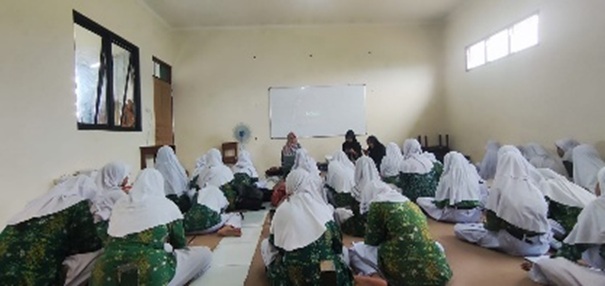
Adolescent girls encounter more demanding challenges, not only numerous physical and psychological transformations, but also an earlier age at the onset of puberty due to various factors. An appropriate strategy is to provide early puberty-related knowledge support through health promotion programs that engage multiple stakeholders, including schools. This community service activity delivered reproductive health education to 36 schoolgirls at Islamic Elementary School Attarbiyatul Islamiyah Kudus, with the objective of enhancing their knowledge and readiness for puberty. The educational approach combined demonstrations, discussions, games, roleplay, and attractive audiovisual media. Knowledge levels were assessed using questionnaires containing 18 questions on puberty-related topics. The results indicated positive responses, evidenced by the students' participation and enthusiasm. The mean score increased from 65.5 to 74.0, indicating an improvement of 8.5 points. All students (100%) achieved scores above 50 after the intervention, compared with 89% prior to it. This activity highlights that providing reproductive health education from an early age not only enhances knowledge and pubertal readiness but also helps early adolescents in defining body boundaries, thereby protecting them from various forms of sexual violence. Schools are encouraged to play a role by integrating puberty and reproductive health education into both the curriculum and school programs.
Downloads
Article Details

This work is licensed under a Creative Commons Attribution-ShareAlike 4.0 International License.
Authors who publish with this journal agree to the following terms:
- Any article on the copyright is retained by the author(s).
- Author grant the journal, right of first publication with the work simultaneously licensed under a Creative Commons Attribution License that allows others to share work with acknowledgment of the work authors and initial publications in this journal.
- Authors are able to enter into a separate, additional contractual arrangements for non-exclusive distribution of published articles of work (eg, post-institutional repository) or publish it in a book, with acknowledgment of its initial publication in this journal.
- Authors are permitted and encouraged to post their work online (e.g., in institutional repositories or on their websites) prior to and during the submission process, as can lead to productive exchanges, as well as earlier and greater citation of published work.
- The article and any associated published material is distributed under the Creative Commons Attribution-ShareAlike 4.0 International License
References
Adyani, K., Apriliana, S. D., & Susilowati, E. (2024). Pengaruh Media Edukasi terhadap Pengetahuan Remaja Putri tentang Anemia : Literature Review. Faletehan Health Journal, 11(2), 126–134. https://doi.org/10.33746/fhj.v11i02.683
Adyani, K., Fannanah, M., & Realita, F. (2024). Factors That Influence The Decrease in Age at Menarche : Literature Review. Jurnal MID-Z (Midwifery Zigot) Jurnal Ilmiah Kebidanan, 7(1), 1–10. https://doi.org/10.56013/JURNALMIDZ.V7
Adyani, K., Safitri, O. L. R., & Aisyaroh, N. (2024). Efektivitas Media Edukasi Terhadap Perubahan Pengetahuan dan Perilaku Personal Hygiene Menstruasi Remaja Putri : Literature Review. Media Publikasi Promosi Kesehatan Indonesia (MPPKI), 7(3), 550–558. https://doi.org/10.56338/mppki.v7i3.4672
Agustina, K. S., Agustini, N. R. S., & Utami Ds, N. K. A. D. (2025). Edukasi Kesehatan Reproduksi pada Anak Usia Dini Sebagai Langkah Awal Mencegah Pelecehan Seksual. Jurnal Abdimas ITEKES Bali, 4(2), 105–110. https://doi.org/https://doi.org/10.37294
Aritonang, M. R., Pabidang, S., & Kristiarini, J. J. (2026). Edukasi Pubertas Tanpa Takut pada Siswa SMP Awal Karya Pembangunan Lubuk Pakam. Jurnal Medika: Medika, 5(2), 2218–2227. https://doi.org/10.31004/j6waj978
Azkia, N. S., Rezeki, N. M., Zahra, A. A., & Sari, I. A. (2025). Stimulasi Perkembangan Bahasa Anak Usia Dini dengan Metode Bermain Peran. Jurnal Pendidikan Sosial Dan Humaniora, 4(3), 5358–5367. https://publisherqu.com/index.php/pediaqu/article/view/2434/2177
Bahar, H., Yusran, S., Effendy, D. S., Muchtar, F., Lestari, H., Tosepu, R., Agresiya, A., Amalia, H., Seba, M. S., & Mildah. (2025). Pentingnya edukasi kesehatan reproduksi sejak dini di SD Negeri 52 Kendari. Cendekia Mengabdi: Jurnal Pengabdian Masyarakat, 2(1), 30–36. https://doi.org/10.66689/cmjpm.vi.123
Dewi, N. K. N. R., Mirayanti, N. K. A., & Puspitayantip, N. L. G. (2026). Hubungan Pengetahuan Tentang Menstruasi dengan Kesiapan Remaja Putri Menghadapi Menarche di SMPN 3 Nusa Penida. Jurnal Medicare, 5(1), 397–405. https://doi.org/10.62354/jurnalmedicare.v5i1.353
Dewi, N. M. A. A., Utami, P. A. S., Novel, A. S. J., Perdana, I. P. A., & Dewi, S. A. K. (2026). Teater Edu-Marriage : Intervensi Psikososial Preventif Pernikahan Dini pada Siswa Siswi SMAN 1 Bebandem. Martabe: Jurnal Pengabdian Kepada Masyarakat, 9(2), 776–784. https://doi.org/10.31604/jpm.v9i2.776-784
Elian, F. D., Tasnim, & Useng, Y. (2026). Pengaruh Edukasi Kesehatan Terhadap Kesehatan Reproduksi pada Siswa SMA Negeri 1 Raha. Jurnal Healthy Mandala Waluya, 5(1), 78–86. https://doi.org/10.54883/jhmw.v5i1.1179
Evan, G. (2025). Pertumbuhan Fisik dan Kematangan Seksual Remaja. Manual MSD.
Handayani, A., Latip, A., Kusumaningtyas, K., Maharrani, T., Husni, E., & Pramudianti, D. N. (2024). Efektifitas Metode Ceramah dan Small Group Discussion tentang Kesehatan Reproduksi dan Seksual Terhadap Pengetahuan, Sikap dan Perilaku Remaja. Gema Bidan Indonesia, 13(1), 34–42. https://doi.org/10.36568/gebindo.v13i1.214
Hayati, M., & Fikhriyah, H. (2025). Menjaga Ruang Pribadi: Dinamika Interaksi Sosial dan Batasan Tubuh (Body boundaries) Anak Usia Dini. Jurnal Asghar, 5(2), 101–111. https://doi.org/10.28918/asghar.v5i2.12763
Kasim, S. I., Hafid, R., & Mohamad, R. W. (2025). Hubungan Tingkat Pengetahuan tentang Kesehatan Reproduksi dengan Kesiapan Menghadapi Masa Pubertas Pada Remaja Usia 12-13 Tahun Di SMP Negeri 1 Limboto Relationship Between Knowledge Level about Reproductive Health and Readiness to Face Puberty in Adolesc. Jurnal Kolaboratif Sains (JKS), 8(4), 1769–1784. https://doi.org/10.56338/jks.v8i4.7177
Kemenkes, R. (2023). Mengenal Kecemasan dan Dukungan Sosial pada Pubertas Remaja. https://keslan.kemkes.go.id/view_artikel/2843/mengenal-kecemasan-dan-dukungan-sosial-pada-pubertas-remaja
Natalia, L. E. (2024). Dunia Remaja: Permasalahan dan Solusinya (Febriana, Ed.; 1st ed.). Ananta Vidya.
Nurcahyani, L., Widiyastuti, D., & Jubaedah, E. (2023). Reproductive Health Go To School Model Pendidikan Kesehatan Reproduksi pada Siswa SD. Abdimas Galuh, 5(2), 1194–1208. http://dx.doi.org/10.25157/ag.v5i2.10477
Nurhayati, Fatila, N., Utami, R., Afnanin, F. A., & Ramadhan, M. R. (2025). Efektivitas Pendidikan Kesehatan Reproduksi Berbasis Sekolah : A Literature Review. Holistik Jurnal Kesehatan, 19(4), 643–652. https://doi.org/10.33024/hjk.v19i4.547
Nursiah, W. O. (2022). Gambaran Tingkat Pengetahuan Remaja Putri tentang Perubahan Fisik Masa Pubertas Kelas VII. Jurnal Sains Dan Kesehatan, 1(1), 27–32. https://doi.org/10.57151/jsika.v1i1.29
Nuruniyah, Rizky, A., Mayarestya, N. P., Masdah, S., & Hastuti, L. (2025). Inovasi Media Pembelajaran Edukatif dan Interaktif dalam Peningkatan Pemahaman Kesehatan Reproduktif pada Masa Remaja. Jurnal Abdi Insani, 12(12), 7014–7022. https://doi.org/10.29303/abdiinsani.v12i12.2689
Palifiana, D. A., Khadijah, S., Dewi, D. P., Widayati, Nugroho, F. A., & Lukman, D. S. (2026). Upaya Peningkatan Self-Efficacy Pada Remaja Rehabilitasi Ssosial dan Pengasuhan Anak ( BRSPA ) Daerah Istimewa Yogyakarta. Martabe: Jurnal Pengabdian Kepada Masyarakat, 9(1), 317–324. https://doi.org/10.31604/jpm.v9il.317-324
Riyani, S. C., & Mintarsih, S. (2023). Hubungan Pengetahuan Tentang Menstruasi Dengan Kesiapan Remaja Putri Menghadapi Menarche Relationship Of Knowledge About Menstruation With Readiness Young Women Facing Menarche. Jurnal Fisioterapi Dan Ilmu Kesehatan Sisthana, 5(1), 64–77. https://doi.org/10.55606/jufdikes.v5i1.215
Syamsuddin, S. D. (2023). Pengaruh Edukasi Kesehatan Reproduksi terhadap Pengetahuan pada Remaja Pubertas di SMPN 1 Kapala Pitu Tahun 2022. Jurnal Midwifery, 5(1), 27–33. https://doi.org/10.24252/jmw.v5i1.35187
Zahra, H. A., & Adyani, K. (2025). Factors Associated with The Incidence of Vulvar Pruritus in Adolescents : Literature Review. 8(1), 16–29. https://doi.org/10.36780/jmcrh.v8i1.12318
Zakiyah, E., Nikmah, F., Fitria, H., Hasanatul, N., & Mukharomah, A. (2025). Peningkatan Pemahaman Pubertas Perspektif Islam Melalui Penguatan Karakter pada Anak Usia Dasar. Jurnal Inovasi Hasil Pengabdian Masyarakat, 8(204), 416–429. https://doi.org/10.33474/jipemas.v8i2.23442
Zayani, N., Zaunit, M. M., Alpices, A., Dahlan, A., Mesra, S., & Selsi, D. E. (2025). Kenali Tubuhmu : Program Edukasi Pubertas dan Kebersihan Diri untuk Siswa SD. Jurnal Pengabdian Masyarakat Bhinneka, 4(2), 2234–2241. https://doi.org/10.58266/jpmb.v4i2.770
Zhang, X., Xu, Y., Yan, L., Wang, X., Xiong, J., Wang, F., & Cheng, G. (2026). Global prevalence and incidence of precocious puberty : a systematic review and meta-analysis. BMC Public Health, 26(99). https://doi.org/10.1186/s12889-025-25723-4