Eksplorasi Farmakologis Biji Pala: Transformasi Rempah Dapur Menjadi Solusi Swamedikasi Herbal Masyarakat Malaka Sari
Pharmacological Potential of Nutmeg: Transforming a Kitchen Spice into a Herbal Self-Medication Solution for the Malaka Sari Community
DOI:
https://doi.org/10.33084/pengabdianmu.v11i9.13776Keywords:
Nutmeg, Health Education, Community PharmacyAbstract
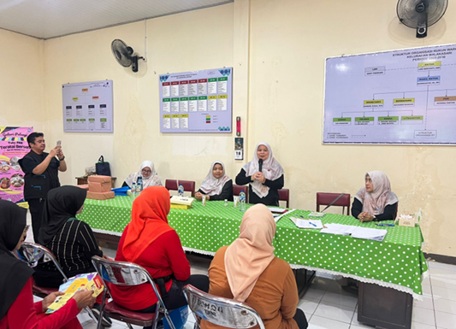
The lack of public awareness regarding herbal medicine often hinders families from managing their health independently in urban areas. This community service program was designed to improve residents' knowledge and practical skills in RW 04 Malaka Sari, Duren Sawit, East Jakarta, with a focus on the health and beauty benefits of nutmeg (Myristica fragrans). The program was conducted using an interactive adult learning approach. It included a presentation on the scientific benefits of nutmeg, a practical demonstration on safe preparation and dosage, and a free blood pressure screening session. The event was warmly welcomed and enthusiastically attended by local community leaders and residents. The evaluation, conducted through descriptive and inferential statistical analysis, showed that the participants' average knowledge score improved significantly from 5.42 to 6.38 (p-value = 0.002 < 0.05). These findings show that pharmacy-based interactive education is an effective way to improve public literacy in herbal medicine. Furthermore, it encourages residents to support sustainable, preventive health programs for a healthier neighborhood.
Downloads
References
Agusta, A. (2021). Minyak atsiri tumbuhan tropika Indonesia: Isolasi, karakterisasi, dan manfaat farmakologis. ITB Press. https://lib.universitas-bth.ac.id/index.php?p=show_detail&id=246
Jaiswal, P., & Kumar, P. (2022). Biological and pharmacological properties of Myristica fragrans Houtt. (Nutmeg): A comprehensive review. Journal of Herbal Medicine, 32, Artikel 100523. https://doi.org/10.1016/j.jep.2025.120916
Setyaningsih, D., Apriyantono, A., & Sari, M. P. (2022). Analisis sensori dan karakterisasi kimiawi rempah-rempah nusantara. IPB Press. http://repository.lppm.unila.ac.id/41719/1/Prosiding%20Seminar%20Dies%20UAJY%20YOGYAKARTA.pdf
Wijaya, K., & Utami, S. (2024). Inovasi Olahan Buah Pala Menjadi Produk Wellcome Drink Sebagai Penguat Identitas Daerah. Jurnal Pengabdian Masyarakat Bhinnekasari, 2(1), 78–87. https://doi.org/10.58266/jpmb.v3i4.196
Pratama, A. R., & Sari, D. P. (2024). Kreativitas pengolahan daging buah pala menjadi usaha UMKM untuk meningkatkan ekonomi masyarakat. Jurnal Pengabdian dan Pemberdayaan Masyarakat, 5(1), 45–54. http://jomparnd.com
Sirait, S. D., Rosalina, R., Sirait, S. M., & Riswati, N. I. (2021). Pengembangan IKM minyak atsiri pala di CV Putra Cinta Damai Desa Ciherang Kecamatan Caringin Kabupaten Bogor. Jurnal Pengabdian Masyarakat AKA, 1(1), 16–23. https://aka.ac.id
Nuralfin Anripa. (2024). Review: Manfaat biji pala (Myristicae semen) sebagai sumber obat tradisional. Sains Medisina: Jurnal Kedokteran dan Kesehatan, 3(2), 45–54. https://doi.org/10.63004/snsmed.v2i5.409
Nasir, M., & Marwati, S. (2024). Potensi ekstrak metanol biji pala (Myristica fragrans Houtt.) sebagai antibakteri alami (Edisi 1, Vol. 2). Nexus Books. https://nexusbooks.id/bookpdf/potensi_ekstrak_metanol_biji_pala_(myristica_fragrans_houtt.)_sebagai_antibakteri_alami_terhadap_staphylococcus_aureus_dan_escherichia_coli_1746693081.pdf
Marwiyah, S., Yantina, Y., Anggraini, A., & Sunarsih, S. (2024). Seduhan bubuk pala terhadap intensitas mual muntah pada ibu hamil TM 1. ResearchGate Journal of Phytopharmaca, 14(1), 32–41. https://doi.org/10.37638/anjani.v4i1.1116
Ramadhan, R. F. (2024). Potensi minyak atsiri biji pala (Myristica fragrans) untuk menurunkan intensitas nyeri sendi. Indonesian Science Journal, 5(3), 154–162. http://dx.doi.org/10.33846/sf15nk123
Putri, A. D., & Handayani, S. (2025). Potensi buah pala (Myristica fragrans) sebagai terapi herbal untuk insomnia: A literature review. Jurnal Syifa Sciences and Medicine, 12(2), 89–98. https://doi.org/10.33084/jsm.v11i3.12010
Downloads
Published
Issue
Section
License
Copyright (c) 2026 Ari Widayanti, Kori Yati, Fitria Nugrahaeni, Kriana Efendi

This work is licensed under a Creative Commons Attribution-ShareAlike 4.0 International License.
Authors who publish with this journal agree to the following terms:
- Any article on the copyright is retained by the author(s).
- Author grant the journal, right of first publication with the work simultaneously licensed under a Creative Commons Attribution License that allows others to share work with acknowledgment of the work authors and initial publications in this journal.
- Authors are able to enter into a separate, additional contractual arrangements for non-exclusive distribution of published articles of work (eg, post-institutional repository) or publish it in a book, with acknowledgment of its initial publication in this journal.
- Authors are permitted and encouraged to post their work online (e.g., in institutional repositories or on their websites) prior to and during the submission process, as can lead to productive exchanges, as well as earlier and greater citation of published work.
- The article and any associated published material is distributed under the Creative Commons Attribution-ShareAlike 4.0 International License