Penguatan Peran Guru SMP Dalam Mendorong Aktivitas Jasmani Siswa Melalui Edukasi Pedoman WHO dan Physical Activity Breaks
Strengthening Junior High School Teachers' Capacity to Promote Students' Physical Activity Through WHO Guidelines Education and Physical Activity Breaks
DOI:
https://doi.org/10.33084/pengabdianmu.v11i9.13813Keywords:
Physical Activity, Sedentary, Physical Activity BreaksAbstract
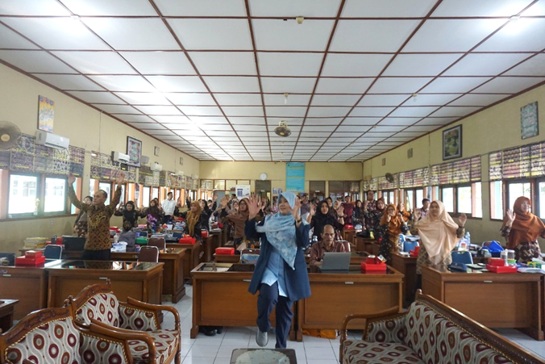
This community service program aimed to improve the knowledge and capacity of junior high school teachers to promote students' physical activity through education on the World Health Organization (WHO) Guidelines and training on Physical Activity Breaks. The workshop was held on 28 April 2026 at SMP Negeri 15 Yogyakarta and attended by 56 teachers, including Physical Education, Sports, and Health (PESH) teachers as well as teachers from other subject areas. The workshop covered physical activity, physical fitness, sedentary behavior in line with WHO Guidelines, and the implementation of Physical Activity Breaks in classroom learning, complemented by hands-on practice sessions. Participants' knowledge was evaluated using pre- and post-tests. The results showed that the average percentage of correct responses increased from 77.5% in the pre-test to 94.2% in the post-test, representing an improvement of 16.7 percentage points. Improvements were observed across all assessment items, particularly those related to Physical Activity Breaks and the WHO recommendations for physical activity. The outputs of this program include a partnership agreement with the partner school, a Physical Activity Breaks training module, publication on the official website of the Physical Education, Health, and Recreation Study Program at Universitas Negeri Yogyakarta, and a manuscript submitted to a community service journal. This program demonstrates that workshops are an effective strategy for strengthening teachers' capacity to foster a more active and healthier school environment and to support the teaching and learning process.
Downloads
References
Andriyani, F. D., Hastuti, T. A., Ries, F., Prasetyawati Tri Purnama Sari, I., Andrianto, S. D., Thomas, G., & Biddle, S. J. H. (2025). Correlates of Physical Activity among 4,719 Indonesian Adolescents: The Role of Sociodemographic, Screen Time, and Sports Participation. International Journal of Human Movement and Sports Sciences, 13(4), 942-953. https://doi.org/10.13189/saj.2025.130430
Bull, F. C., Al-Ansari, S. S., Biddle, S., Borodulin, K., Buman, M. P., Cardon, G., Carty, C., Chaput, J., Chastin, S., & Chou, R. (2020). World Health Organization 2020 guidelines on physical activity and sedentary behaviour. Br J Sports Med, 54, 1451–1462. https://doi.org/10.1136/bjsports-2020-102955
Carson, V., Hunter, S., Kuzik, N., Gray, C. E., Poitras, V. J., Chaput, J. P., Saunders, T. J., Katzmarzyk, P. T., Okely, A. D., Connor Gorber, S., Kho, M. E., Sampson, M., Lee, H., & Tremblay, M. S. (2016). Systematic review of sedentary behaviour and health indicators in school-aged children and youth: an update. Appl Physiol Nutr Metab, 41(6 Suppl 3), S240-265. https://doi.org/10.1139/apnm-2015-0630
Daly-Smith, A. J., Zwolinsky, S., McKenna, J., Tomporowski, P. D., Defeyter, M. A., & Manley, A. (2018). Systematic review of acute physically active learning and classroom movement breaks on children's physical activity, cognition, academic performance and classroom behaviour: understanding critical design features. BMJ Open Sport & Exercise Medicine, 4(1), e000341. https://doi.org/10.1136/bmjsem-2018-000341
Guthold, R., Stevens, G. A., Riley, L. M., & Bull, F. C. (2020). Global trends in insufficient physical activity among adolescents: a pooled analysis of 298 population-based surveys with 1·6 million participants. Lancet Child Adolesc Health, 4(1), 23-35. https://doi.org/10.1016/s2352-4642(19)30323-2
Kementerian Kesehatan, R. I. (2018). Laporan nasional riskesdas 2018. Badan Penelitian dan Pengembangan Kesehatan. http://labdata.litbang.kemkes.go.id/images/download/laporan/RKD/2018/Laporan_Nasional_RKD2018_FINAL.pdf
Mavilidi, M. F., Drew, R., Morgan, P. J., Lubans, D. R., Schmidt, M., & Riley, N. (2020). Effects of different types of classroom Physical Activity Breaks on children’s on-task behaviour, academic achievement and cognition. Acta Paediatrica, 109(1), 158-165. https://doi.org/10.1111/apa.14892
Murtagh, E., Mulvihill, M., & Markey, O. (2013). Bizzy Break! The effect of a classroom-based activity break on in-school physical activity levels of primary school children. Pediatric Exercise Science, 25(2), 300-307. https://doi.org/10.1123/pes.25.2.300
Norris, E., Van Steen, T., Direito, A., & Stamatakis, E. (2020). Physically active lessons in schools and their impact on physical activity, educational, health and cognition outcomes: a Systematic review and meta-analysis. British journal of sports medicine, 54(14), 826-838. https://doi.org/10.1136/bjsports-2018-100502
Poitras, V. J., Gray, C. E., Borghese, M. M., Carson, V., Chaput, J. P., Janssen, I., Katzmarzyk, P. T., Pate, R. R., Connor Gorber, S., Kho, M. E., Sampson, M., & Tremblay, M. S. (2016). Systematic review of the relationships between objectively measured physical activity and health indicators in school-aged children and youth. Appl Physiol Nutr Metab, 41(6 Suppl 3), S197-239. https://doi.org/10.1139/apnm-2015-0663
Priambadha, A. A., Andriyani, F. D., Dimyati, D., & Marhaendro, A. S. D. (2025). Correlates of physical activity, screen time, and engagement in sports extracurricular activities and clubs among urban Indonesian adolescents. TRENDS in Sport Sciences, 32(4). https://doi.org/10.23829/TSS.2025.32.4-1
Sampasa-Kanyinga, H., Colman, I., Goldfield, G. S., Janssen, I., Wang, J., Podinic, I., Tremblay, M. S., Saunders, T. J., Sampson, M., & Chaput, J. P. (2020). Combinations of physical activity, sedentary time, and sleep duration and their associations with depressive symptoms and other mental health problems in children and adolescents: a systematic review. Int J Behav Nutr Phys Act, 17(1), 72. https://doi.org/10.1186/s12966-020-00976-x
Tremblay, M. S., Aubert, S., Barnes, J. D., Saunders, T. J., Carson, V., Latimer-Cheung, A. E., Chastin, S. F., Altenburg, T. M., & Chinapaw, M. J. (2017). Sedentary behavior research network (SBRN)–terminology consensus project process and outcome. Int J Behav Nutr Phys Act, 14(1), 75. https://doi.org/10.1186/s12966-017-0525-8
Watson, A., Timperio, A., Brown, H., Best, K., & Hesketh, K. D. (2017). Effect of classroom-based physical activity interventions on academic and physical activity outcomes: a Systematic review and meta-analysis. International Journal of Behavioral Nutrition and Physical Activity, 14, 1-24. https://doi.org/10.1186/s12966-017-0569-9
Watson, A. J. L., Timperio, A., Brown, H., & Hesketh, K. D. (2019). A pilot primary school active break program (ACTI-BREAK): Effects on academic and physical activity outcomes for students in Years 3 and 4. Journal of science and medicine in sport, 22(4), 438-443. https://doi.org/10.1016/j.jsams.2018.09.232
WHO. (2020). WHO guidelines on physical activity and sedentary behaviour. World Health Organization. https://apps.who.int/iris/bitstream/handle/10665/336657/9789240015111-eng.pdf
Downloads
Published
Issue
Section
License
Copyright (c) 2026 Fitria Dwi Andriyani, Tri Ani Hastuti, Indah Prasetyawati Tri Purnama Sari

This work is licensed under a Creative Commons Attribution-ShareAlike 4.0 International License.
Authors who publish with this journal agree to the following terms:
- Any article on the copyright is retained by the author(s).
- Author grant the journal, right of first publication with the work simultaneously licensed under a Creative Commons Attribution License that allows others to share work with acknowledgment of the work authors and initial publications in this journal.
- Authors are able to enter into a separate, additional contractual arrangements for non-exclusive distribution of published articles of work (eg, post-institutional repository) or publish it in a book, with acknowledgment of its initial publication in this journal.
- Authors are permitted and encouraged to post their work online (e.g., in institutional repositories or on their websites) prior to and during the submission process, as can lead to productive exchanges, as well as earlier and greater citation of published work.
- The article and any associated published material is distributed under the Creative Commons Attribution-ShareAlike 4.0 International License