Interpreting “Urgent Reasons” in Marriage Dispensation Cases: A Socio-Legal Study at the Pangkalan Bun Religious Court
Article Sidebar
Main Article Content
Abstract
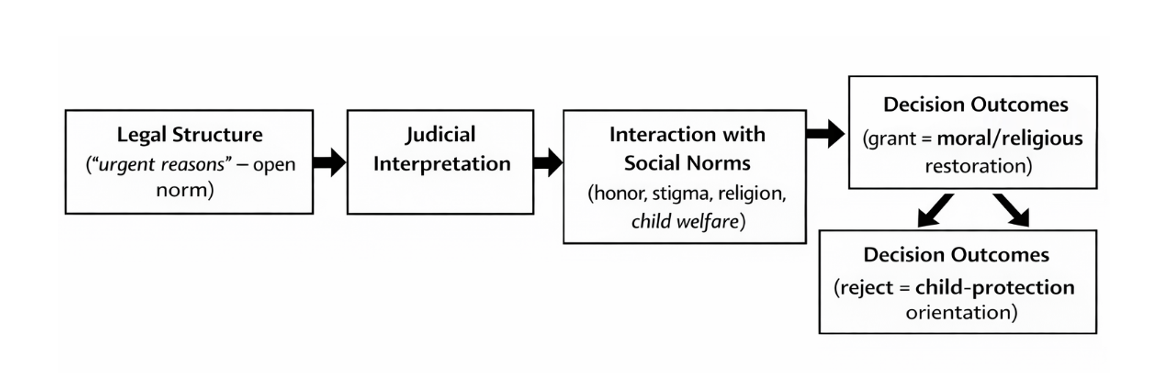
The phrase “urgent reasons” in Indonesian marriage dispensation law is normatively open yet operationally undefined, creating interpretive space that contributes to disparities in judicial decisions. While prior studies explain these disparities through regulatory weakness or judicial discretion, they rarely examine how such normative ambiguity is socially reproduced through judicial practice. Addressing this gap, this study analyses how judges construct the meaning of “urgent reasons” in pregnancy-related marriage dispensation cases and how this process reflects the interaction between legal structure and local social norms. Using a socio-legal approach, the research examines 43 decisions (2020-2025) from the Pangkalan Bun Religious Court and in-depth interviews with three judges.Drawing on Anthony Giddens’ Structuration Theory, the study argues that normative ambiguity does not merely generate discretion but operates as a structuration mechanism through which judges reproduce and negotiate legal meaning inconcrete cases. The findings reveal three dominant interpretive patterns: (1) urgency as moral restoration and protection of family honour, (2) urgency as safeguarding the best interests of the child, and (3) urgency as maintaining religious and social stability. These patterns demonstrate that judicial disparities stem not from inconsistency but from the activation of different normative orientations when judges confront ambiguous legal structures within a specific socio-cultural context.Theoretically, this study contributes to socio-legal scholarship by showing how vague legal norms function as institutional media for the reproduction of legal pluralism through judicial agency. Practically, the findings highlight the need for clearer operational guidelinessuch as minimum age thresholds, psychological assessment standards, and child protection recommendations, to balance legal certainty, judicial discretion, and child rights protection in marriage dispensation policy.
Downloads
Article Details

This work is licensed under a Creative Commons Attribution-ShareAlike 4.0 International License.
Authors continue to retain the copyright to the article if the article is published in the Jurnal Hadratul Madaniyah. They will also retain the publishing rights to the article without any restrictions.
Authors who publish in this journal agree to the following terms:
- Any article on the copyright is retained by the author(s).
- The author grants the journal the right of first publication with the work simultaneously licensed under a Creative Commons Attribution License that allows others to share work with an acknowledgment of the work authors and initial publications in this journal.
- Authors can enter into separate, additional contractual arrangements for the non-exclusive distribution of published articles (e.g., post-institutional repository) or publish them in a book, with acknowledgment of their initial publication in this journal.
- Authors are permitted and encouraged to post their work online (e.g., in institutional repositories or on their websites) before and during submission. This can lead to productive exchanges and earlier and greater citations of published work.
- The article and any associated published material are distributed under the Creative Commons Attribution-ShareAlike 4.0 International License.
References
Asshiddiqie, J. 2021. Pengantar Ilmu Hukum Tata Negara (Ed. Revisi). Rajawali Pers.
Anwar, K., Saefulloh, A., Surawan, S., Nalus, S., & Zuzanti, Z. (2025). Dayak Ngaju Customary Sanctions as a Rehabilitation Mechanism for Drug Addicts in Central Kalimantan. El-Mashlahah, 15(1), 165-188. https://doi.org/10.23971/el-mashlahah.v15i1.9813
Badan Pusat Statistik (BPS). 2022. Perkawinan Anak Di Indonesia: Tren Dan Tantangan Dalam Satu Dekade Terakhir. BPS Indonesia.
Banakar, R. 2020. “Normativity in Socio-Legal Research.” Social & Legal Studies 29(4):505–523.
Banakar, R., and M. Travers. 2020. Theory and Method in Socio-Legal Research (2nd Ed.). Hart Publishing.
Bedner, A. 2020. “Indonesian Legal Scholarship and the Search for Legal Reform.” Asian Journal of Law and Society 7(3):453–471.
Benda-Beckmann, F. von, and K. von. Benda-Beckmann. 2021. “Legal Pluralism and Social Justice in Indonesia.” The Journal of Legal Pluralism and Unofficial Law 52(3):195–214.
Bhan, N. 2020. “Measuring Child Marriage: A Review of Prevalence Estimates.” The Lancet 396(10265):1923–1925.
Bowen, J. R. 2020. On British Islam: Religion, Law, and Everyday Practice in Shari’a Councils.
Bryman, A. 2022. Social Research Methods (6th Ed.). Oxford University Press.
Butt, S. 2020. “Judicial Discretion and the Rule of Law in Indonesia.” Asian Journal of Comparative Law 15(2):245–267.
Butt, S., and T. Lindsey. 2021. “Judicial Dynamics and Islamic Family Law in Indonesia.” Asian Journal of Comparative Law 16(2):287–309.
Cammack, M. 2021. “Islamic Law in Indonesian Family Courts.” Islamic Law and Society 28(3):245–272.
Candraningrum, D., A. Dhewy, and A. M. Pratiwi. 2022. “Child Marriage and Legal Culture in Indonesia: The Persistence of Dispensations. Rights, 6(1), 1–21.” Journal of Southeast Asian Human.
Cislaghi, B., and L. Heise. 2020. “Gender Norms and Social Norms: Differences, Similarities and Why They Matter.” Sociology of Health & Illness 42(2):407–422.
Cotterrell, R. 2021. “Law, Community and Moral Solidarity.” International Journal of Law in Context 17(2):125–139.
Creswell, J. W., and C. N. Poth. 2018. Qualitative Inquiry and Research Design: Choosing among Five Approaches (4th Ed.). SAGE Publications.
Deflem, M. 2020. “Law as a Social System.” Sociology Compass 14(5):e12779.
Delprato, M. 2021. “On the Impact of Early Marriage on Schooling Outcomes.” Review of Development Economics 25(1):214–232.
Ewick, P., and S. S. Silbey. 2020. The Common Place of Law: Stories from Everyday Life. University of Chicago Press.
Feener, R. M. 2021. Shari’a and Social Engineering in Contemporary Indonesia. Oxford University Press.
Fitriani, R., and A. Wibowo. 2023. “Judicial Consideration in Marriage Dispensation Cases after the Amendment of Marriage Law in Indonesia.” Indonesia Law Review 13(1):85–104.
Freeman, M. 2021. “The Best Interests of the Child in International Law.” International Journal of Children’s Rights 29(3):543–561.
Giddens, A. 1984. The Constitution of Society: Outline of the Theory of Structuration. University of California Press.
Girls Not Brides. 2023. Child Marriage and Its Impacts on Girls’ Education and Health. https://www.girlsnotbrides.org.
Grijns, M., and H. Horii. 2021. “Child Marriage in Indonesia: Revisiting the Dispensation Practice.” Journal of Law and Religion 36(1):1–23.
John, N. A. 2020. “Associations between Social Norms and Child Marriage.” Journal of Adolescent Health 66(6):S34–S42.
Lindsey, T. 2020. “Indonesian Law Reform and the Islamic Courts.” Asian Journal of Law and Society 7(3):487–509.
Malhotra, A., and S. Elnakib. 2021. “20 Years of the Evidence Base on Child Marriage: What Has It Taught Us? Journal of Adolescent Health.” Journal of Adolescent Health 68(5):847–852.
McConnachie, K., and G. Piccolino. 2021. “Hybrid Justice and Legal Pluralism.” Law & Society Review 55(2):241–263.
McConville, M., and W. H. Chui. 2020. Research Methods for Law (3rd Ed.). Edinburgh University Press.
Merry, S. E. 2020. “Legal Translation and Local Adaptation.” Annual Review of Law and Social Science 16:27–45.
Mertokusumo, S. 2020. Penemuan Hukum: Sebuah Pengantar (Ed. Revisi). Cahaya Atma Pustaka.
Miles, M. B., A. M. Huberman, and J. Saldaña. 2020. Qualitative Data Analysis: A Methods Sourcebook (4th Ed.). Sage Publications.
Nguyen, M. C., and Q. Wodon. 2021. “Economic Impacts of Child Marriage.” The World Bank Research Observer 36(2):203–223.
Nurlaelawati, E. 2022. “Marriage Dispensation and Child Protection in Indonesian Religious Courts.” Journal of Islamic Law and Society 29(3):357–379.
Petroni, S. 2021. “Associations between Child Marriage and Reproductive Health Outcomes.” The Lancet Global Health 9(8).
Plan International. 2022. Child Marriage and Legal Reform Report. Plan International.
Raj, A., and U. Boehmer. 2021. “Girl Child Marriage and Its Association with National Gender Inequality.” BMJ Global Health 6(9).
Siregar, H. 2021. “Legal Reasoning of Judges in Child Marriage Dispensation Cases in Indonesia.” Hasanuddin Law Review 7(2):150–165.
Stones, R. 2020. “Reflections on Structuration Theory and Its Relevance Today.” Journal of Classical Sociology 20(2):145–160.
Suchman, M. C. 2021. “Legal Legitimacy and Institutional Theory Revisited.” Annual Review of Law and Social Science 17:71–90.
Surawan, S. (2019). Pernikahan Dini; Ditinjau dari Aspek Psikologi. Al-Mudarris (Jurnal Ilmiah Pendidikan Islam), 2(2), 200-219.
Tamanaha, B. Z. 2021a. Legal Realism and the Rule of Law. Cambridge University Press.
Tamanaha, B. Z. 2021b. “The Rule of Law and Legal Indeterminacy.” Law & Social Inquiry 46(4):1051–1073.
Taylor, A. Y. 2021. “Child Marriage Laws and Social Norms.” World Development 138:105254.
Tobin, J. 2022. The UN Convention on the Rights of the Child: A Commentary. Oxford University Press.
UNFPA. 2022. State of World Population 2022: Seeing the Unseen. United Nations Population Fund.
UNICEF. 2023. Child Marriage in Indonesia: Progress and Challenges. United Nations Children’s Fund.
UNICEF. 2021. COVID-19 and Child Marriage. UNICEF.
UNICEF. 2023. Child Marriage Global Overview. UNICEF.
Waldron, J. 2020. The Rule of Law and the Importance of Procedure. Dalam J. E. Fleming (Ed.), Getting to the Rule of Law: Nomos L (Hal. 3–31). New York: New York University Press.
Wodon, Q. 2020. “Child Marriage, Early Childbearing and Educational Attainment.” The World Bank Research Observer 35(1):1–23.
Yaya, S., E. K. Odusina, and G. Bishwajit. 2020. “Prevalence of Child Marriage and Its Determinants.” BMC International Health and Human Rights 20(1):1–10.
Yount, K. M. 2022. “Child Marriage and Human Rights.” Social Science & Medicine 299:114921.