Banking Hegemony over the State Civil Apparatus: Gramsci's Analysis of Decree-Based Credit Culture in the Perspective of Islamic Economics
Article Sidebar
Main Article Content
Abstract
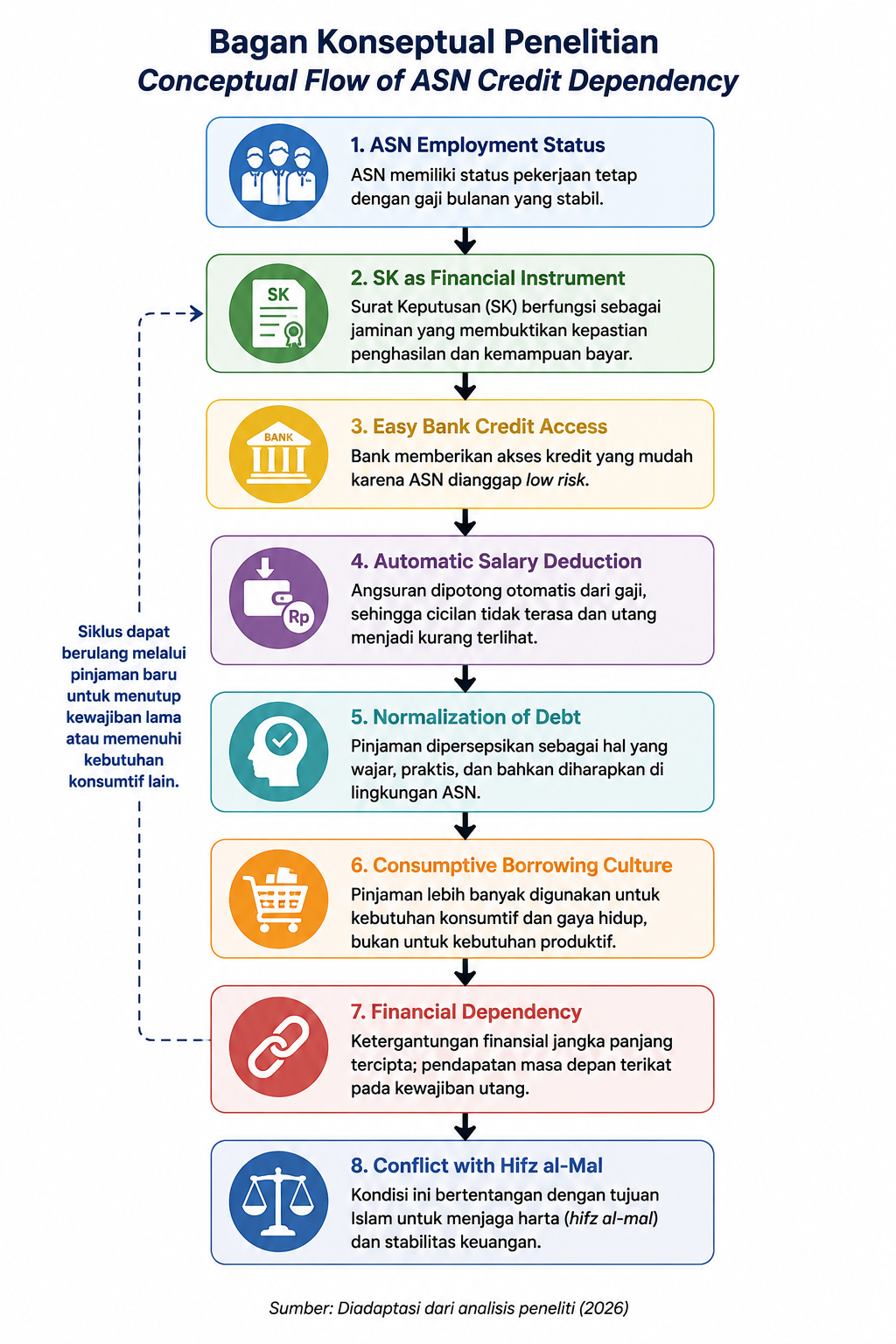
Banking credit practices using the Decree of Appointment as collateral have become a systemic phenomenon among State Civil Servants in Indonesia. This study aims to analyze how the SK-based credit mechanism operates as an instrument of banking hegemony that normalizes debt in the lives of ASN and reviews this phenomenon through an Islamic economic perspective. Using a qualitative method with a literature study approach and critical analysis, this research dissects the power relations between banking institutions and ASN using Antonio Gramsci's theory of hegemony. The research findings indicate that banks, particularly Regional Development Banks, exercise hegemony through "voluntary consent" built on narratives of financial ease and consumptive lifestyles. The ASN SK is no longer just an administrative staffing document but has transformed into an economic commodity that shackle productivity and financial independence. From an Islamic economic perspective, this practice is criticized for containing ribawi elements, encouraging israf (excessive) behavior, and contradicting the principles of Maqashid Shariah, specifically in the aspect of hifzh al-mal (protection of wealth). The novelty of this research lies in the synthesis between Gramscian socio-political critique and Islamic economic axiology in dissecting ASN debt dependence. The implications of the study suggest the need for policy reform in financial literacy and the strengthening of sharia financing models that are more equitable for ASN.
Downloads
Article Details

This work is licensed under a Creative Commons Attribution-ShareAlike 4.0 International License.
Authors continue to retain the copyright to the article if the article is published in the Jurnal Hadratul Madaniyah. They will also retain the publishing rights to the article without any restrictions.
Authors who publish in this journal agree to the following terms:
- Any article on the copyright is retained by the author(s).
- The author grants the journal the right of first publication with the work simultaneously licensed under a Creative Commons Attribution License that allows others to share work with an acknowledgment of the work authors and initial publications in this journal.
- Authors can enter into separate, additional contractual arrangements for the non-exclusive distribution of published articles (e.g., post-institutional repository) or publish them in a book, with acknowledgment of their initial publication in this journal.
- Authors are permitted and encouraged to post their work online (e.g., in institutional repositories or on their websites) before and during submission. This can lead to productive exchanges and earlier and greater citations of published work.
- The article and any associated published material are distributed under the Creative Commons Attribution-ShareAlike 4.0 International License.
References
A’yun, N. (2025). Integrasi Maqashid Syariah dalam Ekonomi Islam: Perspektif Asy-Syatibi dan Implikasinya terhadap Kesejahteraan Umat. Al-Muttaqin Jurnal Studi Sosial Dan Ekonomi, 6(2), 212–217. https://doi.org/10.63230/al-muttaqin.v6i02.309
Aeni, A. N., Aprilia, D., Putri, N. A., & Afriyanti, A. (2022). Penggunaan Video Animasi DESI (Deskriptif, Edukatif, Smart dan Interaktif) Mengenai Sistem Pembayaran Shopee Pay Later dalam Pandangan Ekonomi Islam sebagai Sarana Edukatif bagi Mahasiswa. Jurnal Ilmiah Universitas Batanghari Jambi, 22(2), 1041. https://doi.org/10.33087/jiubj.v22i2.2258
Akbar, M. F., Prasetyawati, E., Pumpungan, M., & Timur, J. (2024). Legalitas SK Pegawai Negeri Sipil Yang Dijadikan Jaminan Kredit Perbankan. 5.
Amanda, R. (2021). Hegemoni Dibalik Hubungan Bilateral Tiongkok-Indonesia. Jurnal Pamator Jurnal Ilmiah Universitas Trunojoyo, 14(1), 34–39. https://doi.org/10.21107/pamator.v14i1.9004
Berly, B., Mahi, B. R., & Mardanugraha, E. (2022). Peran Intermediasi Bank Pembangunan Daerah (BPD) Terhadap Pertumbuhan Ekonomi Daerah. Jurnal Akuntansi Dan Bisnis, 22(2). https://doi.org/10.20961/jab.v22i2.830
Danil, D., Thamrin, A., Ilham, I., & Obie, M. (2022). Implications of the Contract Freedom Principle and Legal Consequences of Standard Contract Which Detrimental to Debtors of Bank Syariah Indonesia (BSI) Makassar. Jurnal Ilmiah AL-Jauhari Jurnal Studi Islam Dan Interdisipliner, 7(2), 236–251. https://doi.org/10.30603/jiaj.v7i2.3063
Fadhilah, L. N., & Ghozali, A. M. (2024). The Phenomenon of Debt-loving Behavior Through the Islamic Worldview Perspective and Literacy in the Digital Era. KnE Social Sciences. https://doi.org/10.18502/kss.v9i12.15812
Fuad, Z. Al, Furqani, H., Zakaria, R. H., & Adha, S. I. (2024). CONSIDERING DEBT IN THE PERSPECTIVE OF MAQASID AL-SHARIAH: MASLAHAH VERSUS MAFSADAH. Petita Jurnal Kajian Ilmu Hukum Dan Syariah, 9(1), 17–29. https://doi.org/10.22373/petita.v9i1.243
Furqani, H., Fuad, Z. Al, Adha, S. I., & Awalurramadhana, A. (2023). Debt-Based Economy: A Reappraisal of Prosperity and Crisis. International Journal of Economics and Financial Issues, 13(2), 109–114. https://doi.org/10.32479/ijefi.14168
Iannone, A. (2024). Memahami hubungan kelas dan hegemoni dari sudut pandang Gramsci. https://doi.org/10.64628/aan.mnafxstdy
Ibrahim, A. A., & Alenezi, A. (2024). Leveraging Qardh al-Hasan within Islamic Finance: A Conceptual Framework for Advancing Sustainable Development among Early-stage Enterprises. Tazkia Islamic Finance and Business Review, 18(1), 18–54. https://doi.org/10.30993/tifbr.v18i1.368
Jazuli, A., Ediyono, S., Malik, A., Ahmad, A. A. H., & Muslifah, S. (2023). THE HEGEMONY OF HAMAS AND ITS IMPACT ON THE SOCIAL BEHAVIOR OF THE PALESTINIAN SOCIETY. Jurnal CMES, 16(1), 73. https://doi.org/10.20961/cmes.16.1.67057
Johan, S. (2023). PELAKSANAAN EKSEKUSI JAMINAN PRIBADI PADA TRANSAKSI PEMBIAYAAN RITEL OLEH LEMBAGA KEUANGAN BERDASARKAN PERUNDANG-UNDANGAN. MASALAH-MASALAH HUKUM, 52(1), 64–73. https://doi.org/10.14710/mmh.52.1.2023.64-73
Jusni, J., Aswan, A., Syamsuddin, A. R., & Possumah, B. T. (2019). Financing profitability optimization: case study on sharia business unit of regional development banks in Indonesia. Banks and Bank Systems, 14(1), 1–10. https://doi.org/10.21511/bbs.14(1).2019.01
Kania, T., Utamy, K. M. P., Apriliani, P., & Marlina, L. (2025). Pemikiran Zaid bin Ali Tentang Transaksi Kredit dalam Perspektif Keadilan Ekonomi Islam. SANTRI Jurnal Ekonomi Dan Keuangan Islam, 3(2), 85–93. https://doi.org/10.61132/santri.v3i2.1366
Leniwati, D., & Wahyuni, E. D. (2023). Mindfulness Based-Asset in Accounting: Interdisciplinary Perspective. Riset Akuntansi Dan Keuangan Indonesia, 7(2), 166–181. https://doi.org/10.23917/reaksi.v7i2.18099
Lestari, S. T., & Rabbani, I. (2023). Belenggu Hegemoni Patriarki dalam Cerpen Bulan Kuning Sudah Tenggelam Karya Ahmad Tohari. MIMESIS, 4(2), 117–132. https://doi.org/10.12928/mms.v4i2.7770
Maulida, D. M. (2021). Pandangan Ekonomi Islam terhadap Sikap Konsumerisme Akibat Metode Pembayaran Tunda Bayar (PayLater). TRANSFORMATIF, 5(2), 131–144. https://doi.org/10.23971/tf.v5i2.2980
Misbahuddin, M., Setyawan, A., Amaliya, N. K., & Sholihah, R. A. (2021). Toilet dan Proses Inkulturasi Masyarakat Jawa Menjadi Masyarakat Kolonial di Surakarta Abad XX. JUSPI (Jurnal Sejarah Peradaban Islam), 4(2), 133. https://doi.org/10.30829/juspi.v4i2.8781
Noh, M. S. B. M. (2021). The Economic Thought of Syeikh al Mutawalli Al-Sya’rawi from His Book of “Tafsir Al-Sya’rawi.” Deleted Journal, 10(2). https://doi.org/10.36835/iqtishoduna.v10i2.1007
Nurbaidah, S. U., Hidayah, N., & Muhajirin, M. (2025). Evaluation of the substance of consumptive murabahah: Maqāṣid perspectives, regulation, and sharia accounting. Journal of Contemporary Accounting, 89–96. https://doi.org/10.20885/jca.vol7.iss2.art2
Putri, D. F., & Syakur, A. (2023). INTEGRASI KONSEP DAN APLIKASI DALAM MENENTUKAN PERILAKU KONSUMSI DALAM KEGIATAN EKONOMI MUSLIM. Jurnal Ekonomi Bisnis Dan Akuntansi, 3(2), 182–190. https://doi.org/10.55606/jebaku.v3i2.1935
Quddus, M. F. (2021). Kritik Konsumerisme dalam Etika Konsumsi Islam. MALIA (TERAKREDITASI), 13(1), 43–60. https://doi.org/10.35891/ml.v13i1.2771
Raharyanti, M. B. (2025). SURAT KEPUTUSAN PENGANGKATAN PEGAWAI NEGERI SIPIL SEBAGAI JAMINAN KREDIT (STUDI KASUS BANK MANDIRI BANJARMASIN). JUSTITIA Jurnal Ilmu Hukum Dan Humaniora, 8(1), 140. https://doi.org/10.31604/justitia.v8i1.140-145
Santosa, B. J., & Yanuar, Y. (2020). Pengaruh Peraturan Bank Indonesia Tentang Kredit UMKM Terhadap Total Kredit, Rasio Kredit Umkm, Risiko, Efisiensi dan Profitabilitas Bank Pembangunan Daerah. Jurnal Manajemen Bisnis Dan Kewirausahaan, 4(2), 57. https://doi.org/10.24912/jmbk.v4i2.7522
Sari, S. R., Andriani, S., & Sari, P. R. K. (2020). Pengaruh Literasi Keuangan Dan Gaya Hidup Terhadap Perilaku Keuangan Aparatur Sipil Negara (ASN) Wanita Di Sumbawa Besar. Jurnal Ekonomi Dan Bisnis Indonesia, 5(2), 33–37. https://doi.org/10.37673/jebi.v5i02.852
Setiawan, D. (2024). Integrasi Islamic Worldview dalam Ekonomi Indonesia: Perspektif Neoklasik, Institusional dan Makroekonomi. BUDAI MULTIDISCIPLINARY JOURNAL OF ISLAMIC STUDIES, 2(1), 1. https://doi.org/10.30659/budai.2.1.01-11
Shidarta, & Martinelli, I. (2023). Consumer Rights to Information in the Middle of Media Hegemony. E3S Web of Conferences, 388, 4028. https://doi.org/10.1051/e3sconf/202338804028
Siregar, D. F., & Daulay, M. A. J. (2023). Formasi dan Negosiasi Ideologi dalam Novel Maryam Karya Okky Madasari: Perspektif Hegemoni Gramsci. Kode Jurnal Bahasa, 12(3). https://doi.org/10.24114/kjb.v12i3.47667
Wahyuningsih, Y. S., Rochayanti, C., & Lestari, P. (2024). Regional Bank customer relationship management model through Public Relations functions. COMMICAST, 5(1), 23–42. https://doi.org/10.12928/commicast.v5i1.10004