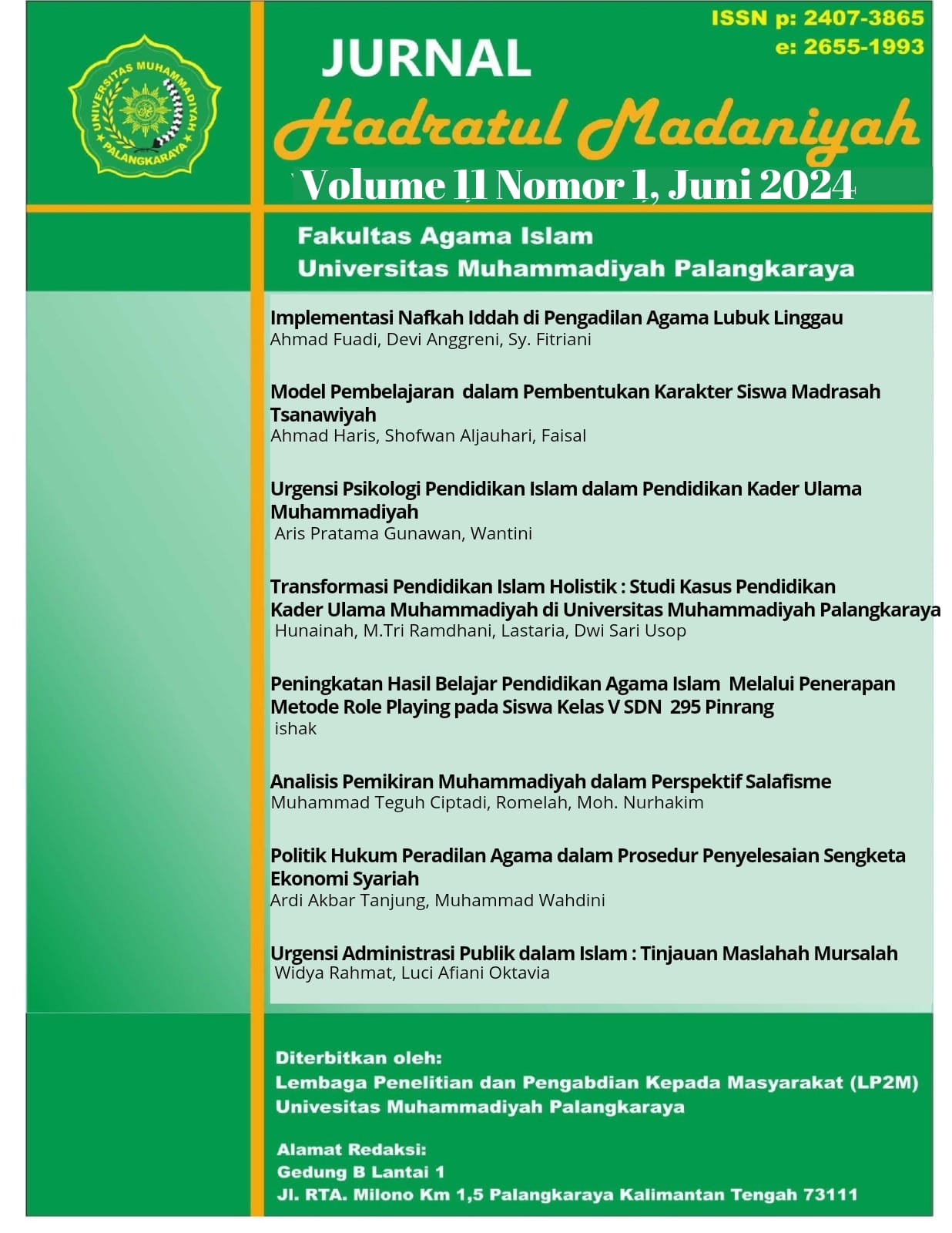
ANALISIS PEMIKIRAN MUHAMMADIYAH DALAM PERSPEKTIF SALAFISME
Article Sidebar
Main Article Content
Abstract
Muhammadiyah as an open and moderate organization, easily accepts ideas and actions from other Islamic groups that have ideologies similar to Muhammadiyah. One such movement is Salafism. The introduction of Salafism into Muhammadiyah has caused various reactions, especially among the Muslims themselves. Some of the issues faced include how the Salafi movement affects the citizens of the Muhammadiyah association, whatever similarities and differences between Salafi and Muhammadiyah movements, as well as the impact of Salafi movements on the Mohammedan association. The research model uses qualitative, and in its discussion this research uses descriptive methods of analysis, while in obtaining data using library methods.In different perspectives, Muhammadiyah is often associated with Salafism and even the movement of radicalism. In addition, the young Mohammedan generation can be influenced by Islamic discourse and transnational movements such as salafism. Furthermore, the unrest that is occurring in Muslim-majority countries in various regions of the world can affect the thinking and attitudes of the young Mohammedan generation. The Muhammadiyah, who has struggled for more than a hundred years to encourage moderation and progress in Islam, is considered too great to change its moderate and progressive tradition, despite the challenges and temptations. The vision of Islamic progress and religious moderation in Indonesia will remain held by the Muhammadiyah.
Downloads
Article Details

This work is licensed under a Creative Commons Attribution-ShareAlike 4.0 International License.
Authors continue to retain the copyright to the article if the article is published in the Jurnal Hadratul Madaniyah. They will also retain the publishing rights to the article without any restrictions.
Authors who publish in this journal agree to the following terms:
- Any article on the copyright is retained by the author(s).
- The author grants the journal the right of first publication with the work simultaneously licensed under a Creative Commons Attribution License that allows others to share work with an acknowledgment of the work authors and initial publications in this journal.
- Authors can enter into separate, additional contractual arrangements for the non-exclusive distribution of published articles (e.g., post-institutional repository) or publish them in a book, with acknowledgment of their initial publication in this journal.
- Authors are permitted and encouraged to post their work online (e.g., in institutional repositories or on their websites) before and during submission. This can lead to productive exchanges and earlier and greater citations of published work.
- The article and any associated published material are distributed under the Creative Commons Attribution-ShareAlike 4.0 International License.
References
Aprilianti, R., Bella Avilia, D. S., & Romelah. (2022). THE ROLE OF MUHAMMADIYAH ISLAMIC MOVEMENT IN HACKING A NEW MAP OF LOCAL CULTURE IN INDONESIA. Audito Comparative Law Journal (ACLJ), 3(1). https://doi.org/https://doi.org/10.22219/aclj.v3i1.19857
Boy ZTF, P. (2019). MUHAMMADIYAH DAN SALAFISME: SEBUAH SURVEI SINGKAT TENTANG TITIK TEMU DAN TITIK SETERU (Vol. 14, Issue 2). https://doi.org/https://doi.org/10.47651/mrf.v14i2.67
Farooq Abdullah, H. M., Hakim, L., & Syahidan, M. (2022). Traditionalist salafi’s involvement in the religious moderation da’wah. Islamic Communication Journal, 7(2), 243–256. https://doi.org/10.21580/icj.2022.7.2.12664
Hamzah, F., Khairil Mursyid, F., Zuhri Syah Umar, M., Maulana, R., & Artikel, I. (2023). The History of Muhammadiyah. In Journal of Indonesian History (Vol. 11, Issue 1). http://journal.unnes.ac.id/sju/index.php/jih
Kahfi, M. (2020). Peranan Muhammadiyah Sebagai Gerakan Islam Berkemajuan Di Era Modern. Al-Risalah : Jurnal Studi Agama Dan Pemikiran Islam, 11. https://doi.org/https://doi.org/10.34005/alrisalah.v11i2.590
Putra, A., Homsatun, A., Jamhari, J., Setiani, M., & Nurhidayah, N. (2021). Pemikiran Islam Wasathiyah Azyumardi Azra sebagai Jalan Moderasi Beragama. Jurnal Riset Agama, 1(3), 212–222. https://doi.org/10.15575/jra.v1i3.15224
Sarwan, S., & Sabri, M. (2023). Distingsi Hadis Bid’ah Perspektif Muhammadiyah dan Wahabi. El-Afkar, 12(1). https://doi.org/10.36563/publiciana.v8i1.45
Suradji, M., Romelah, & Hakim, Moh. N. (2023). EKSISTENSI MUHAMMADIYAH DI TENGAH TANTANGAN ZAMAN. Humanis, 14(1). https://doi.org/https://doi.org/10.52166/humanis.v15i1.3955
Syahbana, T. A. (2015). FENOMENA SALAFI DI KALIMANTAN SELATAN. Jurnal Ilmiah Ilmu Ushuluddin, 14(1), 67. https://doi.org/https://doi.org/10.18592/jiu.v14i1.686
Wahyudin. (2021). MENYOAL GERAKAN SALAFI DI INDONESIA (Pro-Kontra Metode Dakwah Salafi). Al-Tafaqquh: Journal of Islamic Law, 2. https://doi.org/http://dx.doi.org/10.33096/altafaqquh.v2i1.87