Determination of Osteoporosis Risk in Post-Menopausal Women Using the Malaysian Osteoporosis Screening Tool: A Pilot Study in a Community Pharmacy

Article Sidebar
-
Community Pharmacy, Malaysian Osteoporosis Screening Tool (MOST), Osteoporosis, Postmenopausal Women, Calcium, Vitamin D
Abstract
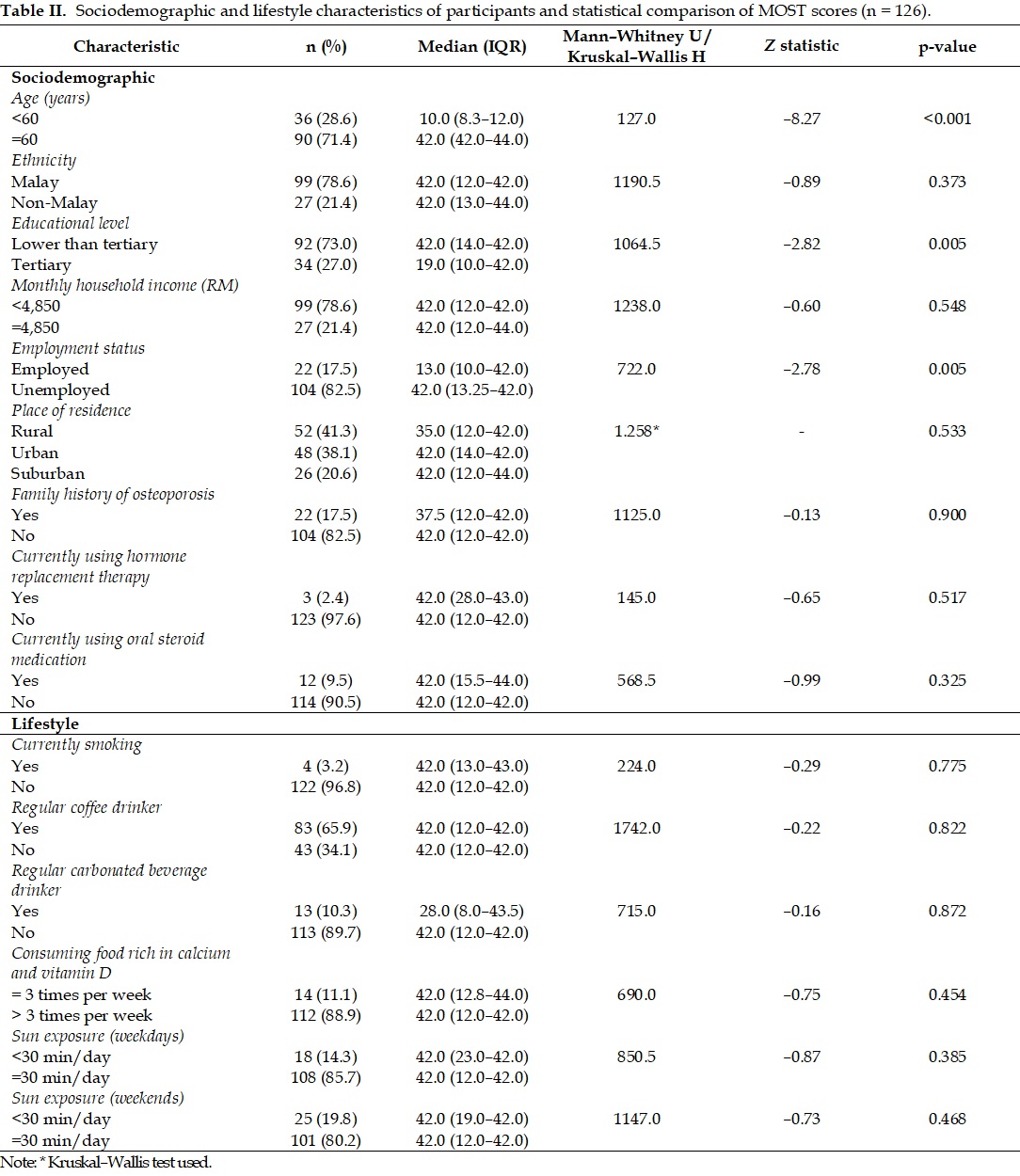
Osteoporosis detection remains suboptimal in Malaysia. This study aimed to evaluate osteoporosis risk using the Malaysian Osteoporosis Screening Tool (MOST) and supplementation behaviors in a community pharmacy. A cross-sectional study was conducted in a private pharmacy in Temerloh, Pahang (May–August 2025). Postmenopausal women (n = 126) completed questionnaires and underwent anthropometric assessment (BMI, hip circumference). MOST scores were calculated, and group differences were analyzed using Mann–Whitney U and Kruskal–Wallis tests (p <0.05). All participants were classified as "at risk" (MOST >4); the median score was 42.0 (IQR 12.0–42.0). Scores were significantly higher among women aged >60 years (p <0.001), those with lower education (p = 0.005), and the unemployed (p = 0.005), but were unrelated to income, ethnicity, or residence. Hip circumference was >90 cm in 96.8% of cases, limiting its discriminatory value. Lifestyle and clinical factors, including family history, hormone therapy, steroid use, smoking, coffee intake, carbonated drinks, and calcium- and vitamin D-rich foods, were not associated with MOST scores. Supplement use included calcium (27.8%), vitamin D (35.7%), and combined calcium–vitamin D (26.2%). Calcium users had higher scores (p = 0.011); vitamin D or combined use showed no differences (p >0.05). MOST concentrated nearly all postmenopausal women into the high-risk category, primarily reflecting age and menopausal duration. Findings support its feasibility in community pharmacies and highlight gaps in coordinated calcium and vitamin D supplementation.
Full text article
References
2. Subramaniam S, Chan CY, Soelaiman IN, Mohamed N, Muhammad N, Ahmad F, et al. Prevalence and Predictors of Osteoporosis Among the Chinese Population in Klang Valley, Malaysia. Appl Sci. 2019;9(9):1820. DOI: 10.3390/app9091820.
3. Chan CY, Subramaniam S, Mohamed N, Ima-Nirwana S, Muhammad N, Fairus A, et al. Determinants of Bone Health Status in a Multi-Ethnic Population in Klang Valley, Malaysia. Int J Environ Res Public Health. 2020;17(2):384. DOI: 10.3390/ijerph17020384; PMID: 31936034; PMCID: PMC7014230.
4. Bhatti Z, Laghari M, Khan AH, Talpur BA, Sulaiman SAS. Assessment of osteoporosis knowledge and its determinants among tuberculosis patients in tertiary care hospital Malaysia: A prospective study. J Clin Tuberc Other Mycobact Dis. 2024;34:100416. DOI: 10.1016/j.jctube.2024.100416; PMID: 38318334; PMCID: PMC10839438.
5. Charde SH, Joshi A, Raut J. A Comprehensive Review on Postmenopausal Osteoporosis in Women. Cureus. 2023;15(11):e48582. DOI: 10.7759/cureus.48582; PMID: 38090417; PMCID: PMC10711335.
6. Afrin N, Sund R, Honkanen R, Koivumaa-Honkanen H, Rikkonen T, Williams L, et al. A fall in the previous 12 months predicts fracture in the subsequent 5 years in postmenopausal women. Osteoporos Int. 2020;31(5):839-47. DOI: 10.1007/s00198-019-05255-5; PMID: 31858171; PMCID: PMC7170829.
7. El-Setouhy M, Khired Z, Darraj H, Zogel B, Alhazmi MH, Maghrabi RE, et al. The Relation Between Osteoporosis and Bone Fractures and Health-Related Quality of Life in Post-menopausal Saudi Women in the Jazan Region: A Cross-Sectional Study. Cureus. 2024;16(2):e54412. DOI: 10.7759/cureus.54412; PMID: 38505434; PMCID: PMC10950383.
8. Chin WL, Chu EC, Chiang R. Screening and Diagnosing Osteoporosis Among Postmenopausal Women in Primary Care Settings in Malaysia: A Systematic Review. Maedica. 2022;17(2):492-504. DOI: 10.26574/maedica.2022.17.2.492; PMID: 36032605; PMCID: PMC9375864.
9. LeBoff MS, Greenspan SL, Insogna KL, Lewiecki EM, Saag KG, Singer AJ, et al. Correction to: The clinician's guide to prevention and treatment of osteoporosis. Osteoporos Int. 2022;33(10):2243. DOI: 10.1007/s00198-022-06479-8; PMID: 35900384; PMCID: PMC9546943.
10. Alshahrani F, Alsulaiman YA, Almashari YM, Alawad NK, Almousa SA, Allarakia Y, et al. Use of the Osteoporosis Self-Assessment Tool as a Screening Tool for Osteoporosis in Saudi Postmenopausal Women. Cureus. 2023;15(4):e37755. DOI: 10.7759/cureus.37755; PMID: 37213999; PMCID: PMC10193514.
11. Saffian SM, Jamil NA, Tahir NAM, Hatah E. Vitamin D insufficiency is high in Malaysia: A systematic review and meta-analysis of studies on vitamin D status in Malaysia. Front Nutr. 2022;9:1050745. DOI: 10.3389/fnut.2022.1050745; PMID: 36466384; PMCID: PMC9715981.
12. Isa ZM, Nordin NRM, Mahmud MH, Hashim S. An Update on Vitamin D Deficiency Status in Malaysia. Nutrients. 2022;14(3):567. DOI: 10.3390/nu14030567; PMID: 35276926; PMCID: PMC8838715.
13. Lee JK, Chee WSS, Foo SH, Lee VKM, Sallehuddin H, Khor HM, et al. Correction: Vitamin D status and clinical implications in the adult population of Malaysia: a position paper by the Malaysian Vitamin D Special Interest Group. Osteoporos Int. 2023;34(11):1851-2. DOI: 10.1007/s00198-023-06865-w; PMID: 37505306.
14. Manon SM, Phuong JM, Moles RJ, Kelly A, Center JR, Luckie K, et al. The role of community pharmacists in delivering interventions for osteoporosis: A systematic review. J Am Pharm Assoc. 2022;62(6):1741-9.e10. DOI: 10.1016/j.japh.2022.06.014; PMID: 35995695.
15. Nik J, Lai PS, Ng CJ, Emmerton L. A qualitative study of community pharmacists' opinions on the provision of osteoporosis disease state management services in Malaysia. BMC Health Serv Res. 2016;16(1):448. DOI: 10.1186/s12913-016-1686-x; PMID: 27577560; PMCID: PMC5006277.
16. Chaiyakunapruk N, Laowakul A, Karnchanarat S, Pikulthong N, Ongphiphadhanakul B. Community pharmacy-based implementation and evaluation of an osteoporosis self-assessment tool for Asians. J Am Pharm Assoc. 2006;46(3):391-6. DOI: 10.1331/154434506777069624; PMID: 16739762.
17. Goode JV, Swiger K, Bluml BM. Regional osteoporosis screening, referral, and monitoring program in community pharmacies: findings from Project ImPACT: Osteoporosis. J Am Pharm Assoc. 2004;44(2):152-60. DOI: 10.1331/154434504773062609; PMID: 15098849.
18. Wahab MSA, Jalani MM, Goh KW, Ming LC, Faller EM. Why Did I Consult My Pharmacist about Herbal and Dietary Supplements? An Online Survey Amid the COVID-19 Pandemic in Malaysia. Int J Environ Res Public Health. 2022;19(17):10994. DOI: 10.3390/ijerph191710994; PMID: 36078707; PMCID: PMC9517816.
19. Kunselman AR. A brief overview of pilot studies and their sample size justification. Fertil Steril. 2024;121(6):899-901. DOI: 10.1016/j.fertnstert.2024.01.040; PMID: 38331310; PMCID: PMC11128343.
20. Blebil AQ, Dujaili JA, Teoh E, Wong PS, Bhuvan KC. Assessment of Awareness, Knowledge, Attitude, and the Practice of Vitamin D among the General Public in Malaysia. J Karnali Acad Health Sci. 2019;2(3):171-80. DOI: 10.3126/jkahs.v2i3.26646.
21. Yusoff MSB. ABC of content validation and content validity index calculation. Educ Med J. 2019;11(2):49-54. DOI: 10.21315/eimj2019.11.2.6.
22. Shan LP, Bee OF, Suniza SS, Adeeb N. Developing a Malaysian Osteoporosis Screening Tool (MOST) for early osteoporosis detection in Malaysian women. Sex Reprod Healthc. 2011;2(2):77-82. DOI: 10.1016/j.srhc.2010.11.004; PMID: 21439525.
23. Sani MP, Fahimfar N, Panahi N, Mansournia MA, Sanjari M, Khalagi K, et al. Evaluation of the performance of osteoporosis/fracture screening models to identify high-risk women for osteoporosis: Bushehr elderly health (BEH) program. J Diabetes Metab Disord. 2022;21(2):1609-17. DOI: 10.1007/s40200-022-01110-3; PMID: 36404865; PMCID: PMC9672243.
24. Francis J, Toh LS, Sellappans R, Loo JSE. Awareness of osteoporosis risk assessment tools and screening recommendations among community pharmacists in Malaysia. Int J Clin Pharm. 2021;43(3):604-12. DOI: 10.1007/s11096-020-01169-z; PMID: 33507463.
25. Noh JW, Park H, Kim M, Kwon YD. Gender Differences and Socioeconomic Factors Related to Osteoporosis: A Cross-Sectional Analysis of Nationally Representative Data. J Womens Health. 2018;27(2):196-202. DOI: 10.1089/jwh.2016.6244; PMID: 28832241.
26. Myong JP, Kim HR, Choi SE, Koo JW. The effect of socioeconomic position on bone health among Koreans by gender and menopausal status. Calcif Tissue Int. 2012;90(6):488-95. DOI: 10.1007/s00223-012-9597-2; PMID: 22527203.
27. Cosman F, de Beur SJ, LeBoff MS, Lewiecki EM, Tanner B, Randall S, et al. Erratum to: Clinician's guide to prevention and treatment of osteoporosis. Osteoporos Int. 2015;26(7):2045-7. DOI: 10.1007/s00198-015-3037-x; PMID: 25986381; PMCID: PMC4643600.
28. Tan L, He R, Zheng X. Effect of vitamin D, calcium, or combined supplementation on fall prevention: a systematic review and updated network meta-analysis. BMC Geriatr. 2024;24(1):390. DOI: 10.1186/s12877-024-05009-x; PMID: 38698349; PMCID: PMC11064304.
29. Wahab MSA, Malik NAA, Sahudin S, Affandi MMRMM, Othman N, Ali AA. Exploring the factors associated with the intention to assess customers’ herbal and dietary supplement use by community pharmacists in Kuala Lumpur, Malaysia. J Appl Pharm Sci. 2019;9(12):108-16. DOI: 10.7324/JAPS.2019.91215.
30. Bukowska-Damska A, Jurewicz J, Jabłońska E. Caffeine consumption as a potential risk factor of osteoporosis development among night shift workers: epidemiological evidences and hypothesis. Int J Occup Med Environ Health. 2025;38(5):474-94. DOI: 10.13075/ijomeh.1896.02646; PMID: 41185921; PMCID: PMC12658969.
31. Cui A, Xiao P, He J, Fan Z, Xie M, Chen L, et al. Association between caffeine consumption and bone mineral density in children and adolescent: Observational and Mendelian randomization study. PLoS One. 2023;18(6):e0287756. DOI: 10.1371/journal.pone.0287756; PMID: 37384670; PMCID: PMC10309635.
Authors
Copyright (c) 2026 Athirah Ahmad Latif, Nursyuhadah Othman, Saliha Azlan, Nik Ateerah Rasheeda Mohd Rocky, Siti Sarah Syahirah Kushairi, Nik Aisyah Najwa Nik Mustaffa Shapri, Mohd Shahezwan Abd Wahab

This work is licensed under a Creative Commons Attribution-ShareAlike 4.0 International License.
This work is licensed under a Creative Commons Attribution-ShareAlike 4.0 International License.
Authors continue to retain the copyright to the article if the article is published in the Borneo Journal of Pharmacy. They will also retain the publishing rights to the article without any restrictions.
Authors who publish in this journal agree to the following terms:
- Any article on the copyright is retained by the author(s).
- The author grants the journal the right of first publication with the work simultaneously licensed under a Creative Commons Attribution License that allows others to share work with an acknowledgment of the work authors and initial publications in this journal.
- Authors can enter into separate, additional contractual arrangements for the non-exclusive distribution of published articles (e.g., post-institutional repository) or publish them in a book, with acknowledgment of their initial publication in this journal.
- Authors are permitted and encouraged to post their work online (e.g., in institutional repositories or on their websites) prior to and during the submission process. This can lead to productive exchanges and earlier and greater citations of published work.
- The article and any associated published material are distributed under the Creative Commons Attribution-ShareAlike 4.0 International License.
Article Details