The Effect of Thymoquinone on Progressive Brain Damage: An Experimental Study in a Wistar Rat Model of Intracerebral Hemorrhage

Article Sidebar
Submitted
12 September 2025
Published
30 June 2026
Keywords:
-
MMP-9, Thymoquinone, Inflammatory, Free radicals, Intracerebral hemorrhage
Abstract
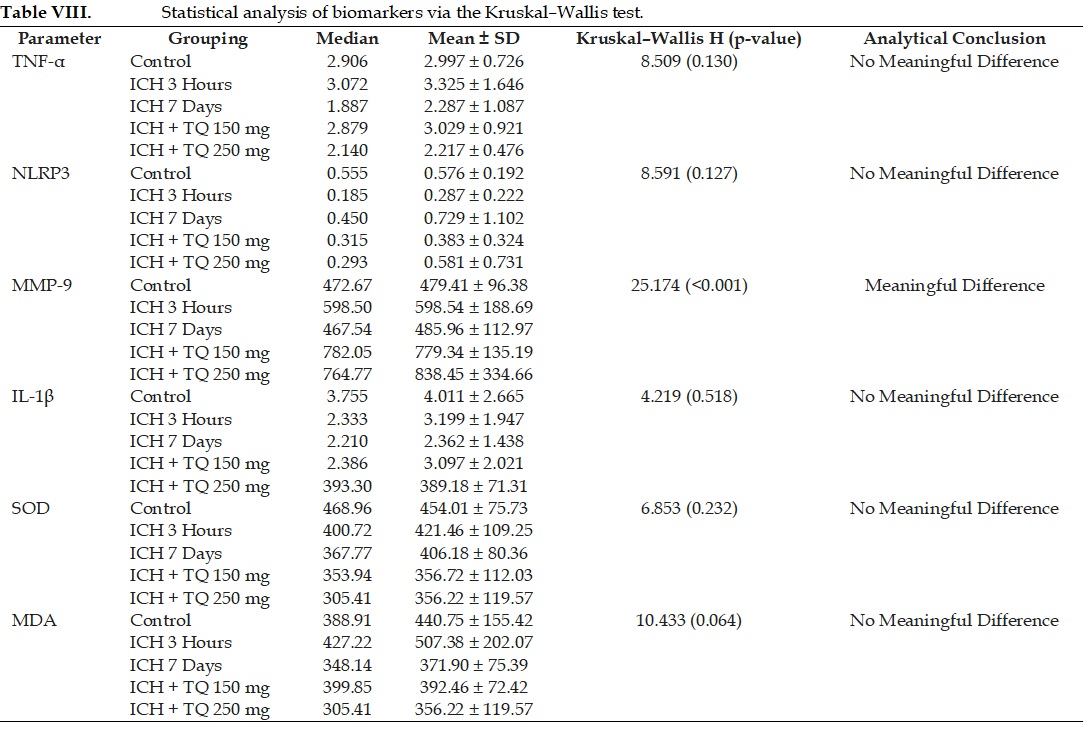
Intracerebral hemorrhage (ICH) accounts for 20% of stroke cases and is associated with a 40–50% mortality rate, yet effective neuroprotective therapies remain lacking. This study evaluated the therapeutic efficacy and molecular mechanisms of thymoquinone (TQ), the primary bioactive constituent of Nigella sativa, in a Wistar rat model of ICH. Male Wistar rats (n = 55, 200–220 g) were randomized into five groups: untreated control, untreated ICH, vehicle-treated ICH (corn oil for 7 days), and ICH treated orally with TQ at 150 mg/kg or 250 mg/kg body weight daily for 7 days. ICH was induced via autologous blood injection (0.12 mL) into the brain parenchyma. Biomarkers for neuroinflammation (NLRP3, TNF-α, IL-6, IL-1β), oxidative stress (SOD, MDA), tissue remodeling (MMP-9), and neuronal necrosis were quantified using ELISA, immunohistochemistry, and histological staining. TQ administration significantly elevated MMP-9 levels (p = 0.000) compared with untreated ICH controls and markedly suppressed NLRP3, TNF-α, and IL-1β expression. Furthermore, TQ increased SOD antioxidant activity, whereas MDA levels remained elevated. These neuroprotective effects were dose-dependent, with maximal modulation observed at 250 mg/kg TQ. In conclusion, TQ modulates critical inflammatory and oxidative pathways in experimental ICH while unexpectedly upregulating MMP-9, suggesting a complex dual function in early neuroprotection and subsequent tissue remodeling. These findings demonstrate that TQ holds promising potential as a natural neuroprotective agent for hemorrhagic stroke management.
Full text article
Generated from XML file
References
1. Montaño A, Hanley DF, Hemphill JC 3rd. Hemorrhagic stroke. Handb Clin Neurol. 2021;176:229-48. DOI: 10.1016/B978-0-444-64034-5.00019-5; PMID: 33272397.
2. Wang S, Zou XL, Wu LX, Zhou HF, Xiao L, Yao T, et al. Epidemiology of intracerebral hemorrhage: A systematic review and meta-analysis. Front Neurol. 2022;13:915813. DOI: 10.3389/fneur.2022.915813; PMID: 36188383; PMCID: PMC9523083.
3. Lindsay MP, Norrving B, Sacco RL, Brainin M, Hacke W, Martins S, et al. World Stroke Organization (WSO): Global Stroke Fact Sheet 2019. Int J Stroke. 2019;14(8):806-17. DOI: 10.1177/1747493019881353; PMID: 31658892.
4. Yudawijaya A, Suling FRW. Comparison of hypertension risk factors in Hemorric Stroke with Non-Hemorric Stroke in UKI General Hospital, East Jakarta. Int J Med Health Res. 2022;8(3):40-8.
5. Yuniati D, Syifak S, Putra PA, Saffanah VSP. Intracerebral hemorrhage Score as a Prognosis Prediction of Spontaneous Intracerebral hemorrhage at RSI Surabaya Jemursari. AKSONA. 2023;3(2):67-73. DOI: 10.20473/aksona.v3i2.40242.
6. Shao Z, Tu S, Shao A. Pathophysiological Mechanisms and Potential Therapeutic Targets in Intracerebral Hemorrhage. Front Pharmacol. 2019;10:1079. DOI: 10.3389/fphar.2019.01079; PMID: 31607923; PMCID: PMC6761372.
7. Zheng S, Jian D, Gan H, Wang L, Zhao J, Zhai X. FUNDC1 inhibits NLRP3-mediated inflammation after intracerebral hemorrhage by promoting mitophagy in mice. Neurosci Lett. 2021;756:135967. DOI: 10.1016/j.neulet.2021.135967; PMID: 34022268.
8. Liu T, Li X, Cui Y, Meng P, Zeng G, Wang Y, Wang Q. Bioinformatics Analysis Identifies Potential Ferroptosis Key Genes in the Pathogenesis of Intracerebral Hemorrhage. Front Neurosci. 2021;15:661663. DOI: 10.3389/fnins.2021.661663; PMID: 34163322; PMCID: PMC8215678.
9. Shad KF, Soubra W, Cordato DJ. The role of thymoquinone, a major constituent of Nigella sativa, in the treatment of inflammatory and infectious diseases. Clin Exp Pharmacol Physiol. 2021;48(11):1445-53. DOI: 10.1111/1440-1681.13553; PMID: 34297870.
10. Bordoni L, Fedeli D, Nasuti C, Maggi F, Papa F, Wabitsch M, De Caterina R, Gabbianelli R. Antioxidant and Anti-Inflammatory Properties of Nigella sativa Oil in Human Pre-Adipocytes. Antioxidants. 2019;8(2):51. DOI: 10.3390/antiox8020051; PMID: 30823525; PMCID: PMC6406245.
11. Tadi P, Lui F. Acute Stroke. In: StatPearls. Treasure Island (FL): StatPearls Publishing; 2026. NBKID: NBK535369
12. Amartey J, Gapper S, Hussein N, Morris K, Withycombe CE. Nigella sativa extract and thymoquinone regulate inflammatory cytokine and TET-2 expression in endothelial cells. Artery Res. 2019;25(3):157-63. DOI: 10.2991/artres.k.191114.002.
13. Cobourne-Duval MK, Taka E, Mendonca P, Soliman KFA. Thymoquinone increases the expression of neuroprotective proteins while decreasing the expression of pro-inflammatory cytokines and the gene expression NFκB pathway signaling targets in LPS/IFNγ -activated BV-2 microglia cells. J Neuroimmunol. 2018;320:87-97. DOI: 10.1016/j.jneuroim.2018.04.018; PMID: 29759145; PMCID: PMC5967628.
14. Durak MA, Ozhan O, Yildiz A, Durhan M, Vardi N, Cigremis Y, et al. Protective effect of short-term thymoquinone administration on the central nervous system in cisplatin-induced neurotoxicity. Eur Rev Med Pharmacol Sci. 2022;26(19):6935-43. DOI: 10.26355/eurrev_202210_29874; PMID: 36263573.
15. Hu X, Tao C, Gan Q, Zheng J, Li H, You C. Oxidative Stress in Intracerebral Hemorrhage: Sources, Mechanisms, and Therapeutic Targets. Oxid Med Cell Longev. 2016;2016:3215391. DOI: 10.1155/2016/3215391; PMID: 26843907; PMCID: PMC4710930.
16. Zhao S, Jiang J, Jing Y, Liu W, Yang X, Hou X, et al. The concentration of tumor necrosis factor-α determines its protective or damaging effect on liver injury by regulating Yap activity. Cell Death Dis. 2020;11(1):70. DOI: 10.1038/s41419-020-2264-z; PMID: 31988281; PMCID: PMC6985193.
17. Isaev NK, Genrikhs EE, Stelmashook EV. Antioxidant Thymoquinone and Its Potential in the Treatment of Neurological Diseases. Antioxidants. 2023;12(2):433. DOI: 10.3390/antiox12020433; PMID: 36829993; PMCID: PMC9952318.
18. Liu Y, Huang L, Kim MY, Cho JY. The Role of Thymoquinone in Inflammatory Response in Chronic Diseases. Int J Mol Sci. 2022;23(18):10246. DOI: 10.3390/ijms231810246; PMID: 36142148; PMCID: PMC9499585.
19. Fanoudi S, Alavi MS, Hosseini M, Sadeghnia HR. Nigella sativa and thymoquinone attenuate oxidative stress and cognitive impairment following cerebral hypoperfusion in rats. Metab Brain Dis. 2019;34(4):1001-10. DOI: 10.1007/s11011-019-00394-4; PMID: 31016464.
20. Könnecke H, Bechmann I. The role of microglia and matrix metalloproteinases involvement in neuroinflammation and gliomas. Clin Dev Immunol. 2013;2013:914104. DOI: 10.1155/2013/914104; PMID: 24023566; PMCID: PMC3759277.
21. Guan X, Li M, Li H, Guo Z, Ullah MS, Liu X, Wu M, Yu W. The role of MMPs in intracerebral hemorrhage. Front Cell Dev Biol. 2025;13:1667228. DOI: 10.3389/fcell.2025.1667228; PMID: 41480312; PMCID: PMC12754015.
22. Kaymak E, Akin AT, Öztürk E, Karabulut D, Kuloğlu N, Yakan B. Thymoquinone has a neuroprotective effect against inflammation, oxidative stress, and endoplasmic reticulum stress in the brain cortex, medulla, and hippocampus due to doxorubicin. J Biochem Mol Toxicol. 2021;35(11):e22888. DOI: 10.1002/jbt.22888; PMID: 34392583.
23. Behairy A, Elkomy A, Elsayed F, Gaballa MMS, Soliman A, Aboubakr M. Antioxidant and anti-inflammatory potential of spirulina and thymoquinone mitigate the methotrexate-induced neurotoxicity. Naunyn Schmiedebergs Arch Pharmacol. 2024;397(3):1875-88. DOI: 10.1007/s00210-023-02739-4; PMID: 37773524; PMCID: PMC10858838.
24. Zhang Y, Yu W, Liu Y, Chang W, Wang M, Zhang L. Regulation of nuclear factor erythroid-2-related factor 2 as a potential therapeutic target in intracerebral hemorrhage. Front Mol Neurosci. 2022;15:995518. DOI: 10.3389/fnmol.2022.995518; PMID: 36245922; PMCID: PMC9559574.
25. Pottoo FH, Ibrahim AM, Alammar A, Alsinan R, Aleid M, Alshehhi A, Alshehri M, Mishra S, Alhajri N. Thymoquinone: Review of Its Potential in the Treatment of Neurological Diseases. Pharmaceuticals. 2022;15(4):408. DOI: 10.3390/ph15040408; PMID: 35455405; PMCID: PMC9026861.
2. Wang S, Zou XL, Wu LX, Zhou HF, Xiao L, Yao T, et al. Epidemiology of intracerebral hemorrhage: A systematic review and meta-analysis. Front Neurol. 2022;13:915813. DOI: 10.3389/fneur.2022.915813; PMID: 36188383; PMCID: PMC9523083.
3. Lindsay MP, Norrving B, Sacco RL, Brainin M, Hacke W, Martins S, et al. World Stroke Organization (WSO): Global Stroke Fact Sheet 2019. Int J Stroke. 2019;14(8):806-17. DOI: 10.1177/1747493019881353; PMID: 31658892.
4. Yudawijaya A, Suling FRW. Comparison of hypertension risk factors in Hemorric Stroke with Non-Hemorric Stroke in UKI General Hospital, East Jakarta. Int J Med Health Res. 2022;8(3):40-8.
5. Yuniati D, Syifak S, Putra PA, Saffanah VSP. Intracerebral hemorrhage Score as a Prognosis Prediction of Spontaneous Intracerebral hemorrhage at RSI Surabaya Jemursari. AKSONA. 2023;3(2):67-73. DOI: 10.20473/aksona.v3i2.40242.
6. Shao Z, Tu S, Shao A. Pathophysiological Mechanisms and Potential Therapeutic Targets in Intracerebral Hemorrhage. Front Pharmacol. 2019;10:1079. DOI: 10.3389/fphar.2019.01079; PMID: 31607923; PMCID: PMC6761372.
7. Zheng S, Jian D, Gan H, Wang L, Zhao J, Zhai X. FUNDC1 inhibits NLRP3-mediated inflammation after intracerebral hemorrhage by promoting mitophagy in mice. Neurosci Lett. 2021;756:135967. DOI: 10.1016/j.neulet.2021.135967; PMID: 34022268.
8. Liu T, Li X, Cui Y, Meng P, Zeng G, Wang Y, Wang Q. Bioinformatics Analysis Identifies Potential Ferroptosis Key Genes in the Pathogenesis of Intracerebral Hemorrhage. Front Neurosci. 2021;15:661663. DOI: 10.3389/fnins.2021.661663; PMID: 34163322; PMCID: PMC8215678.
9. Shad KF, Soubra W, Cordato DJ. The role of thymoquinone, a major constituent of Nigella sativa, in the treatment of inflammatory and infectious diseases. Clin Exp Pharmacol Physiol. 2021;48(11):1445-53. DOI: 10.1111/1440-1681.13553; PMID: 34297870.
10. Bordoni L, Fedeli D, Nasuti C, Maggi F, Papa F, Wabitsch M, De Caterina R, Gabbianelli R. Antioxidant and Anti-Inflammatory Properties of Nigella sativa Oil in Human Pre-Adipocytes. Antioxidants. 2019;8(2):51. DOI: 10.3390/antiox8020051; PMID: 30823525; PMCID: PMC6406245.
11. Tadi P, Lui F. Acute Stroke. In: StatPearls. Treasure Island (FL): StatPearls Publishing; 2026. NBKID: NBK535369
12. Amartey J, Gapper S, Hussein N, Morris K, Withycombe CE. Nigella sativa extract and thymoquinone regulate inflammatory cytokine and TET-2 expression in endothelial cells. Artery Res. 2019;25(3):157-63. DOI: 10.2991/artres.k.191114.002.
13. Cobourne-Duval MK, Taka E, Mendonca P, Soliman KFA. Thymoquinone increases the expression of neuroprotective proteins while decreasing the expression of pro-inflammatory cytokines and the gene expression NFκB pathway signaling targets in LPS/IFNγ -activated BV-2 microglia cells. J Neuroimmunol. 2018;320:87-97. DOI: 10.1016/j.jneuroim.2018.04.018; PMID: 29759145; PMCID: PMC5967628.
14. Durak MA, Ozhan O, Yildiz A, Durhan M, Vardi N, Cigremis Y, et al. Protective effect of short-term thymoquinone administration on the central nervous system in cisplatin-induced neurotoxicity. Eur Rev Med Pharmacol Sci. 2022;26(19):6935-43. DOI: 10.26355/eurrev_202210_29874; PMID: 36263573.
15. Hu X, Tao C, Gan Q, Zheng J, Li H, You C. Oxidative Stress in Intracerebral Hemorrhage: Sources, Mechanisms, and Therapeutic Targets. Oxid Med Cell Longev. 2016;2016:3215391. DOI: 10.1155/2016/3215391; PMID: 26843907; PMCID: PMC4710930.
16. Zhao S, Jiang J, Jing Y, Liu W, Yang X, Hou X, et al. The concentration of tumor necrosis factor-α determines its protective or damaging effect on liver injury by regulating Yap activity. Cell Death Dis. 2020;11(1):70. DOI: 10.1038/s41419-020-2264-z; PMID: 31988281; PMCID: PMC6985193.
17. Isaev NK, Genrikhs EE, Stelmashook EV. Antioxidant Thymoquinone and Its Potential in the Treatment of Neurological Diseases. Antioxidants. 2023;12(2):433. DOI: 10.3390/antiox12020433; PMID: 36829993; PMCID: PMC9952318.
18. Liu Y, Huang L, Kim MY, Cho JY. The Role of Thymoquinone in Inflammatory Response in Chronic Diseases. Int J Mol Sci. 2022;23(18):10246. DOI: 10.3390/ijms231810246; PMID: 36142148; PMCID: PMC9499585.
19. Fanoudi S, Alavi MS, Hosseini M, Sadeghnia HR. Nigella sativa and thymoquinone attenuate oxidative stress and cognitive impairment following cerebral hypoperfusion in rats. Metab Brain Dis. 2019;34(4):1001-10. DOI: 10.1007/s11011-019-00394-4; PMID: 31016464.
20. Könnecke H, Bechmann I. The role of microglia and matrix metalloproteinases involvement in neuroinflammation and gliomas. Clin Dev Immunol. 2013;2013:914104. DOI: 10.1155/2013/914104; PMID: 24023566; PMCID: PMC3759277.
21. Guan X, Li M, Li H, Guo Z, Ullah MS, Liu X, Wu M, Yu W. The role of MMPs in intracerebral hemorrhage. Front Cell Dev Biol. 2025;13:1667228. DOI: 10.3389/fcell.2025.1667228; PMID: 41480312; PMCID: PMC12754015.
22. Kaymak E, Akin AT, Öztürk E, Karabulut D, Kuloğlu N, Yakan B. Thymoquinone has a neuroprotective effect against inflammation, oxidative stress, and endoplasmic reticulum stress in the brain cortex, medulla, and hippocampus due to doxorubicin. J Biochem Mol Toxicol. 2021;35(11):e22888. DOI: 10.1002/jbt.22888; PMID: 34392583.
23. Behairy A, Elkomy A, Elsayed F, Gaballa MMS, Soliman A, Aboubakr M. Antioxidant and anti-inflammatory potential of spirulina and thymoquinone mitigate the methotrexate-induced neurotoxicity. Naunyn Schmiedebergs Arch Pharmacol. 2024;397(3):1875-88. DOI: 10.1007/s00210-023-02739-4; PMID: 37773524; PMCID: PMC10858838.
24. Zhang Y, Yu W, Liu Y, Chang W, Wang M, Zhang L. Regulation of nuclear factor erythroid-2-related factor 2 as a potential therapeutic target in intracerebral hemorrhage. Front Mol Neurosci. 2022;15:995518. DOI: 10.3389/fnmol.2022.995518; PMID: 36245922; PMCID: PMC9559574.
25. Pottoo FH, Ibrahim AM, Alammar A, Alsinan R, Aleid M, Alshehhi A, Alshehri M, Mishra S, Alhajri N. Thymoquinone: Review of Its Potential in the Treatment of Neurological Diseases. Pharmaceuticals. 2022;15(4):408. DOI: 10.3390/ph15040408; PMID: 35455405; PMCID: PMC9026861.
Authors
1.
Thohari K, Fauzi AA, Purwanto DA. The Effect of Thymoquinone on Progressive Brain Damage: An Experimental Study in a Wistar Rat Model of Intracerebral Hemorrhage. Borneo J Pharm [Internet]. 2026Jun.30 [cited 2026Oct.19];9(2):153-64. Available from: https://journal.umpr.ac.id/index.php/bjop/article/view/10849
Copyright (c) 2026 Khamim Thohari, Asra Al Fauzi, Djoko Agus Purwanto

This work is licensed under a Creative Commons Attribution-ShareAlike 4.0 International License.
This work is licensed under a Creative Commons Attribution-ShareAlike 4.0 International License.
Authors continue to retain the copyright to the article if the article is published in the Borneo Journal of Pharmacy. They will also retain the publishing rights to the article without any restrictions.
Authors who publish in this journal agree to the following terms:
- Any article on the copyright is retained by the author(s).
- The author grants the journal the right of first publication with the work simultaneously licensed under a Creative Commons Attribution License that allows others to share work with an acknowledgment of the work authors and initial publications in this journal.
- Authors can enter into separate, additional contractual arrangements for the non-exclusive distribution of published articles (e.g., post-institutional repository) or publish them in a book, with acknowledgment of their initial publication in this journal.
- Authors are permitted and encouraged to post their work online (e.g., in institutional repositories or on their websites) prior to and during the submission process. This can lead to productive exchanges and earlier and greater citations of published work.
- The article and any associated published material are distributed under the Creative Commons Attribution-ShareAlike 4.0 International License.
Article Details