Traditional vs. Modern Medicine: Community Preferences and Health Anthropology in North Sulawesi

Article Sidebar
Submitted
19 October 2025
Published
30 June 2026
Keywords:
-
Traditional Medicine, Modern Medicine, Health anthropology, Community preference
Abstract
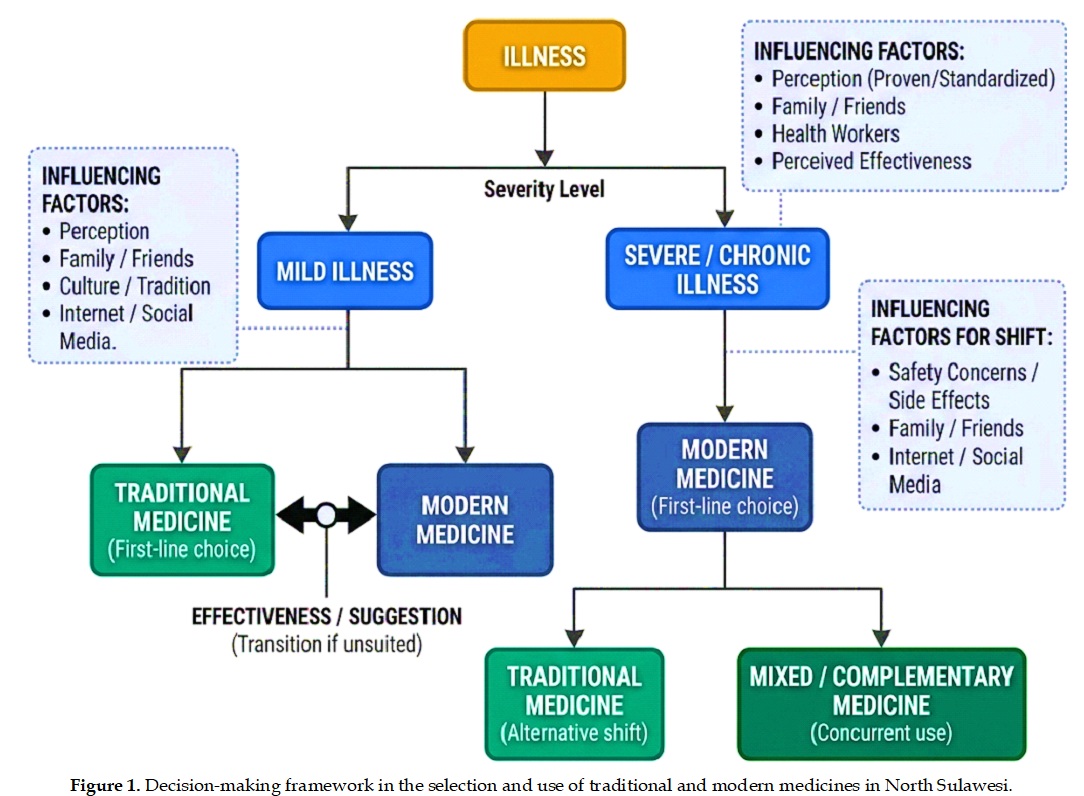
This study explores community preferences and decision-making in the use of traditional and modern medicine in North Sulawesi from a health anthropology perspective. Using a qualitative descriptive approach, in-depth interviews were conducted with 15 participants, and data were analyzed thematically to identify patterns of perception and factors influencing treatment choice. The results show that traditional medicine is preferred for mild illnesses due to perceptions of safety, affordability, and cultural familiarity, whereas modern medicine is favored for severe or chronic conditions because of its clinical validation, measurable outcomes, and professional supervision. However, a growing trend of complementary use, combining both traditional and modern treatments, was observed, motivated by safety concerns, family or peer advice, and information obtained through the internet, especially social media. The study concludes that decision-making in the use of traditional and modern medicine in North Sulawesi is influenced by illness severity, perceptions, social factors, and access to information. Traditional medicine is preferred for mild conditions, whereas modern medicine is used for severe or chronic illnesses. The combined use of both reflects a pragmatic approach within a pluralistic health system. These findings highlight the need for culturally grounded integration and improved health literacy.
Full text article
Generated from XML file
References
1. Febriyanti RM, Saefullah K, Susanti RD, Lestari K. Knowledge, attitude, and utilization of traditional medicine within the plural medical system in West Java, Indonesia. BMC Complement Med Ther. 2024;24(1):64. DOI: 10.1186/s12906-024-04368-7; PMID: 38287364; PMCID: PMC10826289.
2. Yunita F, Gunawan S, Silaban H, Chaidir. The journey of Indonesian traditional medicine. Tarumanagara Med J. 2024;6(2):241–52. DOI: 10.24912/tmj.v6i2.33351.
3. Kashuri M, Ikrar T, Sauriasari R, Juwono V, Yanuar A. Regulatory and HTA framework for herbal medicines in Indonesia. J Pharm Policy Pract. 2026;19(1):2640252. DOI: 10.1080/20523211.2026.2640252; PMID: 41858496; PMCID: PMC12997360.
4. Suwarni S, Atmodjo TG, Setyaningrum P, Al Farizi GR. Sistem Informasi Fitofarmaka (SIFITA) Berbasis Web sebagai Sumber Informasi Apoteker. J Kesehatan Tambusai. 2023;4(4):4575-80. DOI: 10.31004/jkt.v4i4.18450.
5. Widayanti AW, Green JA, Heydon S, Norris P. Health-Seeking Behavior of People in Indonesia: A Narrative Review. J Epidemiol Glob Health. 2020;10(1):6-15. DOI: 10.2991/jegh.k.200102.001; PMID: 32175705; PMCID: PMC7310809.
6. Widayati A, Candrasari DS, Mariana LJ, Veronika. Perceptions of traditional medicines for self-medication among people in Dieng Plateau, Central Java Province, Indonesia. J Riset Kesehatan. 2021;10(2):132–8. DOI: 10.31983/jrk.v10i2.7692.
7. Wibowo A, Diniawati E, Sein TT. Analysis of traditional health care in three community health centers in West Java Province, Indonesia. Kesmas. 2019;14(1):43–50. DOI: 10.21109/kesmas.v14i1.2700.
8. Saunders B, Sim J, Kingstone T, Baker S, Waterfield J, Bartlam B, et al. Saturation in qualitative research: exploring its conceptualization and operationalization. Qual Quant. 2018;52(4):1893-907. DOI: 10.1007/s11135-017-0574-8; PMID: 29937585; PMCID: PMC5993836.
9. DeJonckheere M, Vaughn LM. Semistructured interviewing in primary care research: a balance of relationship and rigour. Fam Med Community Health. 2019;7(2):e000057. DOI: 10.1136/fmch-2018-000057; PMID: 32148704; PMCID: PMC6910737.
10. Pradipta IS, Aprilio K, Febriyanti RM, Ningsih YF, Pratama MAA, Indradi RB, et al. Correction: Traditional medicine users in a treated chronic disease population: a cross-sectional study in Indonesia. BMC Complement Med Ther. 2023;23(1):443. DOI: 10.1186/s12906-023-04276-2; PMID: 38057887; PMCID: PMC10698928.
11. Simatupang A, Widyawati T, Susilaningsih N, Tobing R, Kurniaty L, Silaban H, et al. Perception and use of herbal medicine by Indonesian Medical Doctors. Indones J Biomed Clin Sci. 2025;57(1):64-7. DOI: 10.22146/inajbcs.v57i1.15768.
12. Sari S. Persepsi masyarakat terhadap penggunaan obat tradisional dalam pengobatan penyakit ringan. J Cent Publisher. 2025;2(3):1699–705. DOI: 10.60145/jcp. v2i3.356.
13. Strobel NA, Chamberlain C, Campbell SK, Shields L, Bainbridge RG, Adams C, et al. Family-centred interventions for Indigenous early childhood well-being by primary healthcare services. Cochrane Database Syst Rev. 2022;12(12):CD012463. DOI: 10.1002/14651858.CD012463.pub2; PMID: 36511823; PMCID: PMC9746601.
14. Rogger R, Bello C, Romero CS, Urman RD, Luedi MM, Filipovic MG. Cultural Framing and the Impact on Acute Pain and Pain Services. Curr Pain Headache Rep. 2023;27(9):429-36. DOI: 10.1007/s11916-023-01125-2; PMID: 37405553; PMCID: PMC10462520.
15. Ng JY, Verhoeff N, Steen J. What are the ways in which social media is used in the context of complementary and alternative medicine in the health and medical scholarly literature? a scoping review. BMC Complement Med Ther. 2023;23(1):32. DOI: 10.1186/s12906-023-03856-6; PMID: 36732809; PMCID: PMC9893203.
16. Leal MLGL, Rodrigues AR, Bell V, Forrester M. Exploring the Evolving Role of Pharmaceutical Services in Community Pharmacies: Insights from the USA, England, and Portugal. Healthcare. 2025;13(15):1786. DOI: 10.3390/healthcare13151786; PMID: 40805820; PMCID: PMC12346477.
17. Laksono AD, Wulandari RD, Tumaji T, Rukmini R, Ipa M, Suharmiati S. Traditional health services utilization in disadvantaged areas in Indonesia. Int J Adv Sci Eng Inf Technol. 2024;14(1):231–6. DOI: 10.18517/ijaseit.14.1.18581.
18. Dolovich L, Nair K, Sellors C, Lohfeld L, Lee A, Levine M. Do patients' expectations influence their use of medications? Qualitative study. Can Fam Physician. 2008;54(3):384-93. PMID: 18337533; PMCID: PMC2278356.
19. Hidayatul N, Suryantoto B. Tingkat pengetahuan dan penggunaan obat tradisional sebagai upaya pengobatan mandiri masyarakat Desa Sarikemuning Kabupaten Lumajang. J Ilmiah Farmasi Akademi Farmasi. 2024;7(1):19–28. DOI: 10.53864/jifakfar.v7i1.87.
20. de Oliveira RB, de Paula DA, Rocha BA, Franco JJ, Gobbo-Neto L, Uyemura SA, et al. Renal toxicity caused by oral use of medicinal plants: the yacon example. J Ethnopharmacol. 2011;133(2):434-41. DOI: 10.1016/j.jep.2010.10.019; PMID: 20951787.
21. Hu S, Song D, Wan S, Zhang S, Luo C, Li N, et al. Digital health: current applications, challenges, and future directions for enhancing healthcare quality and safety. Front Public Health. 2025;13:1646802. DOI: 10.3389/fpubh.2025.1646802; PMID: 41089861; PMCID: PMC12516163.
22. Al Mahmud A, Joachim S, Jayaraman PP, Learmonth C, Tyagi S, Forkan ARM, et al. Digital Health Interventions to Support Chronic Disease Management: Systematic Scoping Review. JMIR Mhealth Uhealth. 2026;14:e63742. DOI: 10.2196/63742; PMID: 41533959; PMCID: PMC12803440.
23. Collet GdO, Ferreira FdM, Ceron DF, Fracasso MdLC, Santin GC. Influence of digital health literacy on online health-related behaviors influenced by internet advertising. BMC Public Health. 2024;24(1):1949. DOI: 10.1186/s12889-024-19506-6; PMID: 39033160; PMCID: PMC11265096.
24. Akbari H. Post-Modern Medicine: A Framework for Integrating Traditional and Modern Healthcare : Post-modern Medicine. Galen Med J. 2025;14:e3791. DOI: 10.31661/gmj.v14i.3791. PMID: 42038896; PMCID: PMC12553843.
25. Kleinman A. Caregiving as moral experience. Lancet. 2012;380(9853):1550-1. DOI: 10.1016/s0140-6736(12)61870-4; PMID: 23130363.
26. Cohen KS, Fallik D, Cappola AR. The Role of Family as a Source of Health Information Among College Students. J Community Health. 2025;50(4):613-22. DOI: 10.1007/s10900-025-01448-8; PMID: 39987309; PMCID: PMC12301270.
27. Berhe KT, Gesesew HA, Ward PR. Traditional healing practices, factors influencing to access the practices and its complementary effect on mental health in sub-Saharan Africa: a systematic review. BMJ Open. 2024;14(9):e083004. DOI: 10.1136/bmjopen-2023-083004; PMID: 39322598; PMCID: PMC11429370.
28. M S, Puthiyedath R, Pillai ZS. Drug-herb interactions: a challenge and clinical concern in primary healthcare. Front Med. 2025;12:1657005. DOI: 10.3389/fmed.2025.1657005; PMID: 41282003; PMCID: PMC12634587.
29. Shen C, Ren ZY, Lan HD, Kong LY, Yang M, Su YZ, et al. Perspectives, Experiences, and Practices of Healthcare Professionals and Patients Towards Herb-Drug Interaction: A Systematic Review of Qualitative Studies. Phytother Res. 2025;39(1):505-20. DOI: 10.1002/ptr.8384; PMID: 39537428; PMCID: PMC11745149.
2. Yunita F, Gunawan S, Silaban H, Chaidir. The journey of Indonesian traditional medicine. Tarumanagara Med J. 2024;6(2):241–52. DOI: 10.24912/tmj.v6i2.33351.
3. Kashuri M, Ikrar T, Sauriasari R, Juwono V, Yanuar A. Regulatory and HTA framework for herbal medicines in Indonesia. J Pharm Policy Pract. 2026;19(1):2640252. DOI: 10.1080/20523211.2026.2640252; PMID: 41858496; PMCID: PMC12997360.
4. Suwarni S, Atmodjo TG, Setyaningrum P, Al Farizi GR. Sistem Informasi Fitofarmaka (SIFITA) Berbasis Web sebagai Sumber Informasi Apoteker. J Kesehatan Tambusai. 2023;4(4):4575-80. DOI: 10.31004/jkt.v4i4.18450.
5. Widayanti AW, Green JA, Heydon S, Norris P. Health-Seeking Behavior of People in Indonesia: A Narrative Review. J Epidemiol Glob Health. 2020;10(1):6-15. DOI: 10.2991/jegh.k.200102.001; PMID: 32175705; PMCID: PMC7310809.
6. Widayati A, Candrasari DS, Mariana LJ, Veronika. Perceptions of traditional medicines for self-medication among people in Dieng Plateau, Central Java Province, Indonesia. J Riset Kesehatan. 2021;10(2):132–8. DOI: 10.31983/jrk.v10i2.7692.
7. Wibowo A, Diniawati E, Sein TT. Analysis of traditional health care in three community health centers in West Java Province, Indonesia. Kesmas. 2019;14(1):43–50. DOI: 10.21109/kesmas.v14i1.2700.
8. Saunders B, Sim J, Kingstone T, Baker S, Waterfield J, Bartlam B, et al. Saturation in qualitative research: exploring its conceptualization and operationalization. Qual Quant. 2018;52(4):1893-907. DOI: 10.1007/s11135-017-0574-8; PMID: 29937585; PMCID: PMC5993836.
9. DeJonckheere M, Vaughn LM. Semistructured interviewing in primary care research: a balance of relationship and rigour. Fam Med Community Health. 2019;7(2):e000057. DOI: 10.1136/fmch-2018-000057; PMID: 32148704; PMCID: PMC6910737.
10. Pradipta IS, Aprilio K, Febriyanti RM, Ningsih YF, Pratama MAA, Indradi RB, et al. Correction: Traditional medicine users in a treated chronic disease population: a cross-sectional study in Indonesia. BMC Complement Med Ther. 2023;23(1):443. DOI: 10.1186/s12906-023-04276-2; PMID: 38057887; PMCID: PMC10698928.
11. Simatupang A, Widyawati T, Susilaningsih N, Tobing R, Kurniaty L, Silaban H, et al. Perception and use of herbal medicine by Indonesian Medical Doctors. Indones J Biomed Clin Sci. 2025;57(1):64-7. DOI: 10.22146/inajbcs.v57i1.15768.
12. Sari S. Persepsi masyarakat terhadap penggunaan obat tradisional dalam pengobatan penyakit ringan. J Cent Publisher. 2025;2(3):1699–705. DOI: 10.60145/jcp. v2i3.356.
13. Strobel NA, Chamberlain C, Campbell SK, Shields L, Bainbridge RG, Adams C, et al. Family-centred interventions for Indigenous early childhood well-being by primary healthcare services. Cochrane Database Syst Rev. 2022;12(12):CD012463. DOI: 10.1002/14651858.CD012463.pub2; PMID: 36511823; PMCID: PMC9746601.
14. Rogger R, Bello C, Romero CS, Urman RD, Luedi MM, Filipovic MG. Cultural Framing and the Impact on Acute Pain and Pain Services. Curr Pain Headache Rep. 2023;27(9):429-36. DOI: 10.1007/s11916-023-01125-2; PMID: 37405553; PMCID: PMC10462520.
15. Ng JY, Verhoeff N, Steen J. What are the ways in which social media is used in the context of complementary and alternative medicine in the health and medical scholarly literature? a scoping review. BMC Complement Med Ther. 2023;23(1):32. DOI: 10.1186/s12906-023-03856-6; PMID: 36732809; PMCID: PMC9893203.
16. Leal MLGL, Rodrigues AR, Bell V, Forrester M. Exploring the Evolving Role of Pharmaceutical Services in Community Pharmacies: Insights from the USA, England, and Portugal. Healthcare. 2025;13(15):1786. DOI: 10.3390/healthcare13151786; PMID: 40805820; PMCID: PMC12346477.
17. Laksono AD, Wulandari RD, Tumaji T, Rukmini R, Ipa M, Suharmiati S. Traditional health services utilization in disadvantaged areas in Indonesia. Int J Adv Sci Eng Inf Technol. 2024;14(1):231–6. DOI: 10.18517/ijaseit.14.1.18581.
18. Dolovich L, Nair K, Sellors C, Lohfeld L, Lee A, Levine M. Do patients' expectations influence their use of medications? Qualitative study. Can Fam Physician. 2008;54(3):384-93. PMID: 18337533; PMCID: PMC2278356.
19. Hidayatul N, Suryantoto B. Tingkat pengetahuan dan penggunaan obat tradisional sebagai upaya pengobatan mandiri masyarakat Desa Sarikemuning Kabupaten Lumajang. J Ilmiah Farmasi Akademi Farmasi. 2024;7(1):19–28. DOI: 10.53864/jifakfar.v7i1.87.
20. de Oliveira RB, de Paula DA, Rocha BA, Franco JJ, Gobbo-Neto L, Uyemura SA, et al. Renal toxicity caused by oral use of medicinal plants: the yacon example. J Ethnopharmacol. 2011;133(2):434-41. DOI: 10.1016/j.jep.2010.10.019; PMID: 20951787.
21. Hu S, Song D, Wan S, Zhang S, Luo C, Li N, et al. Digital health: current applications, challenges, and future directions for enhancing healthcare quality and safety. Front Public Health. 2025;13:1646802. DOI: 10.3389/fpubh.2025.1646802; PMID: 41089861; PMCID: PMC12516163.
22. Al Mahmud A, Joachim S, Jayaraman PP, Learmonth C, Tyagi S, Forkan ARM, et al. Digital Health Interventions to Support Chronic Disease Management: Systematic Scoping Review. JMIR Mhealth Uhealth. 2026;14:e63742. DOI: 10.2196/63742; PMID: 41533959; PMCID: PMC12803440.
23. Collet GdO, Ferreira FdM, Ceron DF, Fracasso MdLC, Santin GC. Influence of digital health literacy on online health-related behaviors influenced by internet advertising. BMC Public Health. 2024;24(1):1949. DOI: 10.1186/s12889-024-19506-6; PMID: 39033160; PMCID: PMC11265096.
24. Akbari H. Post-Modern Medicine: A Framework for Integrating Traditional and Modern Healthcare : Post-modern Medicine. Galen Med J. 2025;14:e3791. DOI: 10.31661/gmj.v14i.3791. PMID: 42038896; PMCID: PMC12553843.
25. Kleinman A. Caregiving as moral experience. Lancet. 2012;380(9853):1550-1. DOI: 10.1016/s0140-6736(12)61870-4; PMID: 23130363.
26. Cohen KS, Fallik D, Cappola AR. The Role of Family as a Source of Health Information Among College Students. J Community Health. 2025;50(4):613-22. DOI: 10.1007/s10900-025-01448-8; PMID: 39987309; PMCID: PMC12301270.
27. Berhe KT, Gesesew HA, Ward PR. Traditional healing practices, factors influencing to access the practices and its complementary effect on mental health in sub-Saharan Africa: a systematic review. BMJ Open. 2024;14(9):e083004. DOI: 10.1136/bmjopen-2023-083004; PMID: 39322598; PMCID: PMC11429370.
28. M S, Puthiyedath R, Pillai ZS. Drug-herb interactions: a challenge and clinical concern in primary healthcare. Front Med. 2025;12:1657005. DOI: 10.3389/fmed.2025.1657005; PMID: 41282003; PMCID: PMC12634587.
29. Shen C, Ren ZY, Lan HD, Kong LY, Yang M, Su YZ, et al. Perspectives, Experiences, and Practices of Healthcare Professionals and Patients Towards Herb-Drug Interaction: A Systematic Review of Qualitative Studies. Phytother Res. 2025;39(1):505-20. DOI: 10.1002/ptr.8384; PMID: 39537428; PMCID: PMC11745149.
Authors
1.
Wiyono WI, Lolo WA, Yamlean PVY. Traditional vs. Modern Medicine: Community Preferences and Health Anthropology in North Sulawesi. Borneo J Pharm [Internet]. 2026Jun.30 [cited 2026Oct.19];9(2):235-4. Available from: https://journal.umpr.ac.id/index.php/bjop/article/view/11186
Copyright (c) 2026 Weny Indayany Wiyono, Widya Astuty Lolo, Paulina Veronika Yolanda Yamlean

This work is licensed under a Creative Commons Attribution-ShareAlike 4.0 International License.
This work is licensed under a Creative Commons Attribution-ShareAlike 4.0 International License.
Authors continue to retain the copyright to the article if the article is published in the Borneo Journal of Pharmacy. They will also retain the publishing rights to the article without any restrictions.
Authors who publish in this journal agree to the following terms:
- Any article on the copyright is retained by the author(s).
- The author grants the journal the right of first publication with the work simultaneously licensed under a Creative Commons Attribution License that allows others to share work with an acknowledgment of the work authors and initial publications in this journal.
- Authors can enter into separate, additional contractual arrangements for the non-exclusive distribution of published articles (e.g., post-institutional repository) or publish them in a book, with acknowledgment of their initial publication in this journal.
- Authors are permitted and encouraged to post their work online (e.g., in institutional repositories or on their websites) prior to and during the submission process. This can lead to productive exchanges and earlier and greater citations of published work.
- The article and any associated published material are distributed under the Creative Commons Attribution-ShareAlike 4.0 International License.
Article Details