Computation and Experimental Approaches to Uncover the Antidiabetic Potential of Insulin Leaf (Tithonia diversifolia) Extract Based on Flavonoid Constituents

Article Sidebar
-
Antidiabetics, Diabetes Melitus, Flavonoid, Medicinal Plant, Tithonia diversifolia
Abstract
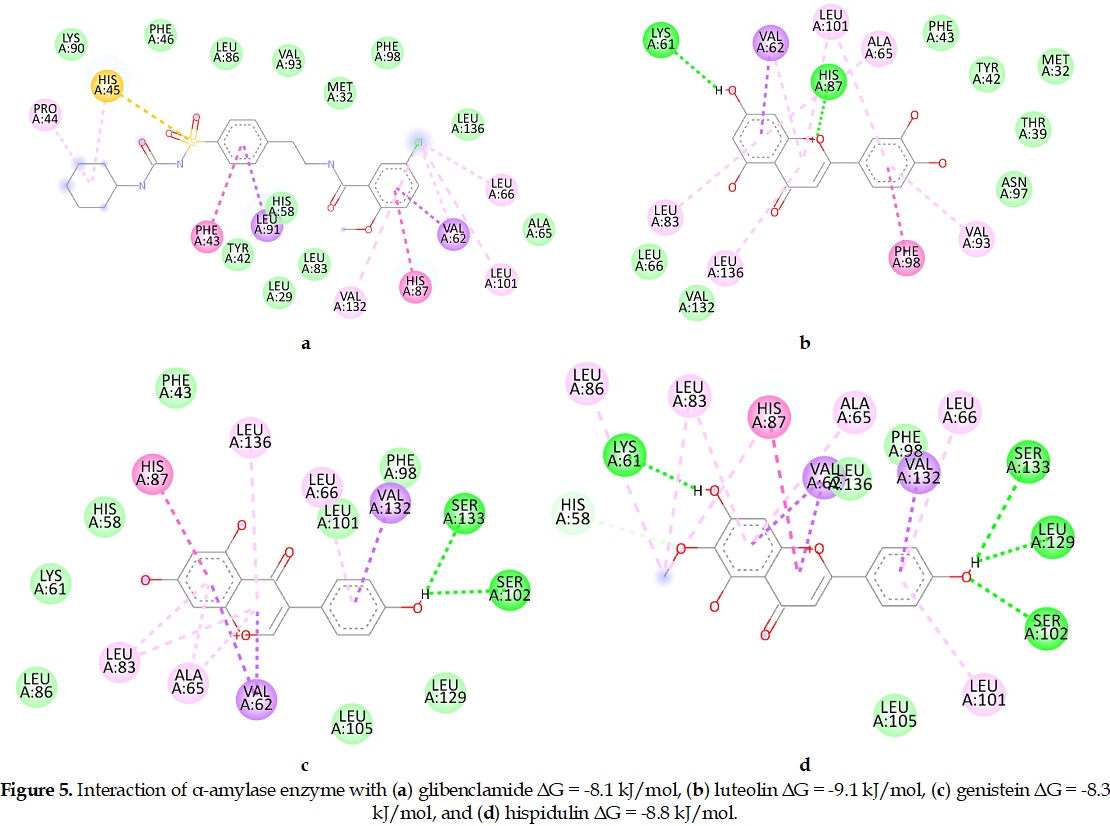
Insulin leaves (Tithonia diversifolia) are traditionally used by the community to lower blood sugar, although this has not been scientifically proven. Tithonia diversifolia is known to contain flavonoids, which are responsible for the antidiabetic activity of these leaves. Therefore, this research was conducted to investigate the antidiabetic effects of T. diversifolia, specifically through its flavonoid content. Tithonia diversifolia was extracted with 90% methanol and analyzed for flavonoid content by Liquid Chromatography-Mass Spectrometry (LC-MS). To investigate the antidiabetic activity, the sample extract was tested for its effect on the in vitro amylase enzyme and inhibition of glycated haemoglobin. Moreover, advanced techniques such as in silico analysis and molecular docking are used to elucidate the molecular mechanism behind the antidiabetic effects of T. diversifolia. The results of our study revealed that plant extracts, particularly those rich in flavonoids such as luteolin, genistein, and hispidulin, are potent inhibitors of the α-amylase enzyme and the formation of glycated haemoglobin. The Inhibition Concentration 50% (IC₅₀) values of flavonoids were lower than those of glibenclamide, suggesting their superior efficacy in stabilizing blood sugar levels. Docking analysis further confirmed the strong interactions between flavonoids and key enzyme residues and haemoglobin, while Absorption, Distribution, Metabolism, Excretion, and Toxicity (ADMET) predictions indicated favourable absorption and distribution profiles. Both experimental and computational approaches show the importance of flavonoids in the antidiabetic activity of T. diversifolia extracts, highlighting their contribution to its effectiveness.
Full text article
References
2. Qamariah N, Handayani R, Indriani O. Etnofarmakologi dan Inventarisasi Tumbuhan Obat di Kecamatan Kapuas Hilir Kabupaten Kapuas Kalimantan Tengah. J Surya Medika. 2021;6(2):25–34. DOI: 10.33084/jsm.v6i2.2117
3. Aulia R, Arsyad M. Pemanfaatan Tumbuhan Obat oleh Masyarakat Kecamatan Banjarmasin Selatan. Prosiding Semin Nasional Pendidikan Biol. 2025;1(1):216–29.
4. Istikharah R, Nugrahaningsih DAA, Sadewa AH, Wahyuningsih MSH. Standardised Ethanol Extract of Tithonia diversifolia (Hemsley) A Gray Leaves Improve Insulin Sensitivity and Increase Mitochondrial DNA Copy Numbers in Skeletal Muscles of Streptozotocin-Nicotinamide-Induced Rats. Malays J Med Sci. 2022;29(3):43-53. DOI: 10.21315/mjms2022.29.3.5. PMID: 35846491; PMCID: PMC9249416.
5. Oluwamodupe C, Sb S, Olayeriju OS, Suresh K. Phytochemical characterisation and toxicity effect of Tithonia diversifolia (Hemls.) A. Gray leaf extract on fall army worm Spodoptera frugiperda (JE Smith) larvae. J Complement Integr Med. 2024;21(3):295-302. DOI: 10.1515/jcim-2023-0310. PMID: 38329821.
6. Robinson TN, Justine D, Maxime P, Alexis S, Sidrine KI, Hugues RJ, et al. Biological activities and phytochemical constituents in the stimulatory potential of Tithonia diversifolia fermented extracts: A review. Eur J Med Plants. 2024;35(6):340–52. DOI: 10.9734/ejmp/2024/v35i61230
7. Al-Ishaq RK, Abotaleb M, Kubatka P, Kajo K, Büsselberg D. Flavonoids and Their Anti-Diabetic Effects: Cellular Mechanisms and Effects to Improve Blood Sugar Levels. Biomolecules. 2019;9(9):430. DOI: 10.3390/biom9090430. PMID: 31480505; PMCID: PMC6769509.
8. Shamsudin NF, Ahmed QU, Mahmood S, Shah SAA, Sarian MN, Khattak MMAK, et al. Flavonoids as Antidiabetic and Anti-Inflammatory Agents: A Review on Structural Activity Relationship-Based Studies and Meta-Analysis. Int J Mol Sci. 2022;23(20):12605. DOI: 10.3390/ijms232012605. PMID: 36293459; PMCID: PMC9604264.
9. Yen FS, Qin CS, Xuan STS, Ying PJ, Le HY, Darmarajan T, et al. Hypoglycemic Effects of Plant Flavonoids: A Review. Evid Based Complement Alternat Med. 2021;2021:2057333. DOI: 10.1155/2021/2057333. PMID: 34925525; PMCID: PMC8674047.
10. Khenifi ML, Serseg T, Migas P, Krauze-Baranowska M, Özdemir S, Bensouici C, et al. HPLC-DAD-MS Characterization, Antioxidant Activity, α-amylase Inhibition, Molecular Docking, and ADMET of Flavonoids from Fenugreek Seeds. Molecules. 2023;28(23):7798. DOI: 10.3390/molecules28237798. PMID: 38067527; PMCID: PMC10708475.
11. Nugroho Y, Budianto WY, Siahaan SC, Agung PP, Thalib I, Suhartono E. Phytochemical Analysis, Anti-Inflammatory, and Antioxidant Activity of Selected Medicinal Plants in Mandiangin Rainforest in South Kalimantan, Indonesia. J Trop Life Sci. 2023;13(1):137–46. DOI: 10.11594/jtls.13.01.14.
12. Kashtoh H, Baek KH. New Insights into the Latest Advancement in α-Amylase Inhibitors of Plant Origin with Anti-Diabetic Effects. Plants. 2023;12(16):2944. DOI: 10.3390/plants12162944. PMID: 37631156; PMCID: PMC10458243.
13. Dedvisitsakul P, Watla-Iad K. Antioxidant activity and antidiabetic activities of Northern Thai indigenous edible plant extracts and their phytochemical constituents. Heliyon. 2022;8(9):e10740. DOI: 10.1016/j.heliyon.2022.e10740. Erratum in: Heliyon. 2022;8(12):e11986. DOI: 10.1016/j.heliyon.2022.e11986. PMID: 36185148; PMCID: PMC9519484.
14. Kartini S, Juariah S, Mardhiyani D, Bakar MFA, Bakar FIA, Endrini S. Phytochemical properties, antioxidant activity and α-amilase inhibitory of Curcuma caesia. J Adv Res Appl Sci Eng Technol. 2023;30(1):255–63. DOI: 10.37934/araset.30.1.255263.
15. Suhartono E, Iskandar, Hamidah S, Arifin YF. Phytochemical Constituents Analysis and Neuroprotective Effect of Leaves of Gemor (Nothaphoebe Coriacea) on Cadmium-Induced Neurotoxicity in Rats: An In-Vitro Study. Int J Toxicol Pharmacol Res. 2016;8(1):1-6.
16. Rubab U, Kumar D, Farah MA, Al-Anazi KM, Ali MA, Ali A. Inhibitory roles of Nigella sativa seed extracts on in vitro glycation and aggregation. Pharmacogn Mag. 2021;17(6):S220–4. DOI: 10.4103/pm.pm_604_20.
17. Rachmawati R, Idroes R, Suhartono E, Maulydia NB, Darusman D. In Silico and In Vitro Analysis of Tacca Tubers (Tacca leontopetaloides) from Banyak Island, Aceh Singkil Regency, Indonesia, as Antihypercholesterolemia Agents. Molecules. 2022;27(23):8605. DOI: 10.3390/molecules27238605. PMID: 36500698; PMCID: PMC9737010.
18. Oliveira APS, Lima DR, Bezerra LL, Monteiro NKV, Loiola OD, Silva MGV. Virtual screening of flavonoids from Chamaecrista genus: ADME and pharmacokinetic properties, interactions of flavonoid-DNA complex by molecular docking and molecular dynamics. J Biomol Struct Dyn. 2023;41(16):7677-85. DOI: 10.1080/07391102.2022.2124455. PMID: 36120963.
19. Pratama MRF, Poerwono H, Siswodiharjo S. ADMET properties of novel 5-O-benzoylpinostrobin derivatives. J Basic Clin Physiol Pharmacol. 2019;30(6):20190251. DOI: 10.1515/jbcpp-2019-0251. PMID: 31851612.
20. Han M, Lu Y, Tao Y, Zhang X, Dai C, Zhang B, et al. Luteolin Protects Pancreatic β Cells against Apoptosis through Regulation of Autophagy and ROS Clearance. Pharmaceuticals. 2023;16(7):975. DOI: 10.3390/ph16070975. PMID: 37513887; PMCID: PMC10385282.
21. Zhu R, Xu X, Ying J, Cao G, Wu X. The Phytochemistry, Pharmacology, and Quality Control of Tetrastigma hemsleyanum Diels & Gilg in China: A Review. Front Pharmacol. 2020;11:550497. DOI: 10.3389/fphar.2020.550497. PMID: 33101019; PMCID: PMC7546407.
22. Shen H, Wang J, Ao J, Hou Y, Xi M, Cai Y, et al. Structure-activity relationships and the underlying mechanism of α-amylase inhibition by hyperoside and quercetin: Multi-spectroscopy and molecular docking analyses. Spectrochim Acta A Mol Biomol Spectrosc. 2023;285:121797. DOI: 10.1016/j.saa.2022.121797. PMID: 36115306.
23. Visvanathan R, Houghton MJ, Barber E, Williamson G. Structure-function relationships in (poly)phenol-enzyme binding: Direct inhibition of human salivary and pancreatic α-amylases. Food Res Int. 2024;188:114504. DOI: 10.1016/j.foodres.2024.114504. PMID: 38823880.
24. Wang Y, Xie Z, Jiang N, Wu Z, Xue R, Dong B, et al. Hispidulin Attenuates Cardiac Hypertrophy by Improving Mitochondrial Dysfunction. Front Cardiovasc Med. 2020;7:582890. DOI: 10.3389/fcvm.2020.582890. PMID: 33324687; PMCID: PMC7726192.
25. Muralidharan M, Bhat V, Mandal AK. Structural analysis of glycated human hemoglobin using native mass spectrometry. FEBS J. 2020;287(6):1247-54. DOI: 10.1111/febs.15085. PMID: 31599087.
26. Rabbani N, Thornalley PJ. Protein glycation - biomarkers of metabolic dysfunction and early-stage decline in health in the era of precision medicine. Redox Biol. 2021;42:101920. DOI: 10.1016/j.redox.2021.101920. PMID: 33707127; PMCID: PMC8113047.
27. Sarmah S, Pahari S, Belwal VK, Jana M, Roy AS. Elucidation of molecular interaction of bioactive flavonoid luteolin with human serum albumin and its glycated analogue using multi-spectroscopic and computational studies. J Mol Liq. 2020;318:114147. DOI: 10.1016/j.molliq.2020.114147.
28. Cao N, Wang JJ, Wu JM, Xu WL, Wang R, Chen XD, et al. Glibenclamide alleviates β adrenergic receptor activation-induced cardiac inflammation. Acta Pharmacol Sin. 2022;43(5):1243-50. DOI: 10.1038/s41401-021-00734-0. PMID: 34349235; PMCID: PMC9061800.
29. Jia J, Dou B, Gao M, Zhang C, Liu Y, Zhang N. Effect of Genistein on Starch Digestion In Vitro and Its Mechanism of Action. Foods. 2024;13(17):2809. DOI: 10.3390/foods13172809. PMID: 39272574; PMCID: PMC11394712.
30. Bitew M, Desalegn T, Demissie TB, Belayneh A, Endale M, Eswaramoorthy R. Pharmacokinetics and drug-likeness of antidiabetic flavonoids: Molecular docking and DFT study. PLoS One. 2021;16(12):e0260853. DOI: 10.1371/journal.pone.0260853. PMID: 34890431; PMCID: PMC8664201.
31. Bai Z, Wang Z. Genistein protects against doxorubicin-induced cardiotoxicity through Nrf-2/HO-1 signaling in mice model. Environ Toxicol. 2019;34(5):645-51. DOI: 10.1002/tox.22730. PMID: 30734460.
Authors
Copyright (c) 2026 Masniah Masniah, Eko Suhartono, Fujiati Fujiati, Muhammad Ali Faisal, Budu Budu, Mohammad Bakhriansyah, Istiana Istiana, Dewi Indah Noviana Pratiwi

This work is licensed under a Creative Commons Attribution-ShareAlike 4.0 International License.
This work is licensed under a Creative Commons Attribution-ShareAlike 4.0 International License.
Authors continue to retain the copyright to the article if the article is published in the Borneo Journal of Pharmacy. They will also retain the publishing rights to the article without any restrictions.
Authors who publish in this journal agree to the following terms:
- Any article on the copyright is retained by the author(s).
- The author grants the journal the right of first publication with the work simultaneously licensed under a Creative Commons Attribution License that allows others to share work with an acknowledgment of the work authors and initial publications in this journal.
- Authors can enter into separate, additional contractual arrangements for the non-exclusive distribution of published articles (e.g., post-institutional repository) or publish them in a book, with acknowledgment of their initial publication in this journal.
- Authors are permitted and encouraged to post their work online (e.g., in institutional repositories or on their websites) prior to and during the submission process. This can lead to productive exchanges and earlier and greater citations of published work.
- The article and any associated published material are distributed under the Creative Commons Attribution-ShareAlike 4.0 International License.
Article Details