Evaluation of Antioxidant Potential and Phytochemical Composition of Carrageenan Extracts from Nine Edible Seaweed Species

Article Sidebar
Submitted
31 October 2024
Published
30 March 2026
Keywords:
-
Seaweeds, Antioxidant, Phytochemical, DPPH, TLC
Abstract
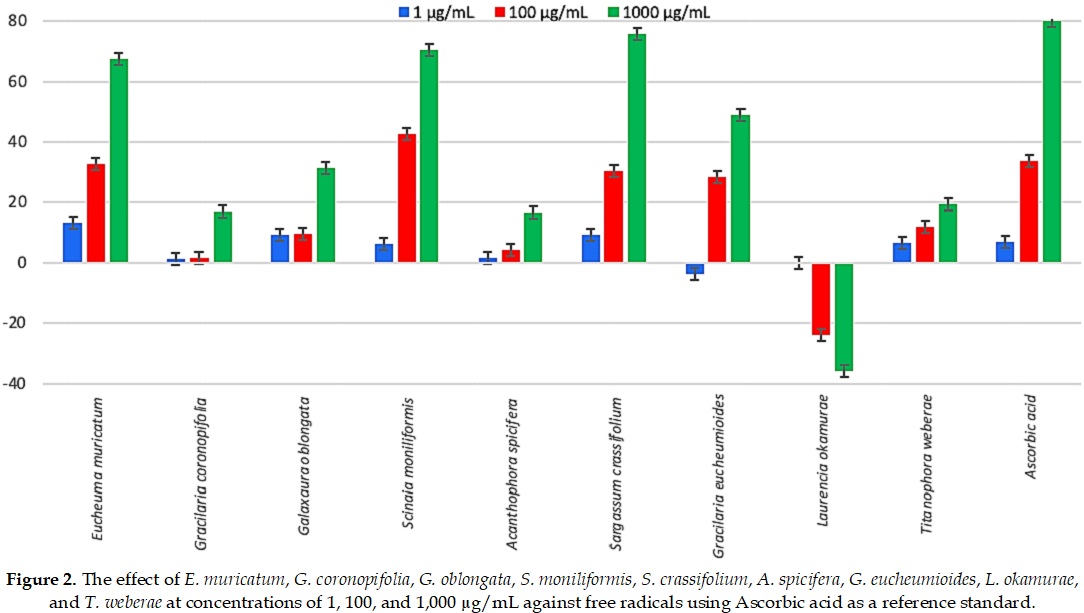
Seaweeds have become a subject of interest due to their dual role, not only in providing functional attributes, such as gelling, thickening, and stabilizing in food products, but also for their potential antioxidant properties. Currently, a growing body of research supports the idea that supplementation with antioxidants is a valuable approach in preventing oxidative stress, which can lead to cancer, diabetes, cardiovascular, and neurological diseases, where free radicals are implicated. This study aimed to determine the antioxidant activity and phytochemical composition of carrageenan extracts from nine algae collected from the Western Visayas region. Antioxidant activity was evaluated using the 1,1-diphenyl-2-picrylhydrazyl (DPPH) assay, and the phytochemical composition was analyzed by thin-layer chromatography. Eight of the nine algal extracts exhibited antioxidant activity. The most active extracts were observed in S. crassifolium (IC50 = 559 μg/mL), followed by S. moniliformis (IC50 = 573 μg/mL) and E. muricatum (IC50 = 629 μg/mL), with no significant difference from the positive control. The abundance of flavonoids, phenols, alkaloids, saponins, tannins, steroids, essential oils, and other phenolic compounds was observed across all extracts, indicating significant antioxidant activity. These findings imply that the integration of natural antioxidants from algae as a dietary supplement could prove beneficial in mitigating oxidative stress, thus holding significance in a wide array of disease prevention strategies, such as cancer, diabetes, cardiovascular diseases, and neurological disorders, all of which are intricately linked to the role of free radicals.
Full text article
Generated from XML file
References
1. Udo T, Mummaleti G, Mohan A, Singh RK, Kong F. Current and emerging applications of carrageenan in the food industry. Food Res Int. 2023;173(Pt 2):113369. DOI: 10.1016/j.foodres.2023.113369; PMID: 37803710.
2. Rusu ME, Fizeșan I, Vlase L, Popa DS. Antioxidants in Age-Related Diseases and Anti-Aging Strategies. Antioxidants. 2022;11(10):1868. DOI: 10.3390/antiox11101868; PMID: 36290589; PMCID: PMC9598595.
3. Wang W, Kang PM. Oxidative Stress and Antioxidant Treatments in Cardiovascular Diseases. Antioxidants. 2020;9(12):1292. DOI: 10.3390/antiox9121292; PMID: 33348578; PMCID: PMC7766219.
4. Sharifi-Rad M, Kumar NVA, Zucca P, Varoni EM, Dini L, Panzarini E, et al. Lifestyle, Oxidative Stress, and Antioxidants: Back and Forth in the Pathophysiology of Chronic Diseases. Front Physiol. 2020;11:694. DOI: 10.3389/fphys.2020.00694; PMID: 32714204; PMCID: PMC7347016.
5. Pasupuleti VR, Arigela CS, Gan SH, Salam SKN, Krishnan KT, Rahman NA, et al. A Review on Oxidative Stress, Diabetic Complications, and the Roles of Honey Polyphenols. Oxid Med Cell Longev. 2020;2020:8878172. DOI: 10.1155/2020/8878172; PMID: 33299532; PMCID: PMC7704201.
6. Vona R, Pallotta L, Cappelletti M, Severi C, Matarrese P. The Impact of Oxidative Stress in Human Pathology: Focus on Gastrointestinal Disorders. Antioxidants. 2021;10(2):201. DOI: 10.3390/antiox10020201; PMID: 33573222; PMCID: PMC7910878.
7. Martemucci G, Fracchiolla G, Muraglia M, Tardugno R, Dibenedetto RS, D'Alessandro AG. Metabolic Syndrome: A Narrative Review from the Oxidative Stress to the Management of Related Diseases. Antioxidants. 2023;12(12):2091. DOI: 10.3390/antiox12122091; PMID: 38136211; PMCID: PMC10740837.
8. Ogunro OB, Fakayode AE, Batiha GES. Involvement of Antioxidant in the Prevention of Cellular Damage. In: Sabuncuoğlu S, Yalcinkaya A, eds. Importance of Oxidative Stress and Antioxidant System in Health and Disease. London: IntechOpen; 2023. DOI: 10.5772/intechopen.108732.
9. Moussa Z, Judeh ZMA, Ahmed SAA. Nonenzymatic Exogenous and Endogenous Antioxidants. In: Das K, Das S, Biradar MS, Bobbarala V, Tata SS, eds. Free Radical Medicine and Biology. London: IntechOpen; 2020. DOI: 10.5772/intechopen.87778.
10. Kalogerakou T, Antoniadou M. The Role of Dietary Antioxidants, Food Supplements and Functional Foods for Energy Enhancement in Healthcare Professionals. Antioxidants. 2024;13(12):1508. DOI: 10.3390/antiox13121508; PMID: 39765836; PMCID: PMC11672929.
11. Arguelles EDLR. Chemical composition and in vitro study of antioxidant and antibacterial activities of Sargassum oligocystum Montagne (Sargassaceae, Ochrophyta). Asian J Agric Biol. 2022;4:1-10. DOI: 10.35495/ajab.2021.05.209.
12. Villaflores OB, Ortega KMM, Empaynado-Porto A, Lirio S, Yak HK, Albano DR, et al. Anti-angiogenic activity of Gracilaria coronopifolia J.G. Agardh extract by lowering the levels of trace metals (iron, zinc and copper) in duck chorioallantoic membrane and in vitro activation of AMP-kinase. Mol Biol Rep. 2019;46(4):4151-60. DOI: 10.1007/s11033-019-04864-x; PMID: 31102149.
13. Mallabo MRB, Corpuz MJT, Salonga RB, Vasquez RD. Inhibitory Effect of Sulfated Polysaccharide from Codium edule P.C. Silva Against 2,4-Dinitrofluorobenzene (DNFB)- Induced Allergic Contact Dermatitis on Female BALB/c Mice. Adv Pharm Bull. 2022;12(2):410-8. DOI: 10.34172/apb.2022.042; PMID: 35620333; PMCID: PMC9106951.
14. Arguelles EDLR, Sapin A. Bioactive properties of Sargassum siliquosum J. Agardh (Fucales, Ochrophyta) and its potential as source of skin-lightening active ingredient for cosmetic application. J Appl Pharm Sci. 2020;10(7):51-8. DOI: 10.7324/JAPS.2020.10707.
15. Beeby E, Magalhães M, Poças J, Collins T, Lemos MFL, Barros L, et al. Secondary metabolites (essential oils) from sand-dune plants induce cytotoxic effects in cancer cells. J Ethnopharmacol. 2020;258:112803. DOI: 10.1016/j.jep.2020.112803; PMID: 32251759.
16. Erdoğan M, Konya R, Özhan Y, Sipahi H, Çinbilgel İ, Masullo M, et al. Secondary metabolites from Scutellaria brevibracteata subsp. subvelutina and their in vitro anti-inflammatory activities. S Afr J Bot. 2021;139:12-8. DOI: 10.1016/j.sajb.2021.01.028.
17. Das S, Barman S, Teron R, Bhattacharya SS, Kim KH. Secondary metabolites and anti-microbial/anti-oxidant profiles in Ocimum spp.: Role of soil physico-chemical characteristics as eliciting factors. Environ Res. 2020;188:109749. DOI: 10.1016/j.envres.2020.109749; PMID: 32531524.
18. Kuephadungphan W, Macabeo A, Luangsa-ard J, Stadler M. Discovery of novel biologically active secondary metabolites from Thai mycodiversity with anti-infective potential. Curr Res Biotechnol. 2021;3:160-72. DOI: 10.1016/j.crbiot.2021.05.003.
19. Sharma A, Kumar A. Role of antioxidant therapy for pain relief in chronic pancreatitis: Finding the signal in the noise. JGH Open. 2021;5(3):327-8. DOI: 10.1002/jgh3.12488; PMID: 33732877; PMCID: PMC7936622.
20. Sobeh M, El-Raey M, Rezq S, Abdelfattah MAO, Petruk G, Osman S, et al. Chemical profiling of secondary metabolites of Eugenia uniflora and their antioxidant, anti-inflammatory, pain killing and anti-diabetic activities: A comprehensive approach. J Ethnopharmacol. 2019;240:111939. DOI: 10.1016/j.jep.2019.111939; PMID: 31095981.
21. Mazumder MK, Borah A, Choudhury S. Inhibitory potential of plant secondary metabolites on anti-Parkinsonian drug targets: Relevance to pathophysiology, and motor and non-motor behavioural abnormalities. Med Hypotheses. 2020;137:109544. DOI: 10.1016/j.mehy.2019.109544; PMID: 31954292.
22. Kandsi F, Conte R, Marghich M, Lafdil FZ, Alajmi MF, Bouhrim M, et al. Phytochemical Analysis, Antispasmodic, Myorelaxant, and Antioxidant Effect of Dysphania ambrosioides (L.) Mosyakin and Clemants Flower Hydroethanolic Extracts and Its Chloroform and Ethyl Acetate Fractions. Molecules. 2021;26(23):7300. DOI: 10.3390/molecules26237300; PMID: 34885883; PMCID: PMC8659140.
23. Liang T, Xie Z, Dang B, Wang J, Zhang T, Luan X, et al. Discovery of indole-piperazine derivatives as selective histone deacetylase 6 inhibitors with neurite outgrowth-promoting activities and neuroprotective activities. Bioorg Med Chem Lett. 2023;81:129148. DOI: 10.1016/j.bmcl.2023.129148; PMID: 36690041.
24. Shen N, Wang T, Gan Q, Liu S, Wang L, Jin B. Plant flavonoids: Classification, distribution, biosynthesis, and antioxidant activity. Food Chem. 2022;383:132531. DOI: 10.1016/j.foodchem.2022.132531; PMID: 35413752.
25. Sun YJ, Bai HY, Han RJ, Zhao QL, Li M, Chen H, et al. Dysosmaflavonoid A-F, new flavonols with potent DPPH radical scavenging activity from Dysosma versipellis. Fitoterapia. 2023;166:105440. DOI: 10.1016/j.fitote.2023.105440; PMID: 36736596.
26. Sihag S, Pal A, Ravikant, Saharan V. Antioxidant properties and free radicals scavenging activities of pomegranate (Punica granatum L.) peels: An in-vitro study. Biocatal Agric Biotechnol. 2022;42:102368. DOI: 10.1016/j.bcab.2022.102368.
27. Tao Y, Zhang H, Wang Y. Revealing and predicting the relationship between the molecular structure and antioxidant activity of flavonoids. LWT. 2023;174:114433. DOI: 10.1016/j.lwt.2023.114433.
28. Sirin S, Dolanbay N, Aslim B. Role of plant derived alkaloids as antioxidant agents for neurodegenerative diseases. Health Sci Rev. 2023;6:100071. DOI: 10.1016/j.hsr.2022.100071.
29. Macáková K, Afonso R, Saso L, Mladěnka P. The influence of alkaloids on oxidative stress and related signaling pathways. Free Radic Biol Med. 2019;134:429-44. DOI: 10.1016/j.freeradbiomed.2019.01.026; PMID: 30703480.
30. Zarren G, Shafiq N, Arshad U, Rafiq N, Parveen S. Copper-catalyzed one-pot relay synthesis of anthraquinone based pyrimidine derivative as a probe for antioxidant and antidiabetic activity. J Mol Struct. 2021;1227:129668. DOI: 10.1016/j.molstruc.2020.129668.
31. Charlton NC, Mastyugin M, Török B, Török M. Structural Features of Small Molecule Antioxidants and Strategic Modifications to Improve Potential Bioactivity. Molecules. 2023;28(3):1057. DOI: 10.3390/molecules28031057; PMID: 36770724; PMCID: PMC9920158.
32. Konus M, Çetin D, Kızılkan N, Yılmaz C, Fidan C, Algso M, et al. Synthesis and biological activity of new indole based derivatives as potent anticancer, antioxidant and antimicrobial agents. J Mol Struct. 2022;1263:133168. DOI: 10.1016/j.molstruc.2022.133168.
33. Moazzen A, Öztinen N, Ak-Sakalli E, Koşar M. Structure-antiradical activity relationships of 25 natural antioxidant phenolic compounds from different classes. Heliyon. 2022;8(9):e10467. DOI: 10.1016/j.heliyon.2022.e10467; PMID: 36091954; PMCID: PMC9459676.
34. Ansari A, Ali A, Khan N, Umar MS, Owais M, Shamsuzzaman. Synthesis of steroidal dihydropyrazole derivatives using green ZnO NPs and evaluation of their anticancer and antioxidant activity. Steroids. 2022;188:109113. DOI: 10.1016/j.steroids.2022.109113; PMID: 36152868.
35. Nonato CdFA, Camilo CJ, Leite DOD, Nobrega MGLAd, Ribeiro-Filho J, de Menezes IRA, et al. Comparative analysis of chemical profiles and antioxidant activities of essential oils obtained from species of Lippia L. by chemometrics. Food Chem. 2022;384:132614. DOI: 10.1016/j.foodchem.2022.132614; PMID: 35413775.
36. Benamar-Aissa B, Gourine N, Ouinten M, Yousfi M. Synergistic effects of essential oils and phenolic extracts on antimicrobial activities using blends of Artemisia campestris, Artemisia herba alba, and Citrus aurantium. Biomol Concepts. 2024;15(1):20220040. DOI: 10.1515/bmc-2022-0040; PMID: 38353049.
37. López-Gómez A, Navarro-Martínez A, Martínez-Hernández GB. Effects of essential oils released from active packaging on the antioxidant system and quality of lemons during cold storage and commercialization. Sci Hortic. 2023;312:111855. DOI: 10.1016/j.scienta.2023.111855.
2. Rusu ME, Fizeșan I, Vlase L, Popa DS. Antioxidants in Age-Related Diseases and Anti-Aging Strategies. Antioxidants. 2022;11(10):1868. DOI: 10.3390/antiox11101868; PMID: 36290589; PMCID: PMC9598595.
3. Wang W, Kang PM. Oxidative Stress and Antioxidant Treatments in Cardiovascular Diseases. Antioxidants. 2020;9(12):1292. DOI: 10.3390/antiox9121292; PMID: 33348578; PMCID: PMC7766219.
4. Sharifi-Rad M, Kumar NVA, Zucca P, Varoni EM, Dini L, Panzarini E, et al. Lifestyle, Oxidative Stress, and Antioxidants: Back and Forth in the Pathophysiology of Chronic Diseases. Front Physiol. 2020;11:694. DOI: 10.3389/fphys.2020.00694; PMID: 32714204; PMCID: PMC7347016.
5. Pasupuleti VR, Arigela CS, Gan SH, Salam SKN, Krishnan KT, Rahman NA, et al. A Review on Oxidative Stress, Diabetic Complications, and the Roles of Honey Polyphenols. Oxid Med Cell Longev. 2020;2020:8878172. DOI: 10.1155/2020/8878172; PMID: 33299532; PMCID: PMC7704201.
6. Vona R, Pallotta L, Cappelletti M, Severi C, Matarrese P. The Impact of Oxidative Stress in Human Pathology: Focus on Gastrointestinal Disorders. Antioxidants. 2021;10(2):201. DOI: 10.3390/antiox10020201; PMID: 33573222; PMCID: PMC7910878.
7. Martemucci G, Fracchiolla G, Muraglia M, Tardugno R, Dibenedetto RS, D'Alessandro AG. Metabolic Syndrome: A Narrative Review from the Oxidative Stress to the Management of Related Diseases. Antioxidants. 2023;12(12):2091. DOI: 10.3390/antiox12122091; PMID: 38136211; PMCID: PMC10740837.
8. Ogunro OB, Fakayode AE, Batiha GES. Involvement of Antioxidant in the Prevention of Cellular Damage. In: Sabuncuoğlu S, Yalcinkaya A, eds. Importance of Oxidative Stress and Antioxidant System in Health and Disease. London: IntechOpen; 2023. DOI: 10.5772/intechopen.108732.
9. Moussa Z, Judeh ZMA, Ahmed SAA. Nonenzymatic Exogenous and Endogenous Antioxidants. In: Das K, Das S, Biradar MS, Bobbarala V, Tata SS, eds. Free Radical Medicine and Biology. London: IntechOpen; 2020. DOI: 10.5772/intechopen.87778.
10. Kalogerakou T, Antoniadou M. The Role of Dietary Antioxidants, Food Supplements and Functional Foods for Energy Enhancement in Healthcare Professionals. Antioxidants. 2024;13(12):1508. DOI: 10.3390/antiox13121508; PMID: 39765836; PMCID: PMC11672929.
11. Arguelles EDLR. Chemical composition and in vitro study of antioxidant and antibacterial activities of Sargassum oligocystum Montagne (Sargassaceae, Ochrophyta). Asian J Agric Biol. 2022;4:1-10. DOI: 10.35495/ajab.2021.05.209.
12. Villaflores OB, Ortega KMM, Empaynado-Porto A, Lirio S, Yak HK, Albano DR, et al. Anti-angiogenic activity of Gracilaria coronopifolia J.G. Agardh extract by lowering the levels of trace metals (iron, zinc and copper) in duck chorioallantoic membrane and in vitro activation of AMP-kinase. Mol Biol Rep. 2019;46(4):4151-60. DOI: 10.1007/s11033-019-04864-x; PMID: 31102149.
13. Mallabo MRB, Corpuz MJT, Salonga RB, Vasquez RD. Inhibitory Effect of Sulfated Polysaccharide from Codium edule P.C. Silva Against 2,4-Dinitrofluorobenzene (DNFB)- Induced Allergic Contact Dermatitis on Female BALB/c Mice. Adv Pharm Bull. 2022;12(2):410-8. DOI: 10.34172/apb.2022.042; PMID: 35620333; PMCID: PMC9106951.
14. Arguelles EDLR, Sapin A. Bioactive properties of Sargassum siliquosum J. Agardh (Fucales, Ochrophyta) and its potential as source of skin-lightening active ingredient for cosmetic application. J Appl Pharm Sci. 2020;10(7):51-8. DOI: 10.7324/JAPS.2020.10707.
15. Beeby E, Magalhães M, Poças J, Collins T, Lemos MFL, Barros L, et al. Secondary metabolites (essential oils) from sand-dune plants induce cytotoxic effects in cancer cells. J Ethnopharmacol. 2020;258:112803. DOI: 10.1016/j.jep.2020.112803; PMID: 32251759.
16. Erdoğan M, Konya R, Özhan Y, Sipahi H, Çinbilgel İ, Masullo M, et al. Secondary metabolites from Scutellaria brevibracteata subsp. subvelutina and their in vitro anti-inflammatory activities. S Afr J Bot. 2021;139:12-8. DOI: 10.1016/j.sajb.2021.01.028.
17. Das S, Barman S, Teron R, Bhattacharya SS, Kim KH. Secondary metabolites and anti-microbial/anti-oxidant profiles in Ocimum spp.: Role of soil physico-chemical characteristics as eliciting factors. Environ Res. 2020;188:109749. DOI: 10.1016/j.envres.2020.109749; PMID: 32531524.
18. Kuephadungphan W, Macabeo A, Luangsa-ard J, Stadler M. Discovery of novel biologically active secondary metabolites from Thai mycodiversity with anti-infective potential. Curr Res Biotechnol. 2021;3:160-72. DOI: 10.1016/j.crbiot.2021.05.003.
19. Sharma A, Kumar A. Role of antioxidant therapy for pain relief in chronic pancreatitis: Finding the signal in the noise. JGH Open. 2021;5(3):327-8. DOI: 10.1002/jgh3.12488; PMID: 33732877; PMCID: PMC7936622.
20. Sobeh M, El-Raey M, Rezq S, Abdelfattah MAO, Petruk G, Osman S, et al. Chemical profiling of secondary metabolites of Eugenia uniflora and their antioxidant, anti-inflammatory, pain killing and anti-diabetic activities: A comprehensive approach. J Ethnopharmacol. 2019;240:111939. DOI: 10.1016/j.jep.2019.111939; PMID: 31095981.
21. Mazumder MK, Borah A, Choudhury S. Inhibitory potential of plant secondary metabolites on anti-Parkinsonian drug targets: Relevance to pathophysiology, and motor and non-motor behavioural abnormalities. Med Hypotheses. 2020;137:109544. DOI: 10.1016/j.mehy.2019.109544; PMID: 31954292.
22. Kandsi F, Conte R, Marghich M, Lafdil FZ, Alajmi MF, Bouhrim M, et al. Phytochemical Analysis, Antispasmodic, Myorelaxant, and Antioxidant Effect of Dysphania ambrosioides (L.) Mosyakin and Clemants Flower Hydroethanolic Extracts and Its Chloroform and Ethyl Acetate Fractions. Molecules. 2021;26(23):7300. DOI: 10.3390/molecules26237300; PMID: 34885883; PMCID: PMC8659140.
23. Liang T, Xie Z, Dang B, Wang J, Zhang T, Luan X, et al. Discovery of indole-piperazine derivatives as selective histone deacetylase 6 inhibitors with neurite outgrowth-promoting activities and neuroprotective activities. Bioorg Med Chem Lett. 2023;81:129148. DOI: 10.1016/j.bmcl.2023.129148; PMID: 36690041.
24. Shen N, Wang T, Gan Q, Liu S, Wang L, Jin B. Plant flavonoids: Classification, distribution, biosynthesis, and antioxidant activity. Food Chem. 2022;383:132531. DOI: 10.1016/j.foodchem.2022.132531; PMID: 35413752.
25. Sun YJ, Bai HY, Han RJ, Zhao QL, Li M, Chen H, et al. Dysosmaflavonoid A-F, new flavonols with potent DPPH radical scavenging activity from Dysosma versipellis. Fitoterapia. 2023;166:105440. DOI: 10.1016/j.fitote.2023.105440; PMID: 36736596.
26. Sihag S, Pal A, Ravikant, Saharan V. Antioxidant properties and free radicals scavenging activities of pomegranate (Punica granatum L.) peels: An in-vitro study. Biocatal Agric Biotechnol. 2022;42:102368. DOI: 10.1016/j.bcab.2022.102368.
27. Tao Y, Zhang H, Wang Y. Revealing and predicting the relationship between the molecular structure and antioxidant activity of flavonoids. LWT. 2023;174:114433. DOI: 10.1016/j.lwt.2023.114433.
28. Sirin S, Dolanbay N, Aslim B. Role of plant derived alkaloids as antioxidant agents for neurodegenerative diseases. Health Sci Rev. 2023;6:100071. DOI: 10.1016/j.hsr.2022.100071.
29. Macáková K, Afonso R, Saso L, Mladěnka P. The influence of alkaloids on oxidative stress and related signaling pathways. Free Radic Biol Med. 2019;134:429-44. DOI: 10.1016/j.freeradbiomed.2019.01.026; PMID: 30703480.
30. Zarren G, Shafiq N, Arshad U, Rafiq N, Parveen S. Copper-catalyzed one-pot relay synthesis of anthraquinone based pyrimidine derivative as a probe for antioxidant and antidiabetic activity. J Mol Struct. 2021;1227:129668. DOI: 10.1016/j.molstruc.2020.129668.
31. Charlton NC, Mastyugin M, Török B, Török M. Structural Features of Small Molecule Antioxidants and Strategic Modifications to Improve Potential Bioactivity. Molecules. 2023;28(3):1057. DOI: 10.3390/molecules28031057; PMID: 36770724; PMCID: PMC9920158.
32. Konus M, Çetin D, Kızılkan N, Yılmaz C, Fidan C, Algso M, et al. Synthesis and biological activity of new indole based derivatives as potent anticancer, antioxidant and antimicrobial agents. J Mol Struct. 2022;1263:133168. DOI: 10.1016/j.molstruc.2022.133168.
33. Moazzen A, Öztinen N, Ak-Sakalli E, Koşar M. Structure-antiradical activity relationships of 25 natural antioxidant phenolic compounds from different classes. Heliyon. 2022;8(9):e10467. DOI: 10.1016/j.heliyon.2022.e10467; PMID: 36091954; PMCID: PMC9459676.
34. Ansari A, Ali A, Khan N, Umar MS, Owais M, Shamsuzzaman. Synthesis of steroidal dihydropyrazole derivatives using green ZnO NPs and evaluation of their anticancer and antioxidant activity. Steroids. 2022;188:109113. DOI: 10.1016/j.steroids.2022.109113; PMID: 36152868.
35. Nonato CdFA, Camilo CJ, Leite DOD, Nobrega MGLAd, Ribeiro-Filho J, de Menezes IRA, et al. Comparative analysis of chemical profiles and antioxidant activities of essential oils obtained from species of Lippia L. by chemometrics. Food Chem. 2022;384:132614. DOI: 10.1016/j.foodchem.2022.132614; PMID: 35413775.
36. Benamar-Aissa B, Gourine N, Ouinten M, Yousfi M. Synergistic effects of essential oils and phenolic extracts on antimicrobial activities using blends of Artemisia campestris, Artemisia herba alba, and Citrus aurantium. Biomol Concepts. 2024;15(1):20220040. DOI: 10.1515/bmc-2022-0040; PMID: 38353049.
37. López-Gómez A, Navarro-Martínez A, Martínez-Hernández GB. Effects of essential oils released from active packaging on the antioxidant system and quality of lemons during cold storage and commercialization. Sci Hortic. 2023;312:111855. DOI: 10.1016/j.scienta.2023.111855.
Authors
1.
Ortega KMM, Punzalan ECR, Lagman MCA. Evaluation of Antioxidant Potential and Phytochemical Composition of Carrageenan Extracts from Nine Edible Seaweed Species. Borneo J Pharm [Internet]. 2026Mar.30 [cited 2026Oct.20];9(1):101-10. Available from: https://journal.umpr.ac.id/index.php/bjop/article/view/8294
Copyright (c) 2026 Katrin Mae Mendoza Ortega, Eric Camilo Rubia Punzalan, Ma Carmen Ablan Lagman

This work is licensed under a Creative Commons Attribution-ShareAlike 4.0 International License.
This work is licensed under a Creative Commons Attribution-ShareAlike 4.0 International License.
Authors continue to retain the copyright to the article if the article is published in the Borneo Journal of Pharmacy. They will also retain the publishing rights to the article without any restrictions.
Authors who publish in this journal agree to the following terms:
- Any article on the copyright is retained by the author(s).
- The author grants the journal the right of first publication with the work simultaneously licensed under a Creative Commons Attribution License that allows others to share work with an acknowledgment of the work authors and initial publications in this journal.
- Authors can enter into separate, additional contractual arrangements for the non-exclusive distribution of published articles (e.g., post-institutional repository) or publish them in a book, with acknowledgment of their initial publication in this journal.
- Authors are permitted and encouraged to post their work online (e.g., in institutional repositories or on their websites) prior to and during the submission process. This can lead to productive exchanges and earlier and greater citations of published work.
- The article and any associated published material are distributed under the Creative Commons Attribution-ShareAlike 4.0 International License.
Article Details