Optimization of ADMET Properties Prediction for Remdesivir, Favipiravir, and their Metabolites Elimination Profiles

Article Sidebar
-
Remdesivir, Favipiravir, COVID-19, Pharmacokinetics, ADMET
Abstract
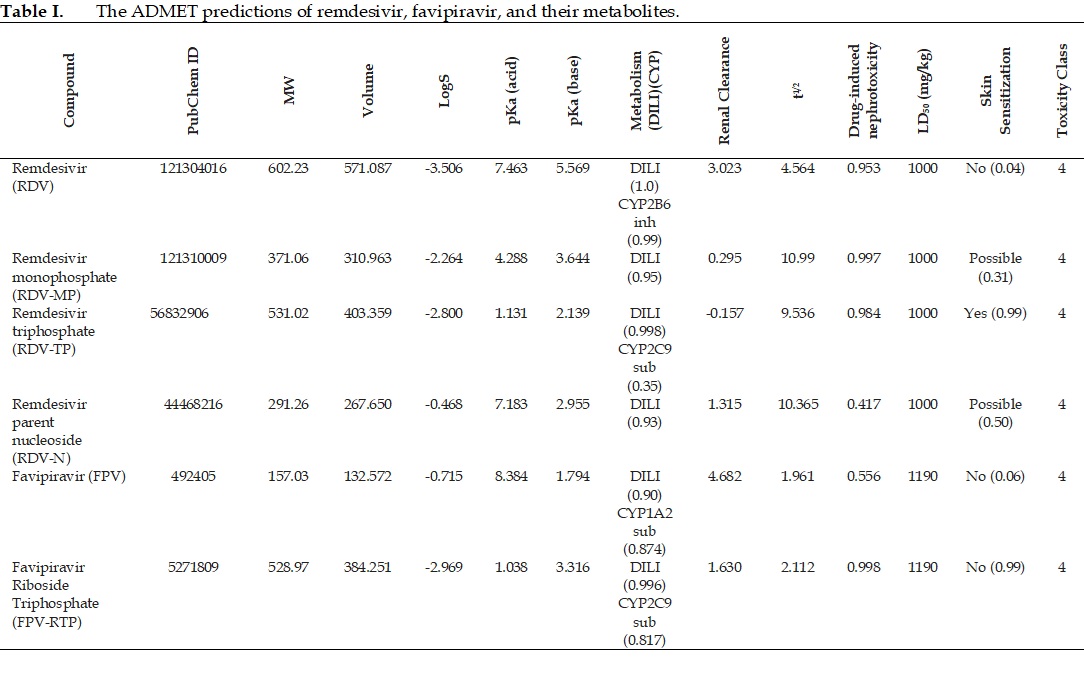
In silico methods have become crucial for the rapid preliminary assessment of drug compound absorption, distribution, metabolism, excretion, and toxicity (ADMET) properties, particularly for vital antivirals such as remdesivir and favipiravir, early in the drug development process. This study aimed to predict the pharmacokinetic profiles of remdesivir, favipiravir, and their respective metabolites, explicitly focusing on their interactions within the unique anatomy and physiology of human elimination organs. Compound summaries from PubChem were computationally analyzed using the pkCSM, ProTox-II, and ADMETLab 3.0 platforms. These predictions were then critically evaluated in the context of established hepatic and renal elimination mechanisms. Favipiravir and its metabolites generally exhibited a favorable ADMET profile, characterized by good oral absorption, wide distribution, efficient metabolism, and rapid excretion, albeit with a slight potential for blood-brain barrier penetration. In contrast, remdesivir, its nucleotide metabolite, and favipiravir showed the highest predicted likelihood of inducing hepatotoxicity. Concerning renal toxicity, remdesivir, remdesivir monophosphate, and the active triphosphate forms of both remdesivir and favipiravir presented a notable risk. This elevated renal risk was primarily attributed to their predicted low renal clearances, potentially resulting from insufficient penetration across the negatively charged glomerular filtration barrier. In conclusion, favipiravir and its metabolites demonstrated a more desirable ADMET profile than remdesivir. These preliminary findings suggest a differential safety and pharmacokinetic landscape between the two antiviral agents. Future research should prioritize leveraging advanced AI-based ADMET platforms to simulate complex human organ functions more accurately, refining these predictive models, and guiding subsequent in vivo investigations.
Full text article
References
2. Venkataraman M, Rao GC, Madavareddi JK, Maddi SR. Leveraging machine learning models in evaluating ADMET properties for drug discovery and development. ADMET DMPK. 2025;13(3):2772. DOI: 10.5599/admet.2772; PMID: 40585410; PMCID: PMC12205928.
3. Paliwal A, Jain S, Kumar S, Wal P, Khandai M, Khandige PS, et al. Predictive Modelling in pharmacokinetics: from in-silico simulations to personalized medicine. Expert Opin Drug Metab Toxicol. 2024;20(4):181-95. DOI: 10.1080/17425255.2024.2330666; PMID: 38480460.
4. Zhang S, Jeong S, Jiang B, Ho H. Pharmacokinetic simulations for remdesivir and its metabolites in healthy subjects and patients with renal impairment. Front Pharmacol. 2025;16:1488961. DOI: 10.3389/fphar.2025.1488961; PMID: 40213698; PMCID: PMC11982744.
5. Schooley RT, Carlin AF, Beadle JR, Valiaeva N, Zhang XQ, Clark AE, et al. Rethinking Remdesivir: Synthesis, Antiviral Activity, and Pharmacokinetics of Oral Lipid Prodrugs. Antimicrob Agents Chemother. 2021;65(10):e0115521. DOI: 10.1128/AAC.01155-21; PMID: 34310217; PMCID: PMC8448143.
6. Konstantinova ID, L Andronova V, Fateev IV, Esipov RS. Favipiravir and Its Structural Analogs: Antiviral Activity and Synthesis Methods. Acta Naturae. 2022;14(2):16-38. DOI: 10.32607/actanaturae.11652; PMID: 35923566; PMCID: PMC9307979.
7. Azman M, Sabri AH, Anjani QK, Mustaffa MF, Hamid KA. Intestinal Absorption Study: Challenges and Absorption Enhancement Strategies in Improving Oral Drug Delivery. Pharmaceuticals. 2022;15(8):975. DOI: 10.3390/ph15080975; PMID: 36015123; PMCID: PMC9412385.
8. Lemaitre F, Solas C, Grégoire M, Lagarce L, Elens L, Polard E, et al. Potential drug-drug interactions associated with drugs currently proposed for COVID-19 treatment in patients receiving other treatments. Fundam Clin Pharmacol. 2020;34(5):530-47. DOI: 10.1111/fcp.12586; PMID: 32603486; PMCID: PMC7361515.
9. Hassanipour S, Arab-Zozani M, Amani B, Heidarzad F, Fathalipour M, Martinez-de-Hoyo R. Addendum: The efficacy and safety of Favipiravir in treatment of COVID-19: a systematic review and meta-analysis of clinical trials. Sci Rep. 2022;12(1):1996. DOI: 10.1038/s41598-022-05835-2; PMID: 35105913; PMCID: PMC8805134.
10. Daehn IS, Duffield JS. The glomerular filtration barrier: a structural target for novel kidney therapies. Nat Rev Drug Discov. 2021;20(10):770-88. DOI: 10.1038/s41573-021-00242-0; PMID: 34262140; PMCID: PMC8278373.
11. Waldauf P, Jurisinova I, Svobodova E, Diblickova M, Tencer T, Zavora J, et al. The impact of remdesivir on renal and liver functions in severe COVID-19 patients with presence of viral load. Sci Rep. 2025;15(1):20900. DOI: 10.1038/s41598-025-05541-9; PMID: 40594535; PMCID: PMC12214511.
Authors
Copyright (c) 2026 Anita Purnamayanti, Suharjono Suharjono, Mahardian Rahmadi

This work is licensed under a Creative Commons Attribution-ShareAlike 4.0 International License.
This work is licensed under a Creative Commons Attribution-ShareAlike 4.0 International License.
Authors continue to retain the copyright to the article if the article is published in the Borneo Journal of Pharmacy. They will also retain the publishing rights to the article without any restrictions.
Authors who publish in this journal agree to the following terms:
- Any article on the copyright is retained by the author(s).
- The author grants the journal the right of first publication with the work simultaneously licensed under a Creative Commons Attribution License that allows others to share work with an acknowledgment of the work authors and initial publications in this journal.
- Authors can enter into separate, additional contractual arrangements for the non-exclusive distribution of published articles (e.g., post-institutional repository) or publish them in a book, with acknowledgment of their initial publication in this journal.
- Authors are permitted and encouraged to post their work online (e.g., in institutional repositories or on their websites) prior to and during the submission process. This can lead to productive exchanges and earlier and greater citations of published work.
- The article and any associated published material are distributed under the Creative Commons Attribution-ShareAlike 4.0 International License.
Article Details