Formulation and The Hen's Egg Chorioallantoic Membrane (HET-CAM) Test to Predict Irritation Potential of FCEE and FCEA Facial Cleansing Gel

Article Sidebar
-
Citrus amblycarpa, Facial cleansing gel, HET-CAM
Abstract
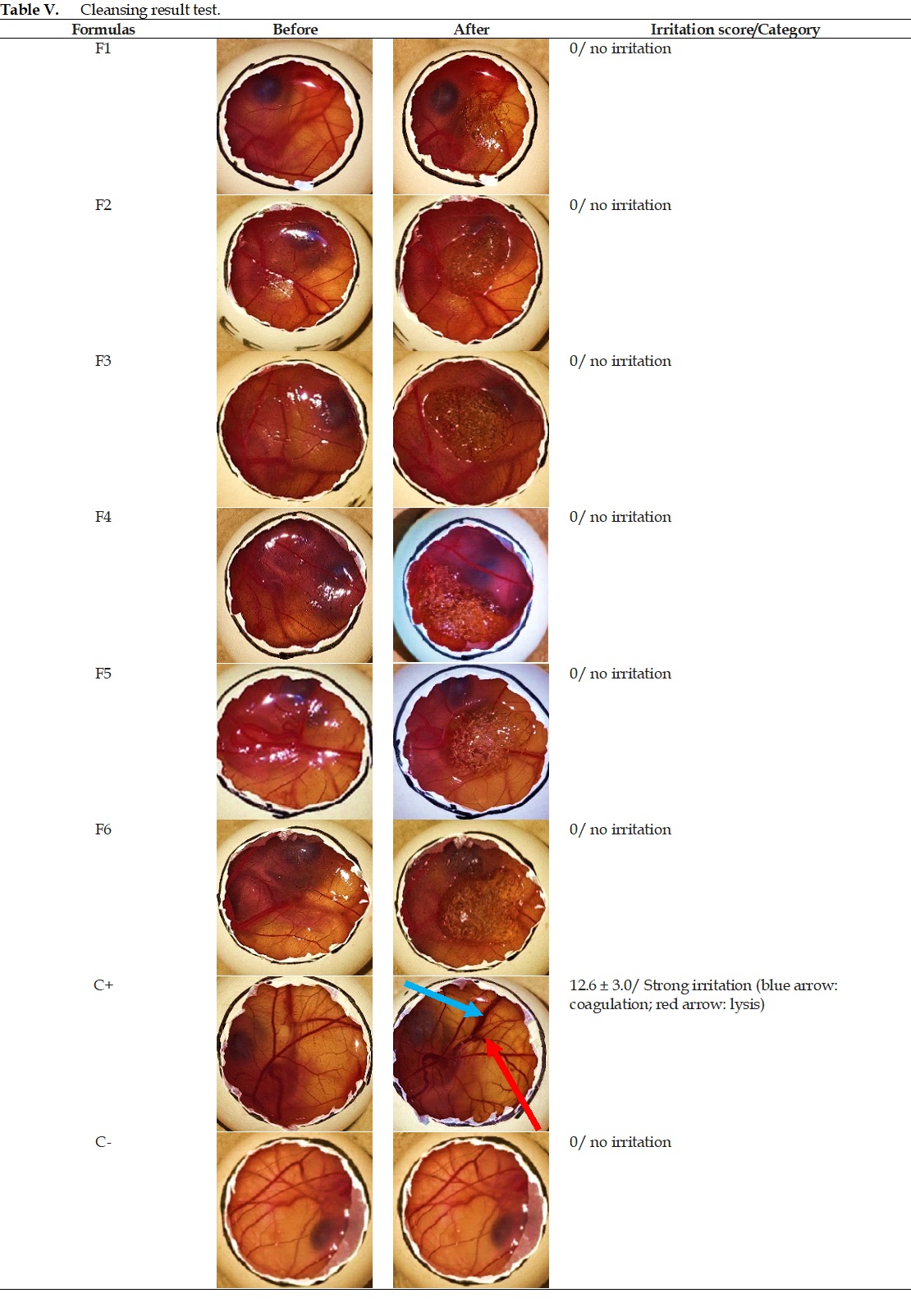
Limau citrus (Citrus amblycarpa (Hassk.) Ochse) peel contains vitamin C, vitamin A, flavonoids, essential oils, coumarin, and rosmarinic acid derivatives. Due to its antioxidant and antibacterial properties, it can be used as an active ingredient in facial cleansers. This study examined the quality of the ethanol fraction (FCEE) and ethyl acetate fraction (FCEA) formulas derived from C. amblycarpa peels and their irritation potential. Citrus amblycarpa peel was macerated with 96% ethanol and partitioned successively with n-hexane and ethyl acetate. The facial cleansing gel FCEE and FCEA, with concentrations of 0.20%, 0.35%, and 0.50%, respectively. The Hen's Egg Chorioallantoic Membrane (HET-CAM) method was used to determine the potential irritation. The evaluation of the FCEE and FCEA formulas showed a greenish-brownish yellow color, a distinctive aroma of C. amblycarpa, and a soft texture. The pH values ranged from 5.66 to 6.27. All formulas were homogeneous, and the viscosity values were recorded in the range of 65.33 to 91.67 dPa.s. The foam stabilities ranged from 65.94 to 69.40%, and the formulas demonstrated effective cleaning ability. The results of the HET-CAM irritation test show that the irritation score of the positive control (SLS 30%) was 12.6 (strong irritation category), that of the negative control (water for injection), and that of all FCEE and FCEA facial cleansing gel formulas, which have an irritation score of 0 (no irritation category). The study presents quantitative and qualitative data in evaluating facial skin cleansers. These results demonstrate safe formulation.
Full text article
References
2. Zhang XE, Zheng P, Ye SZ, Ma X, Liu E, Pang YB, et al. Microbiome: Role in Inflammatory Skin Diseases. J Inflamm Res. 2024;17:1057-82. DOI: 10.2147/JIR.S441100. PMID: 38375021; PMCID: PMC10876011.
3. Du Y, Doraiswamy C, Mao J, Zhang Q, Liang Y, Du Z, et al. Facial skin characteristics and concerns in Indonesia: A cross-sectional observational study. Skin Res Technol. 2022;28(5):719-28. DOI: 10.1111/srt.13189. PMID: 35785442; PMCID: PMC9907585.
4. Patel M, Khatri A, Khatri R, Sreevallabhan S, Jose S, Patel N, et al. Clinical Evaluation of a Soap-Free Cleansing Lotion Containing Sodium Cocoyl Apple Amino Acids for Effective Impurity Removal and Skin Barrier Preservation in Healthy Adults With Diverse Skin Types. Cureus. 2025;17(8):e90538. DOI: 10.7759/cureus.90538. PMID: 40978887; PMCID: PMC12446884.
5. Samant BS, Kaliappan R. The use of surfactants in the extraction of active ingredients from natural resources: a comprehensive review. RSC Adv. 2025;15(29):23569-87. DOI: 10.1039/d5ra02072g. PMID: 40630693; PMCID: PMC12236305.
6. Slavova T, Stanimirova R, Marinova K, Danov K. Cleansing Mechanisms and Efficacy on Artificial Skin. Molecules. 2025;30(8):1813. DOI: 10.3390/molecules30081813. PMID: 40333845; PMCID: PMC12029698.
7. Katoh Y, Natsume O, Yasuoka R, Hayano S, Okada E, Ito Y, et al. Skin care by washing with water is not inferior to washing with a cleanser in children with atopic dermatitis in remission in summer: WASH study. Allergol Int. 2024;73(3):428-35. DOI: 10.1016/j.alit.2024.01.007. PMID: 38310043.
8. Phucharoenrak P, Muangnoi C, Trachootham D. Metabolomic Analysis of Phytochemical Compounds from Ethanolic Extract of Lime (Citrus aurantifolia) Peel and Its Anti-Cancer Effects against Human Hepatocellular Carcinoma Cells. Molecules. 2023;28(7):2965. DOI: 10.3390/molecules28072965. PMID: 37049726; PMCID: PMC10095956.
9. Pieracci Y, Pistelli L, Cecchi M, Pistelli L, De Leo M. Phytochemical Characterization of Citrus-Based Products Supporting Their Antioxidant Effect and Sensory Quality. Foods. 2022;11(11):1550. DOI: 10.3390/foods11111550. PMID: 35681300; PMCID: PMC9180594.
10. Dewi KS, Julaeha E, Farabi K, Supratman U. Flavonoids from Limau Peel (Citrus amblycarpa (Hassk.) Ochse) and Their Antioxidant Activity. Molekul. 2022;17(2):193-9. DOI: 10.20884/1.jm.2022.17.2.5430
11. Rizki MI, Agustina NKA, Sari AK, Rahmatullah SW, Isnani N. Characteristics and Antioxidant Activity of Limau Kuit Peel (Citrus hystrix) Extract with Variation of Extraction Solvent. Med Lab Tech J. 2025;11(1):110-22. DOI: 10.31964/mltj.v11i1.650
12. Cherubim DJdL, Martins CVB, Fariña LO, de Lucca RAdS. Polyphenols as natural antioxidants in cosmetics applications. J Cosmet Dermatol. 2020;19(1):33-7. DOI: 10.1111/jocd.13093. PMID: 31389656.
13. Pezantes-Orellana C, Bermúdez FG, Montalvo J, Packer T, Orellana-Manzano A. Evaluating efficacy, safety, and innovation in skin care applications of essential oils: a systematic review. Front Med. 2025;12:1589691. DOI: 10.3389/fmed.2025.1589691. PMID: 40917836; PMCID: PMC12408269.
14. Rivero MN, Lenze M, Izaguirre M, Damonte SHP, Aguilar A, Wikinski S, et al. Comparison between HET-CAM protocols and a product use clinical study for eye irritation evaluation of personal care products including cosmetics according to their surfactant composition. Food Chem Toxicol. 2021;153:112229. DOI: 10.1016/j.fct.2021.112229. PMID: 33887397.
15. Budai P, Kormos É, Buda I, Somody G, Lehel J. Comparative evaluation of HET-CAM and ICE methods for objective assessment of ocular irritation caused by selected pesticide products. Toxicol In Vitro. 2021;74:105150. DOI: 10.1016/j.tiv.2021.105150. PMID: 33753176.
16. Elberskirch L, Le Harzic R, Scheglmann D, Wieland G, Wiehe A, Mathieu-Gaedke M, et al. A HET-CAM based vascularized intestine tumor model as a screening platform for nano-formulated photosensitizers. Eur J Pharm Sci. 2022;168:106046. DOI: 10.1016/j.ejps.2021.106046. PMID: 34670122.
17. Caplar BD, Togoe MM, Ribatti D, Pop D, Sinescu C, Rominu M, et al. The Chick Embryo Chorioallantoic Membrane (CAM) Assay: A Novel Experimental Model in Dental Research. Cureus. 2024;16(11):e74714. DOI: 10.7759/cureus.74714. PMID: 39655138; PMCID: PMC11626256.
18. Kusumawati IGAW, Yogeswara IBA, Wasito H. Metabolite profiling and antioxidant activity of peel extract from Citrus amblycarpa. Biodiversitas. 2025;26(6):2601-10. DOI: 10.13057/biodiv/d260605
19. Sari DY, Lestari GW, Pulungan HFF, Remiyati I, Widyasari R. Moisturized and non-irritating hand gel based on sappan wood (Caesalpinia sappan l.) and limau citrus peel (Citrus amblycarpa (hassk.) ochse) extracts. J Public Health Afr. 2023;14(Suppl 1):2509. DOI: 10.4081/jphia.2023.2509. PMID: 37492550; PMCID: PMC10365648.
20. Liu J, Huang G, Li R, Ho CT, Huang Q. Edible 3D printed emulsion gels: Effects of inulin on sensory characteristics and mechanical properties. Curr Res Food Sci. 2025;11:101154. DOI: 10.1016/j.crfs.2025.101154. PMID: 40822884; PMCID: PMC12355414.
21. Hussen EM, Endalew SA. In vitro antioxidant and free-radical scavenging activities of polar leaf extracts of Vernonia amygdalina. BMC Complement Med Ther. 2023;23(1):146. DOI: 10.1186/s12906-023-03923-y. PMID: 37143058; PMCID: PMC10157976.
22. Pandey J, Gaire S, Sharma K, Pun D, Gyawali A, Lamichhane G, et al. Exploring the potentials of Ziziphus mauritiana Lam. seed kernel oil as pharmaceutical oil base: Physicochemical characterization and ketoconazole soap formulation. Heliyon. 2023;9(11):e21034. DOI:10.1016/j.heliyon.2023.e21034
23. Shahmarvand S, Ameli F, Mohammadi S, Fouladi KHA. Experimental investigation on the stability of foam using combination of anionic and zwitterionic surfactants: A screening scenario to obtain optimum compound. J Disper Sci Technol. 2024;45(10):2016-27. DOI: 10.1080/01932691.2023.2244613
24. Raknam P, Pinsuwan S, Amnuaikit T. Rubber Seed Cleansing Oil Formulation and Its Efficacy of Makeup Remover. Int J Pharm Sci Res. 2020;11(1):146-55. DOI: 10.13040/ijpsr.0975-8232.11(1).146-55.
25. Sari DY, Rahman IR. Keamanan Hair Tonic Ekstrak Etanol, Fraksi Etanol, dan Fraksi Kloroform-Metanol dari Kayu Secang (Caesalpinia sappan L.) dengan Metode Uji Iritasi Primer dan HET-CAM. J Farmasi Udayana. 2021;10(2):156-62. DOI: 10.24843/JFU.2021.v10.i02.p08.
26. Sari DY, Widyasari R. Antioxidant Activity and Irritation Potency of Face Tonic Formulation from Ethanol Fraction of Sappan Wood (Caesalpinia SappanL.). Indones J Pharm. 2023;34(2):261–71. DOI: 10.22146/ijp.4552.
27. Nitthikan N, Preedalikit W, Supadej K, Chaichit S, Leelapornpisid P, Kiattisin K. Exploring the Wound Healing Potential of a Cuscuta chinensis Extract-Loaded Nanoemulsion-Based Gel. Pharmaceutics. 2024;16(5):573. DOI: 10.3390/pharmaceutics16050573. PMID: 38794235; PMCID: PMC11124339.
28. Aljabri H, Cherif M, Siddiqui SA, Bounnit T, Saadaoui I. Evidence of the drying technique's impact on the biomass quality of Tetraselmis subcordiformis (Chlorophyceae). Biotechnol Biofuels Bioprod. 2023;16(1):85. DOI: 10.1186/s13068-023-02335-x. PMID: 37210534; PMCID: PMC10199630.
29. Pinto D, Ciardiello T, Franzoni M, Pasini F, Giuliani G, Rinaldi F. Effect of commonly used cosmetic preservatives on skin resident microflora dynamics. Sci Rep. 2021;11(1):8695. DOI: 10.1038/s41598-021-88072-3. PMID: 33888782; PMCID: PMC8062602.
30. Kiattisin K, Srithongchai P, Jaiyong W, Boonpisuttinant K, Ruksiriwanich W, Jantrawut P, et al. Preparation and characterization of ultrasound-assisted nanoemulsions containing natural oil for anti-aging effect. J Agric Food Res. 2024;15:101004. DOI: 10.1016/j.jafr.2024.101004.
31. Kuo SH, Shen CJ, Shen CF, Cheng CM. Role of pH Value in Clinically Relevant Diagnosis. Diagnostics (Basel). 2020;10(2):107. DOI: 10.3390/diagnostics10020107. PMID: 32079129; PMCID: PMC7167948.
32. Tottoli EM, Dorati R, Genta I, Chiesa E, Pisani S, Conti B. Skin Wound Healing Process and New Emerging Technologies for Skin Wound Care and Regeneration. Pharmaceutics. 2020;12(8):735. DOI: 10.3390/pharmaceutics12080735. PMID: 32764269; PMCID: PMC7463929.
33. Lukić M, Pantelić I, Savić SD. Towards Optimal pH of the Skin and Topical Formulations: From the Current State of the Art to Tailored Products. Cosmetics. 2021;8(3):69. DOI: 10.3390/cosmetics8030069.
34. Choi EH, Kang H. Importance of Stratum Corneum Acidification to Restore Skin Barrier Function in Eczematous Diseases. Ann Dermatol. 2024;36(1):1-8. DOI: 10.5021/ad.23.078. PMID: 38325428; PMCID: PMC10861303.
35. Bohbot JM, Rebelo C, Nappi RE. Vulvar Care: Reviewing Concepts in Daily Hygiene. Healthcare (Basel). 2025;13(13):1523. DOI: 10.3390/healthcare13131523. PMID: 40648548; PMCID: PMC12248671.
36. Rahman MS, Hasan MS, Nitai AS, Nam S, Karmakar AK, Ahsan MS, et al. Recent Developments of Carboxymethyl Cellulose. Polymers. 2021;13(8):1345. DOI: 10.3390/polym13081345. PMID: 33924089; PMCID: PMC8074295.
37. Bogdan C, Safta DA, Iurian S, Petrușcă DR, Moldovan ML. QbD Approach in Cosmetic Cleansers Research: The Development of a Moisturizing Cleansing Foam Focusing on Thickener, Surfactants, and Polyols Content. Gels. 2024;10(8):484. DOI: 10.3390/gels10080484. PMID: 39195013; PMCID: PMC11354169.
38. Liu L. Penetration of Surfactants into Skin. J Cosmet Sci. 2020;71(2):91-109. PMID: 32271711.
39. Nagtode VS, Cardoza C, Yasin HKA, Mali SN, Tambe SM, Roy P, et al. Green Surfactants (Biosurfactants): A Petroleum-Free Substitute for Sustainability-Comparison, Applications, Market, and Future Prospects. ACS Omega. 2023;8(13):11674-99. DOI: 10.1021/acsomega.3c00591. PMID: 37033812; PMCID: PMC10077441.
40. Deng Z, Tang S, Ou M, Wang Z. Ionic liquids self-assembled micelles for transdermal delivery: characterization, functions and applications. Int J Pharm X. 2025;10:100350. DOI: 10.1016/j.ijpx.2025.100350. PMID: 40688029; PMCID: PMC12270802.
41. Öztürk AA, Kıyan HT. Treatment of oxidative stress-induced pain and inflammation with dexketoprofen trometamol loaded different molecular weight chitosan nanoparticles: Formulation, characterization and anti-inflammatory activity by using in vivo HET-CAM assay. Microvasc Res. 2020;128:103961. DOI: 10.1016/j.mvr.2019.103961. PMID: 31758946.
42. Tien LTD, Thao NNN, Hao ND, Linh LQ, Ngan LB, Nhu TLQ, et al. Formulation Development of a Facial Cleansing Gel Containing Phyllanthus amarus Extract and Aloe vera Juice with Antioxidant Activity. VNU J Sci Med Pharm Sci. 2025;42(1):66–76. DOI: 10.1080/22311866.2026.2619602.
43. Listiani PAR, Dewantara IGNA, Prasetia IGNJA. Hasil Skor Indeks Iritasi Primer Natrium Lauril Sulfat 1% sebagai Bahan Baku Deterjen Sintetik. J Farmasi Udayana. 2015;4(1):87-9.
44. Güder S Sr, Güder H. Investigation of the Chemical Content and User Comments on Facial Cleansing Products. Cureus. 2023;15(5):e38673. DOI: 10.7759/cureus.38673. PMID: 37288177; PMCID: PMC10243403.
Authors
Copyright (c) 2026 Dina Yuspita Sari, Evi Eriani, Ibnu Afif, Erick Ferdian, Ika Ristia Rahman

This work is licensed under a Creative Commons Attribution-ShareAlike 4.0 International License.
This work is licensed under a Creative Commons Attribution-ShareAlike 4.0 International License.
Authors continue to retain the copyright to the article if the article is published in the Borneo Journal of Pharmacy. They will also retain the publishing rights to the article without any restrictions.
Authors who publish in this journal agree to the following terms:
- Any article on the copyright is retained by the author(s).
- The author grants the journal the right of first publication with the work simultaneously licensed under a Creative Commons Attribution License that allows others to share work with an acknowledgment of the work authors and initial publications in this journal.
- Authors can enter into separate, additional contractual arrangements for the non-exclusive distribution of published articles (e.g., post-institutional repository) or publish them in a book, with acknowledgment of their initial publication in this journal.
- Authors are permitted and encouraged to post their work online (e.g., in institutional repositories or on their websites) prior to and during the submission process. This can lead to productive exchanges and earlier and greater citations of published work.
- The article and any associated published material are distributed under the Creative Commons Attribution-ShareAlike 4.0 International License.
Article Details