Comparison of Characteristics and Antibacterial Activity of Mandai Cempedak Vinegar with Variations in Fermentation Methods

Article Sidebar
-
Antibacterial, Mandai vinegar, Lactobacillus, Probiotic, Artocarpus champeden
Abstract
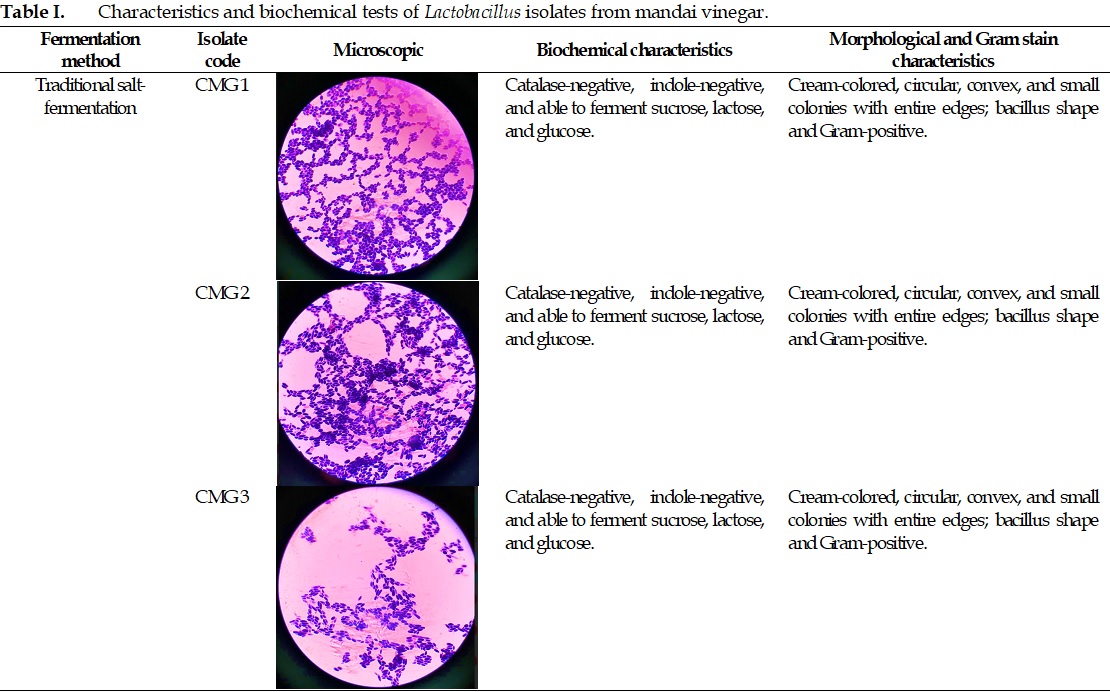
Mandai, a traditional fermented food product from East Kalimantan, is derived from the edible mesocarp of the cempedak (Artocarpus champeden) fruit. This ancestral fermentation technique, passed down through generations, is known to produce lactic acid bacteria (LAB) with potential probiotic properties. This study aimed to characterize LAB isolated from mandai vinegar and evaluate their antibacterial activity under two distinct fermentation conditions: a defined starter culture of Lactobacillus casei strain Shirota and spontaneous fermentation in a 10% NaCl solution. The latter, referred to as salt fermentation, yielded three bacterial colonies, while the starter culture method produced four. All isolates from both methods shared similar morphological characteristics, including a rod shape, white coloration, entire margins, and convex surfaces. Further analysis confirmed they were Gram-positive, catalase-negative, and indole-negative, with the ability to ferment various carbohydrates. While all LAB isolates demonstrated generally low antibacterial activity against Escherichia coli ATCC 25922, isolate CML 1 exhibited the highest antibacterial potential. These findings highlight the potential of mandai vinegar as a source of functional LAB, warranting further investigation into its applications as a functional food ingredient.
Full text article
References
2. Rahmadi A. Bakteri Asam Laktat dan Mandai Cempedak. Samarinda: Mulawarman University Press; 2019. DOI: 10.13140/RG.2.2.18884.27521/1
3. Nur HS. Suksesi Mikroba dan Aspek Biokimiawi Fermentasi Mandai dengan Kadar Garam Rendah. Makara J Sci. 2009;13(1):3-7. DOI: 10.7454/mss.v13i1.350
4. Voidarou C, Antoniadou M, Rozos G, Tzora A, Skoufos I, Varzakas T, et al. Fermentative Foods: Microbiology, Biochemistry, Potential Human Health Benefits and Public Health Issues. Foods. 2020;10(1):69. DOI: 10.3390/foods10010069; PMCID: PMC7823516; PMID: 33396397
5. Rahayu ES. Lactic acid bacteria in fermented food of Indonesian origin. Agritech. 2018;23(2):75-84. DOI: 10.22146/agritech.13515
6. Spanhaak S, Havenaar R, Schaafsma G. The effect of consumption of milk fermented by Lactobacillus casei strain Shirota on the intestinal microflora and immune parameters in humans. Eur J Clin Nutr. 1998;52(12):899-907. DOI: 10.1038/sj.ejcn.1600663; PMID: 9881885
7. Takeda K, Okumura K. Effects of a fermented milk drink containing Lactobacillus casei strain Shirota on the human NK-cell activity. J Nutr. 2007;137(3):791-3. DOI: 10.1093/jn/137.3.791s; PMID: 17311976
8. Yuniastuti A. Pengaruh Pemberian Susu Fermentasi Lactobacillus casei Strain Shirota terhadap Perubahan Kadar Fraksi Lipid Serum Tikus Hiperkolesterolemi. Masters thesis. Universitas Diponegoro; 2004.
9. Mariana M, Rahmadi A, Syahrumsyah H. Pengaruh pemberian cuka mandai terhadap kadar kolesterol total, lipoprotein dan trigliserida pada mencit (Mus musculus) dengan induksi kuning telur. J Trop Agrifood. 2020;2(1):45-52. DOI: 10.35941/jtaf.2.1.2020.3918.45-52
10. Holzapfel WH, Haberer P, Geisen R, Björkroth J, Schillinger U. Taxonomy and important features of probiotic microorganisms in food and nutrition. Am J Clin Nutr. 2001;73(2 Suppl):365s-73s. DOI: 10.1093/ajcn/73.2.365s; PMID: 11157343
11. Kurnia M, Amir H, Handayani D. Isolasi dan Identifikasi Bakteri Asam Laktat dari Makanan Tradisional Suku Rejang di Provinsi Bengkulu: “Lemea”. Alotrop. 2020;4(1):25-32. DOI: 10.33369/atp.v4i1.13705
12. Giyatno DC, Retnaningrum E. Isolasi dan Karakterisasi Bakteri Asam Laktat Penghasil Eksopolisakarida dari Buah Kersen (Muntingia calabura L.). J Sains Dasar. 2020;9(2):42-9. DOI: 10.21831/jsd.v9i2.34523
13. Darkoh C, Chappel C, Gonzales C, Okhuysen P. A rapid and specific method for the detection of indole in complex biological samples. Appl Environ Microbiol. 2015;81(23):8093-7. DOI: 10.1128/aem.02787-15; PMCID: PMC4651089; PMID: 26386049
14. Pakadang SR, Marsus I, Ihsanawati I. Antibacterial Activity of Endophytic Fungus Isolates of Mangrove Fruit (Sonneratia alba) Against Staphylococcus aureus and Esherichia coli. J Info Kesehatan. 2021;19(1):55-63. DOI: 10.31965/infokes.vol19.iss1.416
15. Brenner DJ, Krieg NR, Staley JT, Garrity GM, Boone DR, Vos P, et al, editors. Bergey's Manual® of Systematic Bacteriology. New York: Springer; 2010. DOI: 10.1007/0-387-28022-7
16. Holt JG, Krieg NR, Sneath PHA, Staley JT, Williams ST. Bergey's Manual® of Determinative Bacteriology. Philadelphia: Lippincott Williams & Wilkins; 1994.
17. Sharma R, Garg P, Kumar P, Bhatia SK, Kulshrestha S. Microbial Fermentation and Its Role in Quality Improvement of Fermented Foods. Fermentation. 2020;6(4):106. DOI: 10.3390/fermentation6040106
18. Łepecka A, Szymański P, Okoń A, Łaszkiewicz B, Onacik-Gür S, Zielińska D, et al. The Use of Apple Vinegar from Natural Fermentation in the Technology Production of Raw-Ripened Wild Boar Loins. Foods. 2023;12(21):3975. DOI: 10.3390/foods12213975; PMCID: PMC10650204; PMID; 37959092
19. Napitupulu HG, Rumengan IFM, Wullur S, Ginting EL, Rimper JRTSL, Toloh BH. Bacillus sp. As a Decomposition Agent in The Maintenance of Brachionus rotundiformis Which Uses Raw Fish as a Source of Nutrition. J Ilmiah Platax. 2019;7(1):158-69. DOI: 10.35800/jip.7.1.2019.22627
20. Beveridge TJ. Structures of gram-negative cell walls and their derived membrane vesicles. J Bacteriol. 1999;181(16):4725-33. DOI: 10.1128/jb.181.16.4725-4733.1999; PMCID: PMC93954; PMID: 10438737
21. Taylor WI, Achanzar D. Catalase test as an aid to the identification of Enterobacteriaceae. Appl Microbiol. 1972;24(1):58-61. DOI: 10.1128/aem.24.1.58-61.1972; PMCID: PMC380547; PMID: 4560474
22. Iwase T, Tajima A, Sugimoto S, Okuda K, Hironaka I, Kamata Y, et al. A simple assay for measuring catalase activity: a visual approach. Sci Rep. 2013;3:3081. DOI: 10.1038/srep03081; PMCID: PMC3812649; PMID: 24170119
23. Todorov SD, Franco BDGdM. Lactobacillus plantarum: Characterization of the species and application in food production. Food Rev Int. 2010;26(3):205-29. DOI: 10.1080/87559129.2010.484113
24. Davis WW, Stout TR. Disc plate method of microbiological antibiotic assay. I. Factors influencing variability and error. Appl Microbiol. 1971;22(4):659-65. DOI: 10.1128/aem.22.4.659-665.1971; PMCID: PMC376382; PMID: 5002143
25. Sharma G, Dang S, Gupta S, Gabrani R. Antibacterial Activity, Cytotoxicity, and the Mechanism of Action of Bacteriocin from Bacillus subtilis GAS101. Med Princ Pract. 2018;27(2):186-92. DOI: 10.1159/000487306; PMCID: PMC5968280; PMID: 29402863
26. Mokoena MP, Omatola CA, Olaniran AO. Applications of Lactic Acid Bacteria and Their Bacteriocins against Food Spoilage Microorganisms and Foodborne Pathogens. Molecules. 2021;26(22):7055. DOI: 10.3390/molecules26227055; PMCID: PMC8622874; PMID: 34834145
27. Darbandi A, Asadi A, Ari MM, Ohadi E, Talebi M, Zadeh MH, et al. Bacteriocins: Properties and potential use as antimicrobials. J Clin Lab Anal. 2022;36(1):e24093. DOI: 10.1002/jcla.24093; PMCID: PMC8761470; PMID: 34851542
28. Mgomi FC, Yang YR, Cheng G, Yang ZQ. Lactic acid bacteria biofilms and their antimicrobial potential against pathogenic microorganisms. Biofilm. 2023;5:100118. DOI: 10.1016/j.bioflm.2023.100118; PMCID: PMC10139968; PMID: 37125395
29. Reuben RC, Torres C. Bacteriocins: potentials and prospects in health and agrifood systems. Arch Microbiol. 2024;206(5):233. DOI: 10.1007/s00203-024-03948-y; PMCID: PMC11045635; PMID: 38662051
30. Ranasinghe R, Mathai M, Zulli A. Cytoprotective remedies for ameliorating nephrotoxicity induced by renal oxidative stress. Life Sci. 2023;318:121466. DOI: 10.1016/j.lfs.2023.121466; PMID: 36773693
Authors
Copyright (c) 2025 Indah Woro Utami, Sapri Sapri, Nishia Waya Meray, Rezia Elok Canrika

This work is licensed under a Creative Commons Attribution-ShareAlike 4.0 International License.
This work is licensed under a Creative Commons Attribution-ShareAlike 4.0 International License.
Authors continue to retain the copyright to the article if the article is published in the Borneo Journal of Pharmacy. They will also retain the publishing rights to the article without any restrictions.
Authors who publish in this journal agree to the following terms:
- Any article on the copyright is retained by the author(s).
- The author grants the journal the right of first publication with the work simultaneously licensed under a Creative Commons Attribution License that allows others to share work with an acknowledgment of the work authors and initial publications in this journal.
- Authors can enter into separate, additional contractual arrangements for the non-exclusive distribution of published articles (e.g., post-institutional repository) or publish them in a book, with acknowledgment of their initial publication in this journal.
- Authors are permitted and encouraged to post their work online (e.g., in institutional repositories or on their websites) prior to and during the submission process. This can lead to productive exchanges and earlier and greater citations of published work.
- The article and any associated published material are distributed under the Creative Commons Attribution-ShareAlike 4.0 International License.
Article Details