Comparison of Chromatogram Profiles of Red Ginger (Zingiber officinale var. rubrum Theilade) Rhizome Essential Oil Based on Differences in Growing Places

Article Sidebar
-
Red Ginger, GC-MS, Essential oils, Central Java
Abstract
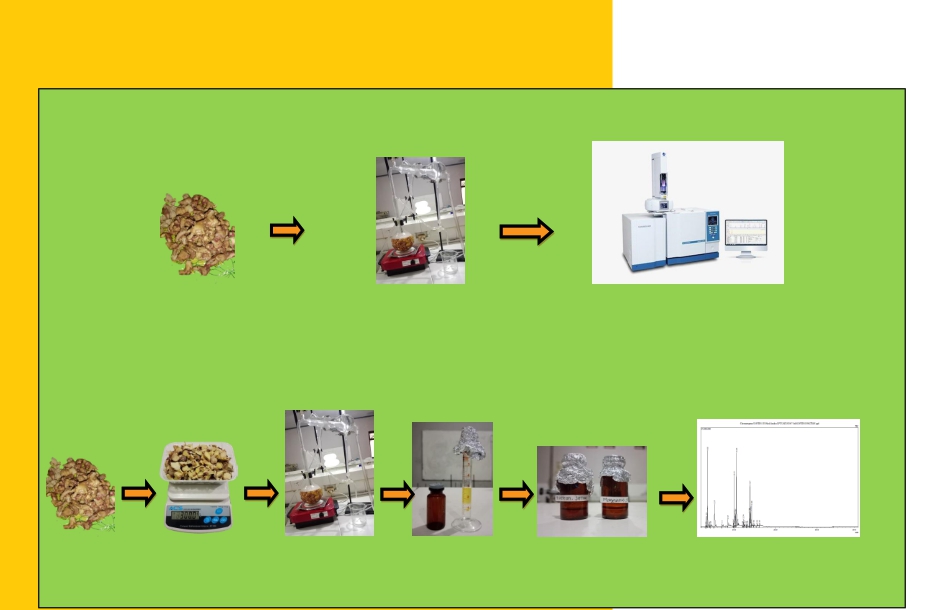
Red ginger (Zingiber officinale var. rubrum Theilade) is a valuable raw material for the pharmaceutical, cosmetic, and food industries, primarily due to its rich essential oil content. This study investigated how cultivation location influences the chromatographic profile of Z. officinale var. rubrum essential oil. Samples were sourced from two distinct regions in Java, Indonesia: Magelang and Pacitan Regencies. Essential oils were isolated using water distillation, and their chemical compositions were subsequently analyzed via gas chromatography-mass spectrometry (GC-MS). A notable difference in essential oil yield was observed, with Magelang producing 0.1% and Pacitan yielding 0.08%. GC-MS analysis of the Magelang sample identified 16 compounds, prominently featuring E-citral (20.30%), Z-citral (11.31%), geraniol (10.34%), and camphene (8.91%). Conversely, the Pacitan sample contained 15 compounds, with E-citral (24.06%), Z-citral (13.93%), camphene (14.86%), and 1,8-cineole (7.86%) as its major constituents. A Mann-Whitney U test confirmed a statistically significant difference (p-value = 0.025 < 0.05) in the essential oil profiles between the two locations. These variations are likely attributable to diverse environmental factors, including soil composition, altitude, ambient temperature, and rhizome maturity. This research underscores the critical role of cultivation location in shaping the chemical characteristics of Z. officinale var. rubrum essential oil, providing valuable insights for developing tailored essential oil-based products to meet specific industrial requirements.
Full text article
References
2. Srikandi S, Humaeroh M, Sutamihardja RTM. Kandungan Gingerol Dan Shogaol Dari Ekstrak Jahe Merah (Zingiber Officinale Roscoe) Dengan Metode Maserasi Bertingkat. Al Kimiya J Ilmu Kimia Terapan. 2020;7(2):75-81. DOI: 10.15575/ak.v7i2.6545
3. Yeh H, Yu, Chuang CC, Chen CH, Wan CJ, Chen TL. Bioactive components analysis of two various gingers (Zingiber officinale Roscoe) and antioxidant effect of ginger extracts. LWT Food Sci Technol. 2014;55(1):329–34. DOI: 10.1016/j.lwt.2013.08.003
4. Styawan AA, Susidarti RA, Purwanto, Windarsih A, Rahmawati N, Sholikah IKM, et al. Review on ginger (Zingiber officinale Roscoe): phytochemical composition, biological activities and authentication analysis. Food Res. 2022;6(4):443-54. DOI: 10.26656/fr.2017.6(4).500
5. Ayustaningwarno F, Anjani G, Ayu AM, Fogliano V. A critical review of Ginger's (Zingiber officinale) antioxidant, anti-inflammatory, and immunomodulatory activities. Front Nutr. 2024;11:1364836. DOI: 10.3389/fnut.2024.1364836; PMCID: PMC11187345; PMID: 38903613
6. Lechner JF, Stoner GD. Gingers and their purified components as cancer chemopreventative agents. Molecules. 2019;24(16):2859. DOI: 10.3390/molecules24162859; PMCID: PMC6719158; PMID: 31394732
7. Kiyama R. Nutritional implications of ginger: chemistry, biological activities and signaling pathways. J Nutr Biochem. 2020;86:108486. DOI: 10.1016/j.jnutbio.2020.108486; PMID: 32827666
8. Halket JM, Waterman D, Przyborowska AM, Patel RKP, Fraser PD, Bramley PM. Chemical derivatization and mass spectral libraries in metabolic profiling by GC/MS and LC/MS/MS. J Exp Bot. 2005;56(410):219–43. DOI: 10.1093/jxb/eri069; PMID: 15618298
9. Farrel R, Aulawi T, Darmawi A. Quality Analysis of Simplicia Red Ginger (Zingiber officinale Var. Rubrum) Rhizome with Different Drying Temperature. J Online Pertanian Tropik. 2020;7(1):136-43. DOI: 10.32734/jopt.v7i1.3866
10. Styawan AA, Susidarti RA, Purwanto P, Irnawati I, Rohman A. Using antioxidant activity and FTIR spectra, Indonesian ginger (Zingiber officinale var. amarum) is classified by pattern recognition. J Appl Pharm Sci. 2023;13(4):149-56. DOI: 10.7324/JAPS.2023.50966
11. Dosoky NS, Setzer WN. Chemical Composition and Biological Activities of Essensial Oils of Curcuma Species. Nutriens. 2018;10(9):1196–237. DOI: 10.3390/nu10091196; PMCID: PMC6164907; PMID: 30200410
12. Meilani SL, Kusumastuti DA, Kulsum U. The Effect of Ginger Extract on Reducing Dysmenorrhea Pain in Adolescents. Adv Healthc Res. 2025;3(2):550-61. DOI: 10.60079/ahr.v3i2.594
13. Kumari M, Kumar M, Solankey SS. Zingiber officinale Roscoe: Ginger. In: Novak J, Blüthner WD, editors. Medicinal, Aromatic and Stimulant Plants. Cham: Springer Nature; 2020. DOI: 10.1007/978-3-030-38792-1
14. Shifa HN, Marliani L, Suhardiman A. Monoterpenoid and sesquiterpenoid active compounds from essential oils of the rhizomes of the Zingiberaceae family. J Ilmiah Farmasi. 2023;19(2):195-208. DOI: 10.20885/jif.vol19.iss2.art17
15. Başer KH, Özek T. Chapter 22 - Analysis of Essential Oils and Fragrances by Gas Chromatography. In: Poole CF, editor. Gas Chromatography. Amsterdam: Elsevier; 2012. DOI: 10.1016/B978-0-12-385540-4.00022-5
16. Maisaroh, Atmaji P, Astuti, Setianto WB, Restiawaty E, Bindar Y. Headspace Gas Chromatography/Mass Spectroscopy Analysis of Volatile Organic Compounds in Red Ginger (Zingiber officinale var. Rubrum): Effects of Drying on Chemical and Functional Properties. IOP Conf Ser Earth Environ Sci. 2025;1477:012068. DOI: 10.1088/1755-1315/1477/1/012068
17. Sharmeen JB, Mahomoodally FM, Zengin G, Maggi F. Essential Oils as Natural Sources of Fragrance Compounds for Cosmetics and Cosmeceuticals. Molecules. 2021;26(3):666. DOI: 10.3390/molecules26030666; PMCID: PMC7865210; PMID: 33514008
18. Ng F, Thong A, Basri N, Wu W, Chew W, Dharmawan J. Profiling of Aroma-Active Compounds in Ylang-Ylang Essential Oils by Aroma Extract Dilution Analysis (AEDA) and Chemometric Methods. J Agric Food Chem. 2022;70(1):260-6. DOI: 10.1021/acs.jafc.1c05492; PMID: 34931852
19. Mehalaine S, Chenchouni H. Quantifying how climatic factors influence essential oil yield in wild-growing plants. Arab J Geosci. 2021;14:1257. DOI: 10.1007/s12517-021-07582-6
20. Filatov VA, Ilin EA, Kulyak OY, Kalenikova EI. Development and Validation of a Gas Chromatography-Mass Spectrometry Method for the Analysis of the Novel Plant-Based Substance with Antimicrobial Activity. Antibiotics. 2023;12(10):1558. DOI: 10.3390/antibiotics12101558; PMCID: PMC10603869; PMID: 37887259
21. Supu RD, Diantini A, Levita J. Red Ginger (Zingiber officinale var. rubrum): Its Chemical Constituents, Pharmacological Activities and Safety. Fitofarmaka J Ilmiah Farmasi. 2018;8(1):23-9. DOI: 10.33751/jf.v8i1.1168
22. Parveen SA, Mir UY, Mir RA, Nayab M, Azeez A, Ansari AN. Beyond Flavor: The Role of Ginger (Zingiber officinale) in Human Health and Disease Prevention. Eur J Pharm Med Res. 2025;12(2):226-33.
23. Dhanik J, Verma A, Arya N, Nand V. Chemical Profiling and Antioxidant Activity of Essential Oil of Zingiber officinale Roscoe from Two Different Altitudes of Uttarakhand. J Essent Oil Bear Plants. 2017;20(6):1547-56. DOI: 10.1080/0972060X.2017.1417747
24. Bhattarai S, Tran VH, Duke CC. The stability of gingerol and shogaol in aqueous solutions. J Pharm Sci. 2001;90(10):1658-64. DOI: 10.1002/jps.1116; PMID: 11745724
25. Quintans-Júnior L, Moreira JCF, Pasquali MAB, Rabie SMS, Pires AS, Schröder R, et al. Antinociceptive Activity and Redox Profile of the Monoterpenes (+)-Camphene, p-Cymene, and Geranyl Acetate in Experimental Models. ISRN Toxicol. 2013;2013:459530. DOI: 10.1155/2013/459530; PMCID: PMC3658412; PMID: 23724298
26. Tualeka AR, Guan NY, Russeng SS, Ahsan A, Susilowati IH, Rahmawati P, et al. Relationship of Benzene Concentration, ECR Benzene, Malondialdehyde, Glutathione, and DNA Degeneration in Shoe Industrial Workers in Osowilangun, Indonesia. Dose Response. 2020;18(2):1559325820921023. DOI: 10.1177/1559325820921023; PMCID: PMC7323299; PMID: 32636718
27. Brennan SE, McDonald S, Murano M, McKenzie JE. Effectiveness of aromatherapy for prevention or treatment of disease, medical or preclinical conditions, and injury: protocol for a systematic review and meta-analysis. Syst Rev. 2022;11(1):148. DOI: 10.1186/s13643-022-02015-1; PMCID: PMC9317467; PMID: 35883155
28. Walasek-Janusz M, Grzegorczyk A, Malm A, Nurzyńska-Wierdak R, Zalewski D. Chemical Composition, and Antioxidant and Antimicrobial Activity of Oregano Essential Oil. Molecules. 2024;29(2):435. DOI: 10.3390/molecules29020435; PMCID: PMC10818459; PMID: 38257351
29. Azizah N, Purnamaningsih SL, Fajriani S. Land Characteristics Impact Productivity and Quality of Ginger (Zingiber officinale Rosc) in Java, Indonesia. Agrivita J Agric Sci. 2019;41(3):1-11. DOI: 10.17503/agrivita.v41i3.2321
30. Sukweenadhi J, Damitasari PD, Kartini K, Christanti P, Putri EN. Gingerol and shogaol on red ginger rhizome (Zingiber officinale var. Rubrum) using high-performance liquid chromatography. Pharmaciana. 2023;13(2):166-78. DOI: 10.12928/pharmaciana.v13i2.25246
31. Swamy MK, Akhtar MS, Sinniah UR. Antimicrobial Properties of Plant Essential Oils against Human Pathogens and Their Mode of Action: An Updated Review. Evid Based Complement Alternat Med. 2016;2016:3012462. DOI: 10.1155/2016/3012462; PMCID: PMC5206475; PMID: 28090211
32. Jiang Z, Luo M, Ma W, Ma S, Wang Y, Zhang K. Protective Effects of 1,8-Cineole Microcapsules Against Inflammation and Gut Microbiota Imbalance Associated Weight Loss Induced by Heat Stress in Broiler Chicken. Front Pharmacol. 2021;11:585945. DOI: 10.3389/fphar.2020.585945; PMCID: PMC7840490; PMID: 33519446
33. Gutiérrez-Pacheco MM, Torres-Moreno H, Flores-Lopez ML, Guadarrama NV, Ayala-Zavala JF, Ortega-Ramírez LA, et al. Mechanisms and Applications of Citral's Antimicrobial Properties in Food Preservation and Pharmaceuticals Formulations. Antibiotics. 2023;12(11):1608. DOI: 10.3390/antibiotics12111608; PMCID: PMC10668791; PMID: 37998810
34. Ministry of Health Republic of Indonesia. Indonesian Herbal Pharmacopeia. Jakarta: Ministry of Health Republic of Indonesia; 2012.
35. Pramana IKBA, Dira MA, Damayanti IAM, Antari NWS. Formulation and Physical Stability Aromatherapy Medicated Oil of Red Ginger (Zingiber officinale var rubrum). J Pijar MIPA. 2024;19(4):688-92. DOI: 10.29303/jpm.v19i4.6934
Authors
Copyright (c) 2025 Anita Agustina Styawan, Helmi Mustofa, Awal Prichatin Kusumadewi

This work is licensed under a Creative Commons Attribution-ShareAlike 4.0 International License.
This work is licensed under a Creative Commons Attribution-ShareAlike 4.0 International License.
Authors continue to retain the copyright to the article if the article is published in the Borneo Journal of Pharmacy. They will also retain the publishing rights to the article without any restrictions.
Authors who publish in this journal agree to the following terms:
- Any article on the copyright is retained by the author(s).
- The author grants the journal the right of first publication with the work simultaneously licensed under a Creative Commons Attribution License that allows others to share work with an acknowledgment of the work authors and initial publications in this journal.
- Authors can enter into separate, additional contractual arrangements for the non-exclusive distribution of published articles (e.g., post-institutional repository) or publish them in a book, with acknowledgment of their initial publication in this journal.
- Authors are permitted and encouraged to post their work online (e.g., in institutional repositories or on their websites) prior to and during the submission process. This can lead to productive exchanges and earlier and greater citations of published work.
- The article and any associated published material are distributed under the Creative Commons Attribution-ShareAlike 4.0 International License.
Article Details